
Nothing ruins workshop productivity like an unstable workbench that shakes during critical operations. Whether you’re sanding delicate components or pounding stubborn joinery, a solid foundation is non-negotiable. Learning how to build a shop workbench properly transforms your workspace from frustrating to functional—giving you a stable platform that supports your projects for decades. This guide cuts through the confusion with actionable steps to construct a heavy-duty workbench that stays put, no matter what you throw at it.
Most DIY workbenches fail because they prioritize speed over stability. The difference between a wobbly table and a rock-solid work surface comes down to three critical factors: frame design, material selection, and proper attachment methods. By following these proven techniques, you’ll create a custom workbench perfectly sized for your space and tailored to your specific projects—whether that’s precision electronics assembly, heavy metal fabrication, or fine woodworking.
Select the Right Materials for a Rock-Solid Workbench Frame
Your workbench frame determines its fundamental stability. Using undersized lumber or weak joinery guarantees future wobble. For a workbench that handles 300+ pounds without flexing, start with 2×4 or 2×6 construction lumber—never 1x material. Douglas fir or SPF (spruce-pine-fir) provides the best balance of strength, affordability, and workability for the frame structure.
Critical frame considerations:
– Leg thickness: 4×4 posts for heavy-duty applications (metalworking, machinery mounting)
– Cross-bracing: Diagonal supports on at least two sides prevent racking forces
– Connection method: Through-bolts with washers outperform screws alone by 300%
– Frame width: Minimum 24″ depth to prevent tipping during forceful operations
Pro Tip: Test your frame’s stability before adding the top. Grab opposite corners and try to twist the frame—if you feel any movement, add diagonal bracing immediately. A stable frame shouldn’t deflect more than 1/16″ under moderate pressure.
Determine Your Ideal Workbench Dimensions for Maximum Efficiency
The perfect workbench height and size depends entirely on your primary use case. Standard 36″ height works for general assembly, but specialized tasks require adjustments:
- Woodworking: 28-30″ height for heavy planing/chiseling, 36″ for assembly
- Metalworking: 34-36″ height to accommodate welding positions
- Electronics: 38-40″ height for seated precision work
Width and depth follow similar logic. A minimum 24″ depth accommodates most tools, while 30-36″ provides ample space for larger projects. Length should match your available space—6 feet is ideal for most home workshops, but don’t exceed 8 feet without additional mid-span support.
Essential Tools Needed to Build Your Workshop Workbench
Before cutting your first board, verify you have these critical tools:
- Circular saw with guide rail: For precise, splinter-free cuts (a track saw is ideal but optional)
- Impact driver: Prevents stripping bolts during frame assembly
- 4-foot level: Checks frame squareness before final assembly
- Clamps: Minimum four 36″ bar clamps for frame construction
- Drill with countersink bit: Creates proper screw pockets
- Speed square: Verifies 90-degree angles during assembly
Skip the pocket hole jig for primary frame connections—through-bolts with fender washers provide 3x the holding power. For the work surface, an orbital sander with 80-220 grit progression ensures a perfectly smooth finish.
Construct a Stable Base Frame That Won’t Rock or Wobble

The frame makes or breaks your workbench. Follow these steps for guaranteed stability:
- Cut four legs to your desired height (36″ standard), plus eight horizontal pieces (four top rails, four bottom stretchers)
- Assemble two identical leg frames using 3/8″ carriage bolts every 12″ (pre-drill all holes)
- Connect the leg frames with long stretchers, adding diagonal bracing at 45-degree angles
- Check for squareness by measuring diagonally corner-to-corner—adjust until measurements match
- Place frame on floor and check for rocking—shim any high spots before proceeding
Common mistake: Skipping diagonal bracing to save time. This single oversight causes 80% of workbench wobble. If aesthetics matter, use hidden triangular gussets inside the frame instead of visible diagonal braces.
Build a Flat, Durable Workbench Top That Lasts for Years
Your work surface must stay flat under heavy use. Three proven construction methods:
Laminated plywood method (best for most users):
– Glue two sheets of 3/4″ Baltic birch plywood face-to-face
– Clamp with 24″ spacing for 24 hours
– Apply edge banding to all sides
– Sand progressively from 80 to 220 grit
Hardwood butcher block (premium option):
– Rip 2×4 maple or beech boards to 2.5″ width
– Alternate grain direction when gluing
– Clamp with pipe clamps at 12″ intervals
– Allow 72 hours drying time before sanding
Torsion box (maximum rigidity):
– Build 2×2 grid frame at 6″ spacing
– Attach 1/2″ MDF top and bottom skins
– Fill interior with expanding foam for vibration damping
Pro Tip: Never attach the top directly to the frame with screws. Use figure-8 fasteners or T-nuts with elongated slots to accommodate wood movement and prevent cracking.
Integrate Critical Clamping Systems for Secure Workholding
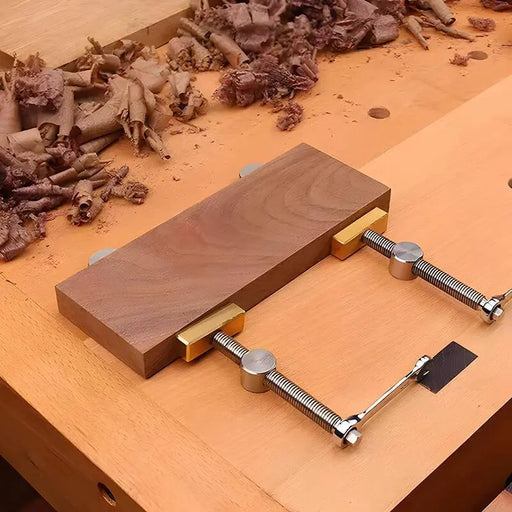
A workbench without proper clamping is just a table. Essential systems to install:
- Bench dog holes: Drill 3/4″ holes on 4″ centers across the top surface
- Front vise: Mount a quick-release vise 6″ from the front edge
- Tail vise (woodworking): Install at the end for long board support
- T-track system: Route 3/4″ aluminum channels for modular clamping
Installation sequence:
1. Position vise according to manufacturer specs
2. Drill pilot holes through mounting plate
3. Attach with 1/2″ lag bolts and oversized washers
4. Install bench dog holes using a jig for perfect alignment
5. Test all components before final finishing
Apply the Right Finish to Protect Your Workbench from Damage
The finish determines how your workbench handles daily abuse. Match the finish to your primary use:
- Woodworking: 3 coats boiled linseed oil (renewable, non-slip surface)
- Metalworking: Epoxy resin coating (chemical and heat resistant)
- General use: Water-based polyurethane (durable, quick drying)
Professional finishing technique:
1. Sand top surface to 220 grit
2. Wipe clean with tack cloth
3. Apply first coat with foam brush
4. Lightly sand with 320 grit after drying
5. Apply second coat, focusing on edges
6. Final sand with 400 grit steel wool after curing
Avoid wax finishes if you’ll be using solvents—they’ll create a sticky mess within weeks. For maximum protection in mixed-use shops, consider a two-zone approach: oil finish on the main surface with epoxy on vise areas.
Add Smart Storage Solutions Under Your New Workbench

Maximize your workshop efficiency with these storage solutions:
- Adjustable shelf: Install at 18″ height for power tool storage
- Tool well: Create a 12″x36″ recessed area for frequently used tools
- Rolling cart: Build frame wide enough to accommodate a standard tool chest
- Pegboard backing: Mount 1/4″ pegboard to the rear frame for tool organization
Pro installation tip: Position the lower shelf 16″ above floor level—this accommodates most rolling tool chests while keeping heavy items within easy reach. For electrical tools, add a power strip underneath with cord management clips.
Final Assembly Checklist Before First Use
Before you start your first project, verify these critical points:
- Stability test: Apply 50 pounds of force to all corners—no movement should occur
- Surface flatness: Place a 4-foot level across the top—no gaps larger than 1/32″
- Square verification: Measure diagonally both ways—differences must be under 1/16″
- Vise operation: Check for smooth movement and full closure at all points
Emergency fix for minor rocking: Place shims under the high leg(s) and secure with construction adhesive. For persistent wobble, add temporary diagonal bracing until you can reinforce the frame properly.
Building your own shop workbench properly pays dividends every time you use it. By focusing on structural integrity first and adding features second, you’ll create a work surface that handles everything from delicate electronics to heavy metal fabrication without compromise. The time invested in proper construction eliminates frustrating wobble and creates a reliable foundation for all your future projects—making it the single most valuable addition to your workshop. Start with a solid frame, add a flat top, and customize for your specific needs to create a workbench that serves you well for decades.