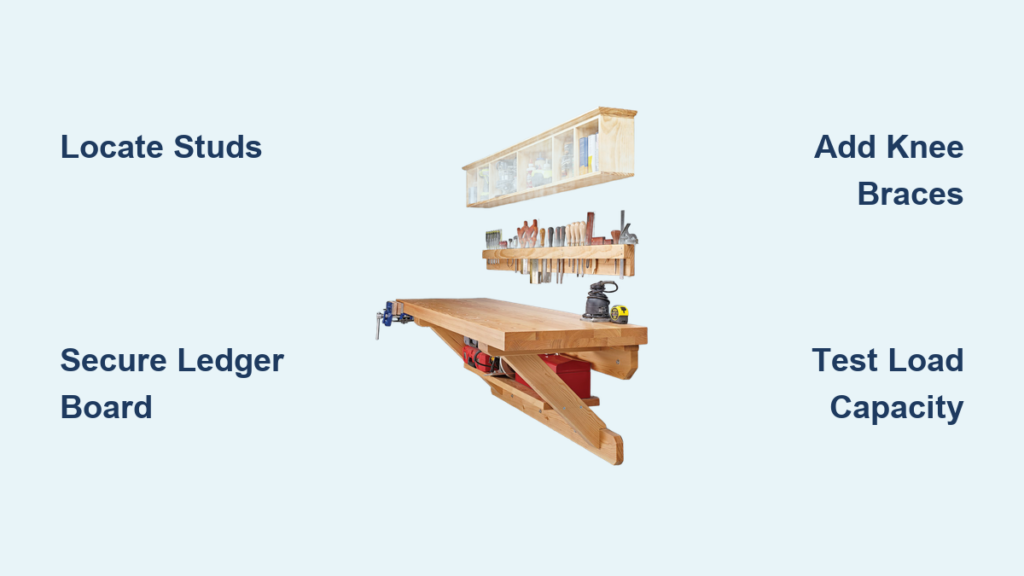
You’re staring at your cluttered garage, dreaming of a dedicated workspace—but floor space is tighter than a drum. That’s where learning how to build a wall mounted workbench becomes your secret weapon. Unlike freestanding models gobbling up square footage, a properly engineered wall-mounted design clears the floor for storage totes, bikes, or even your car. Forget wobbly DIY shelves; we’re creating a rock-solid workstation that handles chisels, clamps, and clatter without shaking your wall studs loose. By the end of this guide, you’ll know exactly how to build a wall mounted workbench that supports 200+ lbs while keeping your floor completely clear.
Most beginners skip critical structural checks and end up with a bench that flexes during light sanding or—worse—detaches from the wall. I’ve seen laminate countertops crack under 60 lbs because the ledger wasn’t secured to studs. Your wall-mounted workbench must transfer dynamic forces (like hammer strikes) safely to your home’s skeleton. This isn’t just about mounting a shelf; it’s about creating a functional workhorse. Let’s transform your cramped space into a professional-grade workshop without sacrificing an inch of floor real estate.
Why Your Garage Needs a Wall-Mounted Workbench (Not Floor Space)
Tired of tripping over bench legs while vacuuming? A wall-mounted workbench solves this by anchoring your workspace to vertical real estate you’re already ignoring. When you build a wall-mounted workbench, the entire floor beneath stays accessible for pressure washers, tool chests, or holiday decorations. One woodworker slashed cleanup time by 70% after switching from a four-legged bench—no more crawling under to sweep sawdust. But here’s the catch: pure wall-mounted designs fail under heavy tasks like planing or chiseling. Vibration transfers through drywall into your home’s framing, making tools “walk” off the surface. For light-duty tasks (electronics repair, potting plants), it’s perfect. For serious woodworking, we’ll use a hybrid approach later.
Skip This Step and Your Bench Will Fail: Wall Assessment Essentials

Your wall type makes or breaks this project. Drywall over wood studs? Proceed. Cinderblock, brick, or plaster? Stop immediately—this design won’t hold without specialized masonry anchors (and even then, it’s risky). Grab a stud finder and locate every stud along your planned bench line. Mark centers with painter’s tape; studs are typically 16″ or 24″ apart. Now, test-load capacity: your ledger board must anchor into at least three studs. A single 2×4 stud holds 1,000+ lbs vertically, but dynamic forces (like hammer blows) multiply stress. If your wall has insulation or wiring, drill 1/4″ test holes at stud centers to confirm clear paths for lag screws. Skip this, and you’ll crack drywall or hit electrical wires during installation.
Pure Wall-Mount vs. Hybrid Design: Which One Won’t Shake During Use?

Why Pure Wall-Mounts Fail Under Real Workloads
A true “floating” bench uses only a ledger board and knee braces. It looks sleek but flexes under 100 lbs of weight—enough to frustrate chiseling or sawing. One user reported his pure wall-mount vibrating so violently during light hammering that it shook pictures off adjacent walls. Knee braces alone can’t counteract torque when you lean on the front edge. Avoid this if you’ll use clamps, vises, or power tools.
The Hybrid Design: Maximum Floor Space Without Sacrificing Stability
This is the professional’s choice. Mount a ledger board to wall studs, then add two front legs (set back 6-8″ from the edge) connected via a 2×4 frame. You gain 80% under-bench clearance while transferring 50% of the load to the floor. The frame acts like a bridge truss, eliminating front-edge sag. For a 67″ bench, this handles 250+ lbs—enough for a bench grinder and tool chest. Crucially, the legs prevent “racking” (side-to-side wobble), which pure wall-mounts suffer from during angled cuts.
Must-Have Tools and Materials for a Bulletproof Wall-Mounted Bench
Don’t wing this with mismatched scraps. Your how to build a wall mounted workbench project demands:
- Structural lumber: 2×8 or 2×10 for the ledger board (minimum 6′ long), 2x4s for framing, and 4×4 posts for hybrid legs
- Work surface: 1.5″ thick solid wood, butcher block, or laminated plywood (avoid hollow-core doors)
- Critical fasteners: 1/2″ x 5″ lag screws with washers (for ledger-to-stud), 3″ deck screws, and 1/2″ plywood gussets for braces
- Tools: Stud finder, 48″ level, 1/4″ drill bit (for pilot holes), socket wrench, and framing square
Pro Tip: Skip drywall anchors—they’ll pull out under 50 lbs. Lag screws must bite into solid stud wood, not drywall.
Locate Wall Studs Like a Pro: Avoid Drywall Disaster
Why Stud Finder Results Lie (And How to Verify)
Stud finders detect density changes but miss wiring or insulation. After marking stud centers, confirm with a nail test: drive an 8d finish nail at each mark. If it hits solid wood at 1.5″ depth, you’ve found a stud. If it slides through, you’re in a cavity—reposition your mark. For a 67″ bench, you’ll need anchors in 4-5 studs (spaced 16″ apart).
Marking for Perfection: The Level Line Trick
Measure your ideal working height (34″-36″ is standard). Snap a chalk line at ledger-top height across all studs. Why the top? Your bench surface sits atop the ledger, so this ensures consistent height. Use a laser level if available—1/8″ variance causes visible sag.
Install the Ledger Board: Secure It to Studs or Risk Collapse
Step 1: Pre-Drill Like Your Bench Depends on It (It Does)
Hold your 2×8 ledger against the chalk line. At each stud center, drill a 1/4″ pilot hole through the ledger. This prevents wood splitting when you drive lags. Never skip this—even pressure-treated lumber cracks under direct lag torque.
Step 2: Anchor to Studs with Military Precision
Position the ledger, then drill a second 1/4″ hole through the pilot into the stud center. Insert 1/2″ x 5″ lags with washers. Tighten until snug, then 1/4 turn more—overtightening crushes wood fibers, reducing hold strength. Check level after each screw; a 2° tilt makes clamping impossible.
Build and Attach the Bench Top: Prevent Flexing and Wobble
Why Your Countertop Needs Reinforcement
That 1.5″-thick laminate top? It’ll sag 1/4″ over 48″ without support. Screw a 2×4 “backer frame” underneath the front edge, anchored to your hybrid leg frame. For pure wall-mounts, add 2×4 ribs every 12″ running front-to-back under the top.
Attachment Method That Won’t Fail
Place the top on the ledger/frame. From below, drive 3″ deck screws upward through the ledger into the top. Space screws every 8″ along the ledger and frame—closer spacing prevents edge lift during heavy use. Add a 1″ front overhang for tool retention; a routered “tool well” along the back catches nails and screws.
Add Critical Knee Braces or Front Legs for Unshakeable Stability
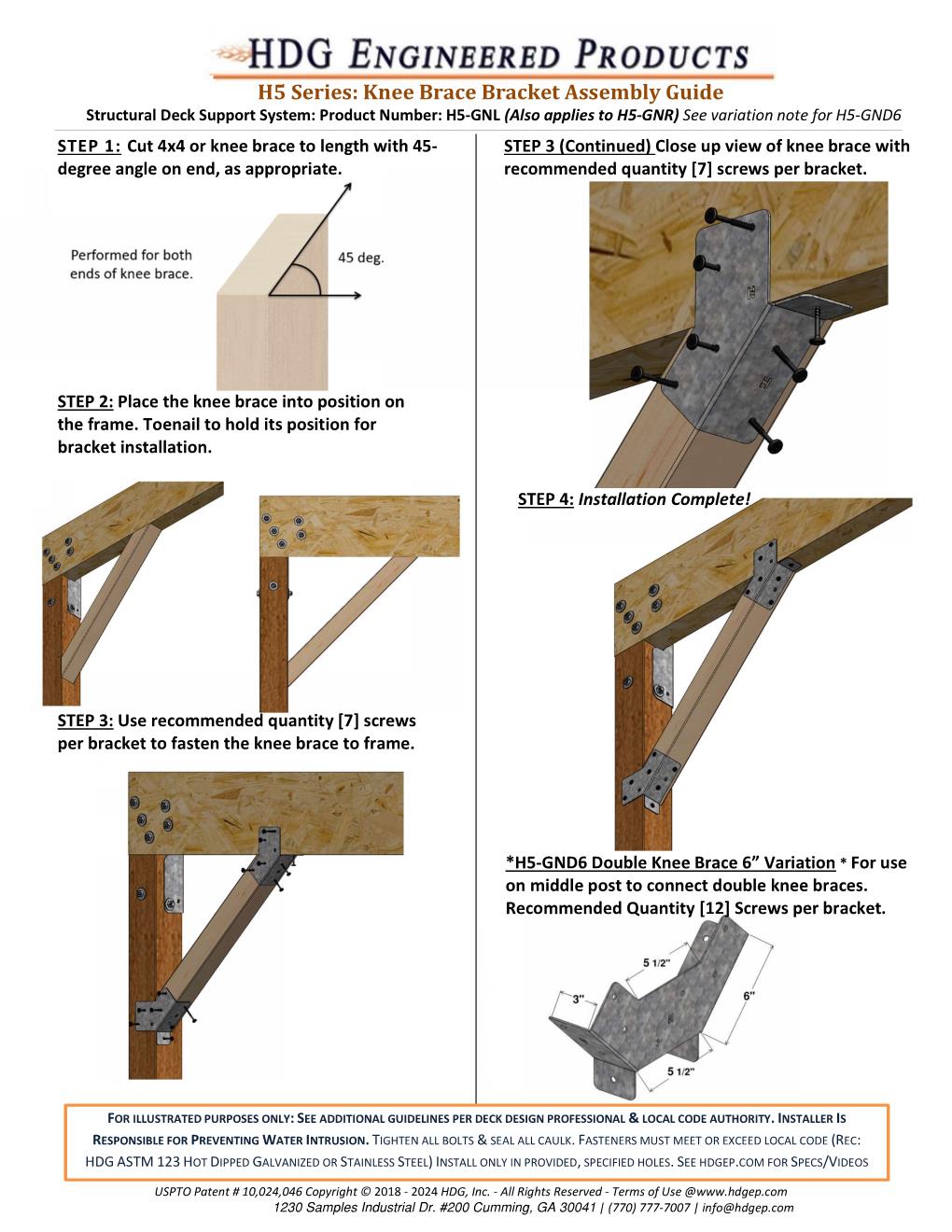
Hybrid Leg Installation: The Stability Game-Changer
For hybrid designs, build a 2×4 rectangle sitting atop the ledger. Attach 4×4 legs to its front corners using 3″ lags. Plumb-check each leg with a level before securing to the floor (use shims if uneven). This frame transfers downward force away from the wall—critical for vise use.
Pure Wall-Mount Bracing: Do This or It Fails
If committed to no legs, cut 2×6 knee braces at 45°. Secure the top end to the bench underside with 3″ lags through a 1/2″ plywood gusset. Bolt the bottom end into a wall stud below the ledger, not just drywall. One user’s brace pulled out because he anchored only to drywall—always hit solid wood.
Customize Your Wall-Mounted Workbench for Real-World Tasks
Storage That Doesn’t Compromise Space
Install a French cleat system above the bench using 1×3 pine strips. Hang vises, clamps, or saws without drilling into drywall. For power tools, mount a switched outlet strip under the front lip—run the cord through a grommet hole in the top.
Lighting and Vise Tips You’ll Wish You Knew Sooner
Stick 16W LED strips under the front edge for shadow-free lighting. If adding a vise, position it 6″ from the wall end—this avoids stud interference and maximizes leverage. Never mount a vise directly over the ledger; it concentrates stress on one stud.
Final Safety Checks: Test Load Capacity Before Disaster Strikes
The 3-Step Stress Test Nobody Skips (Until It’s Too Late)
- Push Test: Apply 50 lbs of downward force at the front edge. Zero movement = success.
- Twist Test: Grasp the front corners and try to rack the bench side-to-side. No wiggle? Good.
- Load Test: Place 100 lbs of weight (e.g., paint cans) at the front edge for 24 hours. Check for sag.
Wall Protection: Save Your Drywall From Tool Scars
Cover the wall behind your bench with 1/2″ sanded plywood. It absorbs tool bumps and provides anchor points for future shelves. Sand all edges smooth—splinters under the bench cause painful surprises.
Building a wall-mounted workbench isn’t about cutting corners—it’s about cutting your floor space footprint. While a pure wall-mount saves every inch, the hybrid design delivers unshakeable stability for real workshop tasks. You’ve now got the blueprint to build a wall-mounted workbench that handles daily abuse without sacrificing garage functionality. Start tomorrow: assess your wall studs, grab those 1/2″ lags, and reclaim your floor. Your pressure washer (and your back) will thank you.