
Your workbench isn’t just furniture—it’s the foundation of every project you’ll ever create. A wobbly, undersized bench sabotages precision work and wastes hours of frustration. The good news? Building a professional-grade workbench costs less than $300 and requires only basic tools. This guide cuts through the noise to show you exactly how to build a workbench that won’t flex under chisels, resist clamping pressure, or rack when planing. Forget flimsy store-bought models—we’ll construct a 6-foot powerhouse with industrial stability using techniques proven by thousands of woodworkers. You’ll finish with a bench so rigid it becomes your shop’s silent partner for decades.
Why Your Current Bench Fails (And How to Fix It)
Most DIY workbenches collapse under real workshop demands because they ignore physics. Watch what happens when you hammer near the edge of a typical four-leg design: the entire structure shifts, ruining your cut. This isn’t about weight—it’s about engineering. The critical flaw? Attaching legs directly to the top without a triangulated frame. Without horizontal bracing between legs, forces travel straight through the structure. Your bench must act like a building foundation: a rigid box that transfers stress into the floor. We’re eliminating this weakness by building a base frame first—a technique used in commercial benches costing $1,000+.
The MDF Top Disaster You Must Avoid
Never use MDF as your primary work surface. While tempting for its smoothness, MDF lacks internal strength. When you clamp a 2×4 to an MDF top, the surface deflects like cardboard, making joinery impossible. Worse, moisture from sweaty hands or damp lumber causes irreversible swelling. One builder reported: “My MDF bench warped 1/4 inch overnight after gluing a door frame.” Save MDF for sacrificial tops only—never structural layers.
Material Choices That Actually Work
Your top thickness dictates performance. Thin plywood (under 1.5″) vibrates during chiseling, bouncing tools off workpieces. The solution? Laminated plywood. Two layers of 3/4″ Baltic Birch glued together create a 1.5″ monolithic slab that absorbs impact without transferring vibration. For heavy-duty use, add a 1/4″ hardboard sacrificial layer on top—replace it when scarred instead of refinishing the entire surface.
Your Exact Build Checklist: Tools & Materials
:max_bytes(150000):strip_icc()/workbench-plan-5941726d3df78c537b871571.jpg)
Skip generic “tools needed” lists. Here’s precisely what you’ll use for this build, with pro substitutions:
-
Non-Negotiable Tools:
- Circular saw (with track for perfect plywood cuts)
- Kreg Jig pocket-hole system (prevents splitting in 2x4s)
- 48″ level (critical for base frame squareness)
- Heavy-duty clamps (8+ for top lamination)
Pro Tip: Rent a planer if using rough lumber—smooth legs prevent wobble.
-
Materials for 6’x24″ Bench (Cost: $220):
| Component | Specs | Why It Matters |
|—————|———–|——————-|
| Top | Two 4×4′ sheets 3/4″ Baltic Birch ply | Laminated = 1.5″ thickness for zero flex |
| Legs | Four 32.5″ lengths of 4×4 pine | 3.5″ width resists twisting forces |
| Frame | 2×4 SPF (8′ lengths x 6) | Creates triangulated base rigidity |
| Critical Hardware | 1/4″ x 3″ lag bolts (x4), 2.5″ pocket screws (x100) | Lag bolts prevent leg separation under stress |
Build Your Unshakeable Base Frame (Step-by-Step)
This frame makes or breaks your bench. A single weak joint here guarantees future wobble.
1. Leg Assembly: The Anti-Wobble Secret
Most builders cut legs to final height—but that ignores top thickness. For a 34″ bench height:
– Cut legs to 32.5″ (34″ minus 1.5″ top thickness)
– Laminate two 2x4s per leg with wood glue instead of using single 4x4s
– Clamp with pipe clamps for 24 hours (not just 1-2 hours!)
Why this works: Two 2x4s create a 3.5″x3.5″ leg with no hidden knots. Single 4x4s often contain weak points that split under clamping pressure.
2. Frame Construction: Eliminate Racking Forever
Racking (side-to-side sway) ruins precision work. Stop it with this sequence:
1. Build two identical side frames: Connect front/back 2×4 rails (57″ long) to legs using pocket holes
2. Add diagonal bracing: Cut two 2x4s at 45° between leg tops and bottom rails
3. Join side frames with 23.5″ cross rails every 16″
4. Install lower shelf: Attach full 3/4″ plywood sheet to bottom frame
Critical step: Dry-fit with clamps, then check for square by measuring diagonals—they must match within 1/8″. If not, twist frame until equal.
3. Leveling Your Foundation (Garage Floors Aren’t Flat)
Uneven floors cause chronic wobble. Fix it permanently:
– Screw 1/2″ thick rubber leveling feet (x4) to leg bottoms
– Place base on floor, then adjust each foot until a 48″ level reads true front-to-back AND side-to-side
– Pro shortcut: Place shims under feet during adjustment, then trace shim shapes to cut permanent wedges from scrap wood
Creating Your Indestructible Work Surface
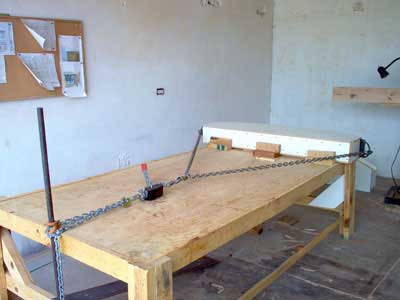
A weak top undermines even the best frame. Here’s how to build a top that outlasts you.
Laminating Plywood Like a Pro (Zero Voids Guaranteed)
- Lay first plywood sheet upside down on flat surface (use sawhorses)
- Apply Titebond III glue with notched trowel (1/8″ depth) across entire surface
- Place second sheet on top, offsetting factory edges by 24″
- Clamp strategically: Place clamps every 8″ in grid pattern—start at center, work outward
- Wipe excess glue immediately with damp rag (dried glue prevents perfect bond)
Time-saver: Weight clamps with concrete blocks if you lack clamp quantity
Top Attachment: Preventing Wood Movement Damage
Solid wood expands across the grain—but plywood doesn’t. Still, attach securely:
– Drill 3/4″ clearance holes through frame rails
– Insert figure-8 tabletop fasteners (x12) into top underside
– Screw fasteners to frame with 1/4″ gap for seasonal movement
Never screw directly through top: This cracks plywood during humidity changes
Pro Upgrades That Transform Your Bench
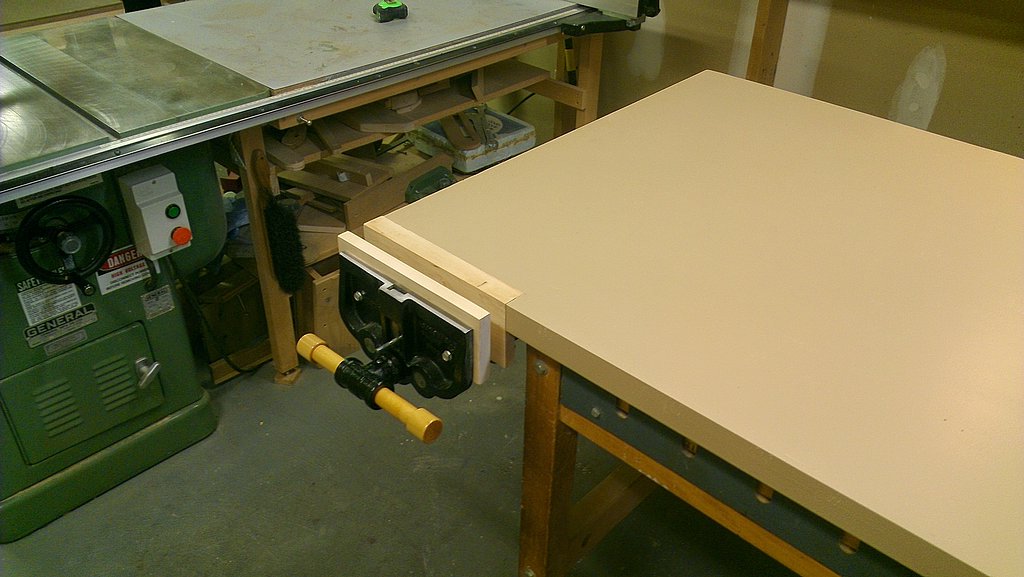
Skip these and you’ll regret it later. These take 20 minutes but add professional functionality.
Vise Installation: The One Non-Negotiable
A front vise isn’t optional—it’s what makes a workbench work. For most DIYers:
– Choose: 6″ Record-style vise (under $150)
– Critical step: Cut 3.5″ deep notch in front apron to seat vise body flush
– Bolt through apron with 1/2″ carriage bolts (x4) + washers
Warning: Never mount vise to top alone—force transfers through apron to base frame
Bench Dog Grid: Secure Any Workpiece
Drill a grid of 3/4″ holes:
– Start 2″ from front edge, 4″ apart in rows
– Space rows 6″ apart across entire top
– Pro pattern: Offset every other row like bricks for infinite positioning
Use: Pair with $10 hold-downs to clamp irregular shapes—no more slipping
Avoiding Costly Mistakes (Real Builder Horror Stories)
The “Almost Square” Frame Disaster
One builder skipped diagonal measurement: “After attaching the top, I couldn’t clamp a door frame square—it was always 1/8″ off.” Fix: Measure diagonals before gluing. If unequal, place a pipe clamp diagonally across the long measurement and tighten until equal.
Top Thickness Compromise
Using single 3/4″ plywood seems cheaper—but fails under pressure: “My bench bounced like a trampoline when chiseling.” Solution: Always laminate two layers. The $40 extra pays for decades of stability.
Final Assembly & Maintenance Protocol
- Attach top: Position upside-down on base, secure with figure-8 fasteners
- Add sacrificial layer: Screw 1/4″ hardboard to top with 1.25″ screws (replace when scarred)
- Seal top: Apply 3 coats Watco Danish Oil (dries in 4 hours vs. 24 for poly)
- Test stability: Stand on bench corners—you should feel zero flex
Why This Bench Outlasts Commercial Models
The secret isn’t exotic wood—it’s physics. Our laminated top + triangulated frame creates a single rigid mass. When you plane near the edge, forces travel through the diagonal bracing into the floor, not through your workpiece. Store hammers in the lower shelf to add 30+ lbs of stabilizing weight. At 120 lbs total, this bench won’t budge during serious work.
Your new workbench isn’t just a surface—it’s the silent partner that enables clean cuts, perfect joinery, and frustration-free building. By following these exact steps, you’ve created a shop centerpiece that will outlive power tools and evolve with your skills. Start sanding that first project tonight: the only thing between you and perfect results is the bench you just built. When future builders ask how you achieved such precision, you’ll point to this bench and say, “I made it myself—and so can you.”