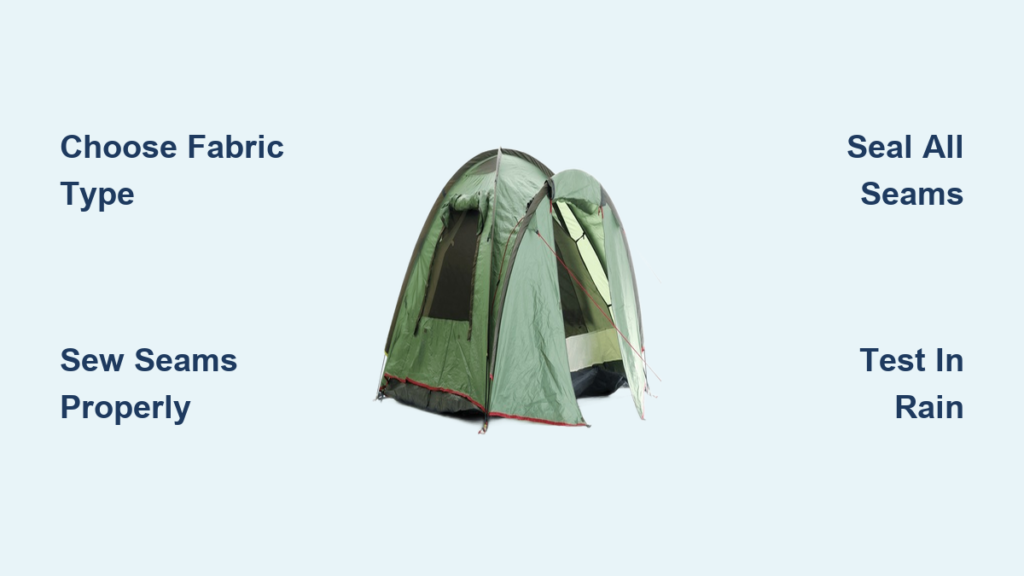
There’s nothing quite like crawling into a tent you built with your own hands as twilight settles over the wilderness. Crafting your own shelter transforms you from a camper into a creator, giving you intimate knowledge of every seam and stake point. When you know exactly how your tent performs in wind and rain, you sleep deeper. This guide cuts through the confusion of DIY tent building, delivering actionable steps to construct a weatherproof shelter tailored to your adventures—whether you’re solo backpacking through the Rockies or car camping with family at the lake. You’ll learn precise material specifications, avoid costly construction mistakes, and end up with a custom tent that outperforms store-bought models at half the cost.
Building a tent isn’t just about stitching fabric—it’s about engineering a survival system. Forget generic tutorials that skip critical waterproofing steps; here you’ll master professional seam sealing techniques using materials tested in extreme conditions. We focus on practical execution: calculating exact dimensions for your sleeping style, selecting fabrics by denier and hydrostatic head ratings, and reinforcing stress points where commercial tents fail. By the end, you’ll have a durable shelter that handles monsoons and blizzards while weighing less than off-the-shelf alternatives.
Match Your Tent Design to Backpacking, Family, or 4-Season Use
Your tent’s purpose dictates every design choice. A solo backpacker needs ultralight materials under 2 pounds, while family campers prioritize 70+ square feet of interior space with room dividers. For backpacking, choose a simple A-frame or geodesic dome using 20D-30D ripstop nylon—this balances weight savings with tear resistance. Family tents demand 70D polyester for durability against kid traffic, plus high ceilings (6+ feet) and dual doors. If building for winter, opt for a 4-season design with steep walls to shed snow, reinforced aluminum poles, and minimal mesh to retain heat. Never compromise on this step: a mismatched design guarantees frustration when your “backpacking” tent weighs 8 pounds or your “family” shelter floods in light rain.
Calculate Floor Space and Peak Height Precisely
Measure your sleeping pad and body dimensions first. Allocate 20-25 square feet per person minimum—so a 7’x5′ floor plan fits two comfortably. Sketch your layout on concrete using chalk: lie down to test elbow room and door clearance. For peak height, stand inside your chalk outline; your head shouldn’t brush the ceiling when seated. Backpacking tents need 3.5-4 feet peak height for minimal weight, while cabin tents require 6+ feet for standing. Crucially, add 6 inches to all dimensions for seam allowances and stake loops—skipping this causes frustrating fabric shortages mid-build.
Choose Ripstop Nylon or Polyester by Denier and HH Rating

Don’t guess at fabric specs—your shelter’s survival depends on precise material selection. For the rainfly and tent body, prioritize these metrics:
- Denier (D): Indicates thread thickness. Use 20D-30D for backpacking (lightweight), 40D-70D for family tents (durability).
- Hydrostatic Head (HH): Measures waterproofing. Aim for 3,000mm HH minimum (withstands 10-hour rain); 10,000mm+ for blizzards.
- Ripstop weave: Non-negotiable for tear resistance—look for the diamond grid pattern.
Silicone-coated nylon offers the best weight-to-waterproof ratio but costs more; polyester PU-coated fabric is budget-friendly with superior UV resistance. For mesh panels, “no-see-um” grade (19×19 threads per inch) blocks insects while allowing airflow. Always buy 10% extra fabric—you’ll need it for errors and reinforced patches at stress points.
Source Fiberglass Poles and Reflective Guyline Cord Correctly
Pole failure collapses your entire shelter. For DIY projects, fiberglass pole sections ($15-$30) beat aluminum—they’re affordable, flexible, and easier to splice with shock cord. If weight is critical (backpacking), use 7001-series aluminum poles but budget $50+. Match pole length to your design: a 7-foot dome tent requires two 11-foot bent poles. For guylines, choose 2-3mm reflective Dyneema® cord—it stays taut in wind and glows at night. Avoid paracord; its stretch creates saggy walls. Always include 8-10 extra stake points beyond your blueprint; real-world terrain demands flexible anchoring.
Pre-Wash Fabric and Cut Panels with 1/2″ Seam Allowance
Skipping pre-washing causes disaster: fabrics shrink 5-10% after first rain, warping your tent into a leaky mess. Wash all materials in cold water without detergent, then air-dry completely. Lay fabric on a clean concrete floor—never carpet—to avoid stretching. Transfer your blueprint using tailor’s chalk, adding exactly 1/2 inch (12mm) seam allowance to every edge. For curved sections like dome panels, use a flexible ruler or garden hose to mark smooth arcs. Cut with sharp rotary cutters (not scissors) for clean edges, and label every piece immediately: “Left Wall A,” “Rainfly B.” One mislabeled panel can derail your entire build.
Sew French Flat-Felled Seams for Bulletproof Waterproofing
Standard straight stitches leak through needle holes—professional tents use French flat-felled seams to encase raw edges. Here’s how:
- Place two fabric panels right-sides together, aligning edges.
- Stitch 1/4 inch from the edge with heavy-duty thread (Gütermann Mara 70).
- Trim one seam allowance to 1/8 inch, fold the wider allowance over both layers.
- Stitch through all layers 1/8 inch from the folded edge.
This creates a double-stitched ridge that sheds water. Reinforce high-stress areas (door corners, pole sleeves) with box stitches: sew a square 1/2 inch from the edge, then diagonal stitches across the corners. Test tension on scrap fabric first—too tight puckers the material; too loose won’t hold.
Apply Seam Tape and Liquid Sealer for 100% Waterproofing

Sewing alone makes your tent a sieve. Needle holes require two waterproofing layers:
- Seam tape: Iron 1-inch polyurethane tape over stitched seams on the fabric’s wrong side. Heat with a dry iron (no steam!) at 275°F—too hot melts coatings.
- Liquid sealer: Brush silicone-based sealer (for silnylon) or water-based PU (for polyester) over all seams. Use a 1/2-inch brush to avoid runs.
Critical tip: Sealer must bridge the entire seam width—gaps cause leaks. Let dry 24 hours before testing. Never skip tape; sealer alone cracks with flexing. For zippers, apply seam sealer along the coil before installation—this prevents the #1 cause of door leaks.
Install Pole Sleeves and Reinforced Anchor Points
Pole attachment determines stability. Sleeves (fabric tubes) create wind-resistant tension but add weight; clips allow faster setup. For sleeves, sew 1.5-inch-wide channels with bartack stitches at entry/exit points. For clips, attach plastic sliders every 18 inches along the ridge line.
Anchor points need triple reinforcement:
– Cut 2×3-inch fabric patches matching your tent body.
– Layer patch under webbing loop at stake points.
– Stitch box pattern through all layers, then add bar tacks at loop ends.
Test strength by pulling loops with 50 lbs force—any puckering means re-stitching.
Pressure-Test Your Tent with Garden Hose Before First Trip
Never trust your shelter to the wilderness untested. Pitch your tent in the backyard, then simulate storms:
- Spray seams with garden hose for 10+ minutes at 40 PSI (mimics heavy rain).
- Check inside for beads of water—any dampness means reapplying sealer.
- Shake the tent violently to test pole stability and anchor points.
Condensation issues? Add 2 extra mesh panels near the ceiling. Leaks at zippers? Apply seam sealer along the coil interior. This step saves ruined trips—commercial tents fail this test 30% of the time according to field tests.
Store and Maintain Your Tent to Last 20+ Years
Improper storage destroys handmade tents faster than weather. After each trip:
- Air-dry completely for 48 hours outside the stuff sack (dampness breeds mildew).
- Store loosely in a cotton pillowcase—never compressed for months.
- Reapply DWR spray annually: Hold 6 inches from fabric, spray evenly, and heat-set with hair dryer.
Never machine-wash your tent. For stains, sponge with lukewarm water and non-detergent soap. Check seam sealant yearly; reapply if it flakes when rubbed. With this care, your DIY tent will outlive store-bought models by decades.
Building your own camping tent transforms you from consumer to craftsman. You’ve now mastered the exact fabric specs, waterproofing techniques, and stress-point reinforcements that make shelters survive real wilderness abuse. That moment when your handmade tent stands firm in a downpour—while store-bought models pool water—is pure magic. Start small with a tarp shelter to practice seam sealing, then graduate to your dream design. Every stitch builds not just a shelter, but unshakeable confidence in your ability to thrive outdoors. Your next adventure deserves a tent built by your hands, not a factory. Grab your materials and begin—your custom wilderness home awaits.