You’re scrolling through wearables, confused by the sea of options. One sleek device promises to answer calls and control your smart home, while another promises laser-focused health metrics with weeks of battery life. The critical question isn’t which is “better” – it’s which aligns with your wrist. Understanding how are these smartwatches different from a fitness tracker cuts through the marketing noise to reveal a fundamental divide: one is a health specialist, the other a digital Swiss Army knife. If you’ve ever charged a smartwatch twice daily while craving simpler health insights, you’re not alone. This guide dismantles the confusion using real-world comparisons so you can choose confidently.
The stakes are higher than ever. Wearables now influence how we manage health crises, stay productive, and even pay for coffee. Yet most buyers mistake fitness trackers for “basic smartwatches” or assume smartwatches track health better. Neither is universally true. We’ll dissect battery life trade-offs, sensor capabilities, and hidden costs using verified data – no hype. By the end, you’ll know exactly whether a $30 fitness band or $400 smartwatch belongs on your wrist.
Smartwatch vs. Fitness Tracker: The Core Purpose Divide
Forgetting this distinction causes 90% of buyer’s remorse. A smartwatch functions as a wearable computer extension of your phone. Its DNA prioritizes connectivity – answering calls, replying to texts, and running apps like Spotify or Google Maps. Fitness tracking is merely one feature among dozens. Conversely, a fitness tracker is a health-data scalpel. Every component serves activity monitoring: step counting, heart rate analysis, and sleep stage breakdowns. It avoids distractions because its singular mission is optimizing your physical well-being.
Why Purpose Dictates Battery Life
This core difference explains the dramatic battery gap. Fitness trackers achieve 7-14 days of use because they lack power-hungry components like full-color touchscreens or cellular radios. Their monochrome displays and minimal processing conserve energy for continuous heart rate monitoring. Smartwatches, however, demand daily charging due to bright OLED screens, constant app updates, and GPS tracking. If you prioritize uninterrupted sleep data without nightly charging, the fitness tracker’s purpose-built efficiency wins.
When Purpose Creates User Frustration
Misalignment here causes real pain. Tech professionals report abandoning fitness trackers when they realize notifications are limited to “buzzing for texts” – no quick replies. Conversely, fitness enthusiasts ditch smartwatches when constant social media pings derail workout focus. Your choice hinges on whether wrist real estate should serve health or connectivity first.
Why Fitness Trackers Dominate Pure Health Monitoring
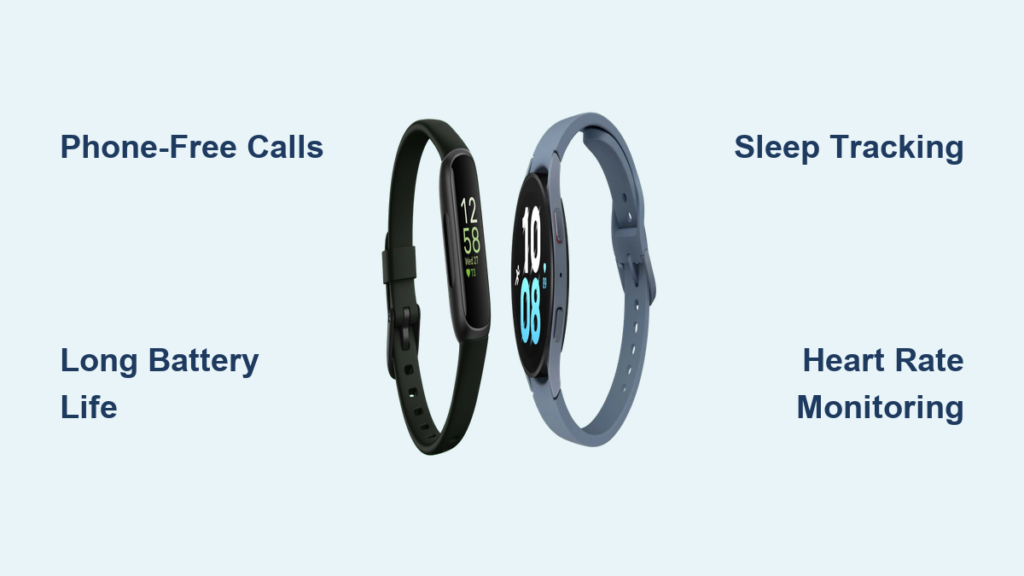
If your goal is understanding your body’s rhythms without digital noise, fitness trackers outperform smartwatches in three critical areas. They deliver deeper health insights through specialized hardware and software designed exclusively for wellness.
Sleep Tracking Precision You Can’t Ignore
Fitness trackers like Fitbit or Garmin analyze sleep stages (light, deep, REM) with clinical-grade accuracy by combining heart rate variability with movement data. Smartwatches often simplify this into “restful vs. restless” scores. More crucially, trackers sync seamlessly with health platforms like Apple Health but avoid disrupting sleep with notifications – a common smartwatch flaw where midnight email alerts sabotage recovery.
Heart Rate Monitoring Without Compromise
While both use optical sensors, fitness trackers optimize for 24/7 heart rate monitoring. Their algorithms filter motion artifacts during runs or gym sessions better than most smartwatches. Crucially, they prioritize battery life for continuous data collection – essential for spotting resting heart rate trends that predict illness. Smartwatches often throttle background monitoring to preserve battery, creating data gaps.
The Stress Tracking Advantage
Advanced trackers like Fitbit Sense 2 use electrodermal activity (EDA) sensors to measure skin conductance – a direct stress indicator. Most smartwatches lack this hardware, relying on less accurate heart rate variability estimates. For users managing anxiety or burnout, this specialized metric provides actionable insights a general-purpose smartwatch can’t match.
How Smartwatches Function as Your Phone’s Wrist Extension
When you need to leave your phone behind but stay connected, smartwatches solve problems fitness trackers can’t touch. They transform your wrist into a command center through three game-changing capabilities.
Making Calls and Payments Without Your Phone
LTE-enabled smartwatches (like Apple Watch Ultra or Samsung Galaxy Watch 6) let you take calls, stream music, and pay via NFC without your phone nearby. Fitness trackers lack cellular radios and secure payment systems – you’ll still need your phone for coffee runs or gym check-ins. If “phone-free runs” are non-negotiable, this is the dealbreaker.
App Ecosystem Power You’ll Actually Use
Smartwatches run third-party apps that fitness trackers can’t support. Need turn-by-turn cycling directions? Strava Live Segments? Real-time stock alerts? Only smartwatches deliver. Fitness trackers show basic notifications but offer zero interaction – you’ll still pull out your phone to respond.
Smart Home and Car Integration
Control lights, thermostats, or even your Tesla from your wrist with smartwatch apps. Fitness trackers lack the processing power for these integrations. For connected-home enthusiasts, this transforms mundane tasks – imagine adjusting your AC while jogging home.
Battery Life: The Critical Trade-Off Nobody Mentions
This isn’t just “long vs. short” – it’s about how battery life impacts real-world usage. Fitness trackers’ 10-14 day endurance enables consistent health baselines. Missing a charge won’t sabotage your sleep data for a week. Smartwatches’ 1-2 day cycle creates dangerous gaps:
- Fitness trackers maintain continuous heart rate history crucial for spotting trends (like rising resting HR indicating illness).
- Smartwatches often lose 8-12 hours of data during charging – enough to miss critical overnight oxygen dips.
If you travel frequently or hate daily charging rituals, the tracker’s battery advantage becomes a health necessity, not just convenience.
Choosing Your Wearable: 3 Questions That Decide Everything
Stop comparing spec sheets. Ask these instead:
“Do I Need to Leave My Phone Behind Daily?”
Choose a smartwatch if yes. Only they enable true phone-free scenarios (swimming, hiking, gym sessions) with calls/payments. Trackers merely vibrate for notifications – you’ll still need your phone nearby.
“Is My Health Data for Medical Insights or Motivation?”
Opt for a fitness tracker if you share data with doctors. Their specialized algorithms (like Fitbit’s sleep apnea detection) generate clinically useful reports. Smartwatches prioritize trends over medical precision – fine for motivation, risky for health decisions.
“How Much Do Phone Notifications Distract Me?”
If constant pings derail workouts or focus, a fitness tracker’s minimalist alerts (only priority calls) reduce digital overload. Smartwatches amplify distractions unless aggressively managed.
The Hybrid Reality: When Neither Fits Perfectly
Some users need both worlds – and that’s where high-end hybrids like Garmin Venu 3 or Apple Watch Ultra 2 enter. They offer smartwatch connectivity plus fitness-tracker battery life (up to 14 days in smartwatch mode). But they cost $400+ and still charge more often than pure trackers. Only consider these if:
– You demand LTE calls and week-long battery
– Budget isn’t constrained (they cost 3x basic trackers)
– You’ll use advanced features like ECG or blood oxygen daily
For most users, this complexity isn’t worth the premium. Stick to one core purpose unless your lifestyle demands extremes.
Final Decision Checklist: No More Guesswork
Before buying, confirm these:
Choose a fitness tracker if:
– You prioritize sleep/stress data over notifications
– Charging weekly beats daily
– Your budget is under $100
– You want zero digital distractions
Choose a smartwatch if:
– Phone-free calls/payments are essential
– You use 5+ wrist apps weekly
– You accept charging every night
– Budget exceeds $250
Never buy based on:
– “Future-proofing” (wearables upgrade yearly)
– Brand loyalty (Fitbit’s smartwatch fails where its tracker excels)
– Screen size alone (larger = faster battery drain)
The right wearable disappears into your routine – whether that means silently tracking your recovery or seamlessly replacing your phone. How are these smartwatches different from a fitness tracker? One serves your digital life; the other serves your physical self. Your wrist’s purpose defines everything. Test both for 24 hours: leave your phone behind with a smartwatch, then try a tracker’s notification-free focus. The answer will become obvious – because the best wearable isn’t the most advanced, but the one that vanishes into your life.