You’ve just installed a beautiful new floor lamp in your living room, but something feels off. Maybe the space still looks gloomy despite the light, or you’re squinting while reading because the bulb is too dim. You’re not alone—over 68% of homeowners struggle with improper lighting levels in their primary living spaces, turning what should be relaxing zones into eye-straining environments. The culprit? Choosing the wrong lumen output for your floor lamp. Unlike outdated wattage measurements that only indicated energy use, lumens measure actual brightness—the critical factor for creating functional, mood-enhancing light.
This guide cuts through the confusion by delivering exact lumen counts for every scenario. Forget generic advice; you’ll discover precisely how many lumens for floor lamp applications across living rooms, bedrooms, and reading nooks. We’ll break down real-world examples like why a 10×10-foot living room needs 1,200 lumens minimum and how 450 lumens prevents reading fatigue. By the end, you’ll confidently select bulbs that transform your space from “meh” to magnificent—no more guessing games or return trips to the hardware store.
Ambient Floor Lamps: Exact Lumens for Room-Wide Lighting
Ambient lighting sets the foundational mood for entire rooms, replacing harsh overhead fixtures with gentle, enveloping glow. Too few lumens leave corners shadowy and unwelcoming, while excessive brightness creates a sterile, clinical feel. Your sweet spot depends entirely on room dimensions and ceiling height—not arbitrary wattage charts.
Living Room Lumens: 1,200-1,600 for Balanced Illumination
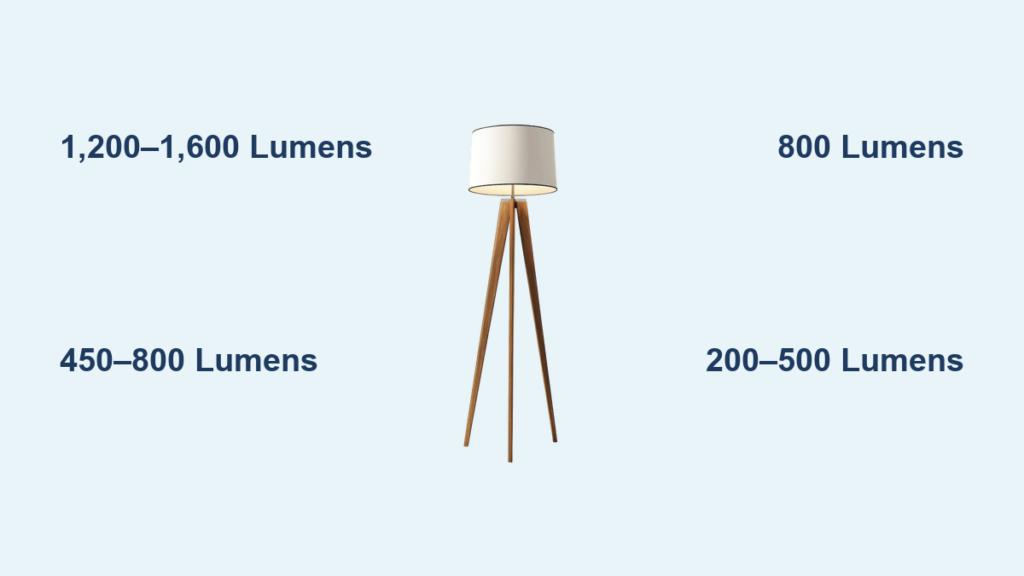
For standard 10×10 to 12×12-foot living rooms, 1,200–1,600 lumens delivers optimal ambient light without glare. Picture this: a 1,400-lumen LED bulb in an arched floor lamp positioned near your sofa evenly illuminates seating areas while reflecting softly off light-colored walls. Skip this range, and you’ll face common pitfalls like a “cave effect” (under 1,000 lumens) where only the lamp’s immediate vicinity is lit, or washed-out colors (over 1,800 lumens) that kill cozy vibes. Always test brightness at night—daylight masks deficiencies.
Bedroom Lumens: 1,000-1,400 for Relaxation Without Shadows
Bedrooms demand softer ambient light than living areas since harsh brightness disrupts melatonin production. Aim for 1,000–1,400 lumens from a single floor lamp in rooms under 150 square feet. For example, a 1,200-lumen bulb in a tall torchiere lamp bathes your space in warm, shadow-free light perfect for winding down. Warning: exceeding 1,400 lumens here causes visual fatigue—your eyes strain to adjust between bright lamp light and dark corners, sabotaging sleep quality. If using multiple light sources (like bedside lamps), reduce the floor lamp to 800 lumens to avoid over-illumination.
Task Lighting Floor Lamps: Prevent Eye Strain with Precision Brightness

Task lighting targets specific zones for reading, crafting, or working, requiring focused intensity that ambient light can’t provide. The critical mistake? Assuming “brighter is better.” Too much light creates glare on pages or screens, while insufficient lumens force pupils to constantly dilate—triggering headaches within 20 minutes. Your lamp’s placement relative to your activity dictates the ideal lumen count.
Reading Lamp Lumens: 450-800 for Comfortable Page Visibility
Position your floor lamp 3–4 feet from your seating area with the bulb 18–24 inches above eye level. Within this setup, 450–800 lumens provides crisp text clarity without glare. A 600-lumen LED bulb in a directional swing-arm lamp is the gold standard: bright enough to illuminate A4-sized pages at arm’s length but dimmable for late-night sessions. Avoid common errors like using 1,000+ lumens bulbs (causes reflection on glossy paper) or placing lamps behind you (casts distracting shadows forward). Pro tip: Warm white bulbs (2700K–3000K) at 600 lumens reduce blue light exposure versus cool whites, easing eye strain during extended reading.
Desk Task Lighting: 800 Lumens for Clear Detail Work

When your floor lamp doubles as desk lighting for detailed tasks like model-building or paperwork, 800 lumens is the non-negotiable minimum. This intensity matches professional drafting lamp standards, revealing fine textures and subtle color variations. Look for floor lamps with adjustable gooseneck arms to direct light precisely onto your workspace—position the bulb 12–15 inches above the surface. Never exceed 1,000 lumens here; concentrated brightness over 800 lumens causes “halo effects” around objects, distorting depth perception. If your lamp has a dark fabric shade, add 100–200 lumens to compensate for light absorption.
Accent Floor Lamps: Low-Lumen Secrets for Mood Enhancement
Accent lighting highlights architectural features or creates atmospheric pockets, where subtlety triumphs over intensity. Many homeowners ruin this effect by using standard “bright” bulbs, turning elegant uplighting into a spotlight. Success hinges on strategic dimness—your goal is to suggest illumination, not define it.
Corner Lighting: 200-500 Lumens for Unobtrusive Glow
For lamps tucked into room corners to soften transitions between walls and ceilings, 200–500 lumens creates an ethereal wash. A 300-lumen bulb in an upward-facing torchiere lamp, for instance, bounces light off 9-foot ceilings to fill space with gentle radiance—no harsh bulb visibility. Crucially, this output must stay below 500 lumens; higher intensities cast defined shadows that fragment the room visually. Always pair with dimmer switches: start at 200 lumens for movie nights, then nudge to 400 lumens for dinner parties.
Why Dimmer Switches Are Non-Negotiable for Accent Lamps
Fixed-brightness bulbs sabotage accent lighting’s purpose. A dimmable 400-lumen LED (like Philips WarmDim series) lets you adjust output from 50 to 400 lumens, transforming one lamp into multiple moods. At 100 lumens, it’s a nightlight-safe glow; at 350 lumens, it subtly highlights artwork. Without dimming, you’ll constantly swap bulbs—a 500-lumen non-dimmable bulb feels glaring at 8 PM but inadequate by 10 PM. Install a trailing-edge dimmer compatible with LEDs (check packaging for “CL” rating) to avoid flickering.
4 Overlooked Factors That Change Your Floor Lamp’s Effective Brightness
Lamp Height: Why Tall Lamps Need 20% Fewer Lumens

A 72-inch torchiere lamp spreads light over 200+ square feet, requiring just 1,000 lumens for ambient room lighting. Shorter 60-inch lamps concentrate light in 100-square-foot zones, demanding 1,200+ lumens for equivalent coverage. Measure from bulb to floor: for every 6 inches under 70 inches, add 100 lumens to your target output.
Shade Material: How Dark Fabrics Block 20-40% of Light
Thick burlap or velvet shades absorb up to 40% of emitted lumens versus sheer linen. If your lamp has a dark shade, choose a bulb with 30% higher lumens than recommended (e.g., 1,040 lumens instead of 800 for reading). Test by placing your hand 6 inches from the shade—if you can’t clearly see finger outlines, the fabric is too dense for task lighting.
Color Temperature’s Hidden Impact on Perceived Brightness
A 800-lumen 5000K “daylight” bulb appears 20% brighter than the same output at 2700K “warm white” due to higher blue-light concentration. For relaxation zones, use warmer temps (2700K–3000K) at standard lumen counts. For task areas, cooler temps (3500K–4000K) let you reduce lumens by 15% while maintaining visibility—e.g., 680 lumens at 4000K equals 800 lumens at 3000K.
Room Placement: Corner vs. Center Lighting Requirements
Lamps against walls or in corners need 25% more lumens than centrally positioned units to compensate for directional light loss. A corner-placed reading lamp requires 625 lumens to match the 500-lumen output of a centered lamp. Always position lamps so light flows toward activity zones, not into reflective surfaces like TVs or mirrors.
Your Floor Lamp Lumen Cheat Sheet by Room and Task
| Room/Application | Ideal Lumens | Bulb Wattage (LED) | Color Temp |
|---|---|---|---|
| Living Room (Ambient) | 1,200–1,600 | 15–20W | 2700–3000K |
| Bedroom (Primary) | 1,000–1,400 | 12–18W | 2700K |
| Reading Chair | 450–800 | 6–10W | 2700–3000K |
| Desk Task Lighting | 800 | 10W | 3500–4000K |
| Corner Accent | 200–500 | 3–7W | 2200–2700K |
Proven Bulb Selection Tips for Flawless Floor Lamp Lighting
The 800-Lumen LED: Your All-Purpose Floor Lamp Solution
For single-bulb floor lamps serving dual ambient/task roles (e.g., in studio apartments), an 800-lumen dimmable LED (like GE Relax LED) is the ultimate compromise. At full brightness, it handles 12×12-foot living spaces; dimmed to 500 lumens, it’s perfect for reading. Verify “soft white” labeling (2700K–3000K) and avoid “bright white” (3500K+) for living areas—it creates clinical vibes.
Multi-Head Lamps: Combine Bulbs for Custom Brightness
Lamps with 2–3 sockets (e.g., tripod arc lamps) let you mix lumen outputs. For a 150-square-foot living room, pair two 600-lumen bulbs (1,200 lumens total) for ambient light. Add a third 400-lumen directional bulb for reading nooks—totaling 1,600 lumens without overpowering the space. Never exceed the lamp’s max wattage rating (check socket labels).
Why Dimmable Bulbs Are Non-Negotiable
Non-dimmable LEDs force you into one brightness level, rendering your floor lamp useless for evening wind-downs or movie nights. Always buy bulbs labeled “dimmable” and pair with compatible dimmer switches (Lutron Diva works universally). This flexibility extends bulb life by 40% and saves energy—running at 50% brightness uses 40% less power.
Final Lighting Adjustments for Lasting Satisfaction
Your perfect floor lamp setup isn’t “set and forget.” Re-evaluate every season: summer’s abundant daylight may require 10–15% higher lumens than winter gloom. Every 6 months, wipe dust from bulbs and shades—grime can reduce light output by 15%. Most importantly, trust your eyes: if you’re squinting, increase lumens by 100; if surfaces look washed out, decrease them. With these precise lumen guidelines, you’ll transform every room into a purpose-built sanctuary where light enhances life instead of complicating it. For next steps, measure your key rooms with a free lumen calculator app like Light Advisor to generate custom recommendations in under two minutes.