You’re standing in the lighting aisle, staring at a “60W equivalent” LED bulb while your floor lamp’s socket sticker warns “Max 60W.” Confusion strikes: How many watts does a floor lamp actually use? Here’s the critical truth: Your floor lamp doesn’t have a fixed wattage. The number depends entirely on the bulb you install. Modern LED bulbs can deliver the same brightness as old 60W incandescents while using just 6-13 watts – and you can safely exceed the lamp’s “Max 60W” rating with these cooler-running bulbs. This heat-safety label (not a power limit) causes widespread misunderstanding, leading to inefficient lighting choices or unnecessary fear. In this guide, you’ll discover exactly how to match bulbs to your lamp’s needs while slashing energy use, avoiding fire risks, and getting perfect light for reading, relaxing, or highlighting decor.
The wattage confusion stems from outdated labels meeting modern technology. When your lamp says “Max 60W,” it’s warning that incandescent bulbs hotter than 60W could overheat the fixture – not that you must use a 60W bulb. Since LEDs produce 90% less heat at equivalent brightness, you’re not just safe using a “100W equivalent” LED (drawing 15W) in that “Max 60W” lamp – you’re actually optimizing efficiency. Understanding this unlocks tailored lighting: a cozy 8W warm LED for movie nights, a crisp 12W daylight bulb for reading, or a dimmable smart bulb for mood shifts. Let’s decode your lamp’s real power needs.
Decoding Your Floor Lamp’s Wattage Rating
Your lamp’s “Max 60W” sticker isn’t about electricity consumption – it’s a heat safety threshold for incandescent bulbs. This rating exists because incandescents waste 90% of energy as heat. A true 60W incandescent can reach 200°F+ inside a shade, risking fire or melting. Modern LEDs and CFLs solve this by converting most energy to light, not heat. An LED labeled “100W equivalent” (producing the same brightness as a 100W incandescent) typically draws only 15 watts and stays cool enough to touch. You can safely ignore the “equivalent” wattage number – focus on the actual wattage the bulb consumes, which will be far below your lamp’s heat rating.
Why Heat Matters More Than Watts for Safety
- Incandescent hazard: A “Max 60W” lamp can’t handle a true 75W incandescent because the extra 15W generates dangerous heat buildup in enclosed shades.
- LED advantage: That same lamp easily handles a 15W LED (marketed as “100W equivalent”) because its actual power draw is below the 60W heat threshold.
- Critical check: Always verify the bulb’s actual wattage (listed on packaging as “Uses 9W”) – not its “equivalent” value – against your lamp’s sticker. If the actual wattage is lower than the sticker’s number (e.g., 9W LED vs. “Max 60W”), you’re safe.
Bulb Types and Their Real Power Draw Explained
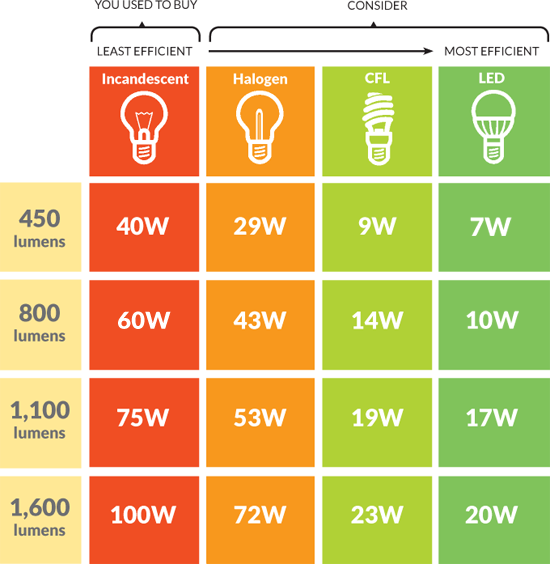
Stop guessing wattage – match bulb technology to your needs:
-
LEDs (4-15W actual draw):
The undisputed efficiency champion. A 9W LED delivers 800 lumens (matching a 60W incandescent’s brightness) while staying cool. Ideal for all floor lamps due to minimal heat, 15,000+ hour lifespan, and instant full brightness. Pro tip: Look for “CRI 90+” on packaging for truer color rendering in art studios or makeup areas. -
CFLs (5-26W actual draw):
Use 70% less energy than incandescents but contain trace mercury. They warm up slowly and struggle in enclosed fixtures. Avoid these – most regions are phasing them out for LEDs. -
Incandescents/Halogens (40-150W+):
Banned in many areas for inefficiency. A “60W” bulb draws 60W but wastes 54W as heat. Only use if your vintage lamp requires them (rare), and never exceed the sticker rating.
Selecting the Perfect Bulb for Your Floor Lamp
1. Read Your Lamp’s Rating Sticker Correctly
Find the sticker near the socket (often hidden under the harp). If it says “Max 40W,” this means:
– ✅ Safe: A 10W LED (labeled “60W equivalent”)
– ❌ Unsafe: A true 45W incandescent (exceeds heat limit)
– Why this works: The 10W LED produces less heat than a 40W incandescent, despite matching its brightness. The sticker’s number references incandescent heat output, not electrical capacity.
2. Match Bulb Specs to Your Lighting Goal
Don’t just grab the brightest bulb – tailor light to your activity:
- Task Lighting (Reading/Detail Work):
- Lumens: 800+ (like old 60W bulbs)
- Color Temp: 3500K-4500K (“bright white” – reduces eye strain)
- Wattage: 9-13W LED
-
Visual cue: Light should cast sharp shadows without glare. Test by reading a newspaper – if text feels harsh, lower the Kelvin.
-
Ambient Lighting (Living Room/Bedroom):
- Lumens: 400-700 (softer glow)
- Color Temp: 2200K-3000K (“warm white” – mimics candlelight)
- Wattage: 6-10W LED
-
Pro tip: Add dimmability to shift from 3000K (evening) to 2200K (bedtime) for better sleep hygiene.
-
Accent Lighting (Highlighting Art/Architecture):
- Lumens: 300-500 (focused beam)
- Bulb Type: Narrow-beam BR30 or smart RGB bulb
- Wattage: 7-12W LED
- Critical check: Ensure beam angle (e.g., 25°) directs light precisely where needed.
3. Verify Physical Compatibility
- Base type: 95% of U.S. floor lamps use E26 (standard screw base). Check your socket – if it’s smaller (like E12), you need candelabra bulbs.
- Bulb shape: A19 bulbs fit most shades. For torchiere (upward-facing) lamps, use reflector bulbs (BR30) to direct light downward.
- Enclosed fixtures: If your shade seals tightly at the top, only use bulbs labeled “For Enclosed Fixtures” – standard LEDs can overheat in trapped spaces.
Critical Compatibility Checks Before Buying
Dimmable Lamps Require Dimmable Bulbs
- Mistake to avoid: Installing non-dimmable LEDs in dimmable lamps causes buzzing, flickering, or premature failure.
- Solution: Look for “Dimmable” on the bulb packaging and ensure your dimmer switch is LED-compatible (older incandescent dimmers often aren’t). Test with a $5 dimmer tester if unsure.
3-Way Lamps Need Special Bulbs
Standard LEDs won’t work with 3-way switches (off/low/medium/high). You must buy a 3-way LED bulb (e.g., “30/70/100W equivalent”). These cost slightly more but last 25x longer than incandescent 3-ways.
Smart Bulbs Demand Signal Access
Want app-controlled color shifting? Confirm your floor lamp’s location has strong Wi-Fi/Zigbee signal. Smart bulbs draw slightly more power (1-2W standby) – negligible for LEDs, but avoid in lamps controlled by pull chains (use smart plugs instead).
Wattage Recommendations by Use Case
| Lighting Scenario | Optimal LED Wattage | Key Specs to Check | Why This Wattage Works |
|---|---|---|---|
| General Living Room | 8-10W | 2700K, 800 lumens, Dimmable | Provides warm, flexible light without overpowering the space. Safe in “Max 60W” lamps. |
| Reading Lamp | 11-13W | 4000K, 900+ lumens, CRI 90+ | High lumens and neutral white reduce eye fatigue during prolonged use. |
| Bedside Accent | 6-8W | 2200K, Dimmable | Ultra-warm glow preserves melatonin production; low wattage prevents overheating. |
| Art Spotlight | 9-12W | 3000K, Narrow beam (25°) | Focused light highlights textures without washing out colors (CRI 90+ recommended). |
Three Costly Wattage Mistakes to Avoid
-
Equating “Equivalent Wattage” with Safety Limits:
Never put a 100W incandescent in a “Max 60W” lamp – the heat risk is real. But a “100W equivalent” LED (15W actual) is perfectly safe. Focus on actual wattage, not marketing terms. -
Mixing Bulb Technologies in Multi-socket Lamps:
Using one incandescent and one LED in a 3-way floor lamp causes uneven brightness and can trip circuits. Stick to one bulb type per fixture. -
Ignoring Enclosed Fixture Ratings:
Standard LEDs in fully enclosed shades (like drum shades with no top vent) overheat and fail early. Only use bulbs explicitly rated “For Enclosed Fixtures” – they cost $1-2 more but last 3x longer.
Your Step-by-Step Bulb Selection Plan
Start here for 90% of floor lamps: Grab a 9W LED bulb (labeled “60W equivalent”) with 2700K-3000K color temperature and dimmable capability. This delivers warm, adjustable light at 1/7 the energy of incandescents while staying cool in any standard lamp. For reading nooks, bump up to 12W at 4000K. Crucially, always check your lamp’s actual sticker rating first – if it says “Max 40W,” a 9W LED is still safe (since 9W < 40W heat threshold). Within 5 minutes, you’ll have perfect lighting that slashes your electricity bill.
Understanding that “how many watts does a floor lamp use” depends on your bulb choice – not the fixture itself – transforms how you light your home. By leveraging LED efficiency, you bypass outdated wattage limits while optimizing comfort and safety. Remember: The sticker’s number is a heat warning for incandescents, not your power ceiling. Choose bulbs by lumens for brightness and Kelvin for mood, verify physical compatibility, and avoid the three critical mistakes outlined here. Within a week, you’ll have tailored lighting for every room that uses 85% less energy – proving that smarter wattage choices truly illuminate your life.