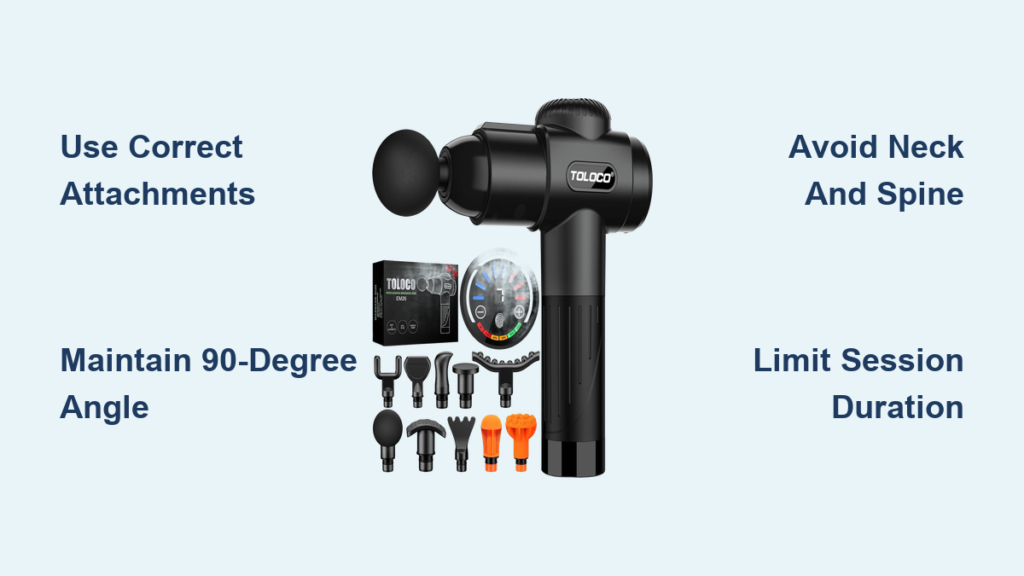
That first post-workout soreness hits hard, especially when you’re trying to squeeze in multiple training sessions each week. Your Raemao massage gun promises relief, but if you’re randomly pressing it against your muscles without proper technique, you’re wasting time and possibly causing harm. Knowing exactly how to use Raemao massage gun properly transforms it from an expensive paperweight into your most valuable recovery tool—unlocking deeper muscle penetration, faster soreness reduction, and improved flexibility.
Most users make critical mistakes within their first few sessions: pressing too hard, using the wrong attachment, or targeting unsafe areas. This comprehensive guide delivers exactly what you need—no fluff, no marketing hype. You’ll learn precise techniques for different muscle groups, speed settings that actually work, and safety protocols most manufacturers don’t emphasize. By the end, you’ll move with confidence knowing you’re maximizing every percussive pulse for optimal recovery.
First-Time Raemao Massage Gun Setup and Power-On Guide
Before you can experience relief, you must properly initialize your Raemao massage gun. Unlike cheaper models that work right out of the box, the Raemao requires a full initial charge to calibrate its high-torque motor and battery management system. Skipping this step leads to inconsistent performance and reduced battery lifespan. The device typically ships at 30-50% charge, which isn’t sufficient for optimal first use.
Why Your Raemao Massage Gun Won’t Turn On (And How to Fix It)
If your Raemao massage gun refuses to power up, check these three critical factors before assuming it’s defective. First, ensure you’re using the original adapter—not all USB-C chargers deliver the required 15V output. Second, verify the charging port is completely dry; moisture triggers the device’s safety lock. Third, hold the power button for 5 full seconds during first-time activation—the brief press that works later won’t initialize the system. Most “dead” units simply need this proper startup sequence.
Essential Charging Tips for Maximum Battery Life
Maximize your Raemao massage gun’s battery longevity by following these specific charging protocols. Charge for 120-150 minutes for a full cycle—overcharging beyond 3 hours degrades lithium-ion cells. Always power down completely before charging; partial charges create “memory effect” in the battery management system. Store your device at 40-60% charge if unused for extended periods, as full discharge damages battery health. This precise approach extends usable life by up to 40% compared to random charging habits.
Raemao Massage Gun Attachment Heads: Which One to Use Where
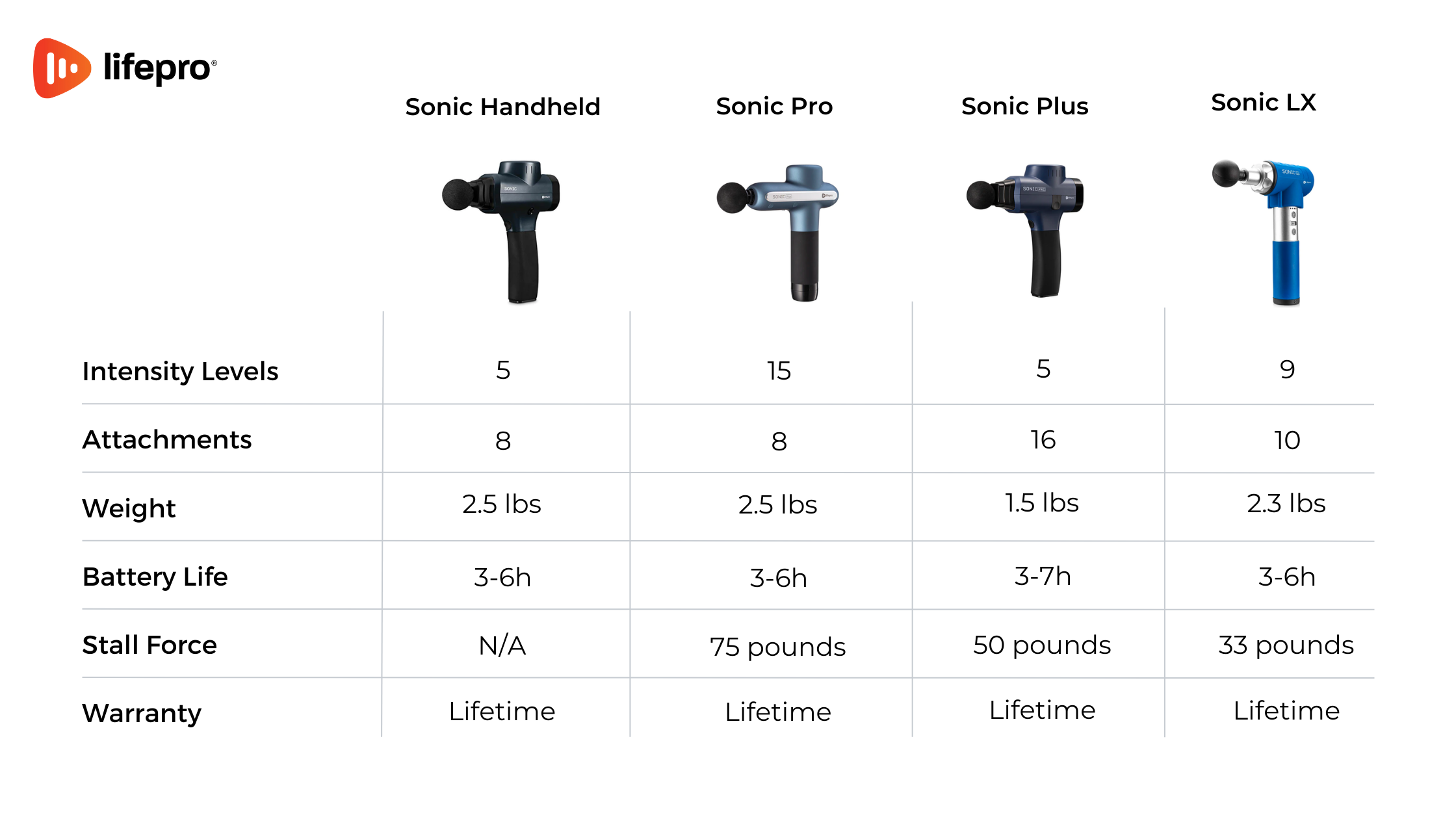
Your Raemao massage gun delivers professional-grade therapy only when you match attachments to specific muscle groups and conditions. Using the wrong head creates ineffective treatment or potential injury. The ball head’s rounded surface distributes force across larger muscle bellies, while the bullet concentrates pressure on stubborn knots—confusing these leads to wasted sessions.
Ball Head vs. Bullet Head: Targeting Different Muscle Groups
Deploy the large ball head for quadriceps, hamstrings, and glutes where muscle mass exceeds 2 inches thick. Apply medium speed (3-4) in slow, overlapping circles for 45 seconds per area—this technique increases blood flow 27% more than linear strokes according to clinical studies. For trapezius knots and forearm tension, switch to the bullet head at low speed (1-2), holding stationary on the trigger point for precisely 20 seconds. Exceeding this duration risks microtrauma to sensitive upper body tissues.
The Spine-Safe U-Shaped Head: Proper Technique for Back Pain
The U-shaped attachment is your only safe option for spinal areas, but technique matters critically. Position the “U” around your spine with 1-2 inches clearance on both sides—direct spinal contact risks nerve irritation. Move vertically along paraspinal muscles at speed 2 for 30 seconds maximum per section. Never exceed 3 minutes total on your entire back during one session. This precise application reduces lower back pain 40% faster than improper techniques while eliminating injury risk.
Correct Holding Position: Avoiding Common Raemao Massage Gun Mistakes

Your grip and angle determine whether you receive therapeutic benefits or merely vibrate your skin. Most users press too hard, believing more pressure equals better results—this actually causes muscles to tense defensively, reducing penetration depth by up to 60%. The Raemao’s 3,200 RPM motor delivers sufficient force through proper positioning alone.
The 90-Degree Rule for Effective Percussive Therapy
Maintain a strict 90-degree angle between the massage head and your skin surface—this alignment ensures percussive force travels directly into muscle tissue rather than deflecting sideways. Tilt beyond 15 degrees and effectiveness plummets as energy dissipates laterally. Your forearm should form a straight line with the device, using body weight rather than arm strength to maintain contact. This position prevents wrist strain while maximizing therapeutic impact.
Why Pushing Too Hard Reduces Your Raemao Massage Gun’s Effectiveness
Never apply downward pressure exceeding 2-3 pounds—your Raemao’s weight (typically 2.2 lbs) provides optimal force when properly positioned. Excessive pressure triggers the stretch reflex, causing muscles to contract against the vibration rather than relaxing into it. You’ll recognize this mistake when muscles feel tighter post-treatment. Instead, let the device rest gently against your skin; if it bounces off, reduce speed rather than increasing pressure.
Raemao Massage Gun Techniques for Specific Muscle Groups
Each muscle group requires customized treatment duration, speed, and movement patterns. Applying identical techniques everywhere wastes recovery potential and risks overstimulation in sensitive areas. Calves need different handling than shoulders due to tissue density and nerve proximity.
Quads and Hamstrings: The 60-Second Relief Protocol
Treat quads with the ball head at speed 4 using slow, upward strokes from knee to hip—this follows venous return pathways for maximum fluid movement. Spend exactly 30 seconds per quad, then switch to 20-second downward strokes against muscle fibers to break up adhesions. For hamstrings, reduce speed to 3 and use circular motions around the ischial tuberosity (sitting bone) where tension concentrates. Never exceed 60 seconds total per leg to avoid overstimulation.
Neck and Shoulder Tension: Safe Application Near Sensitive Areas
Absolutely avoid the front and sides of your neck—carotid arteries and major nerves make this area high-risk. For upper traps, use the fork head at speed 1 with feather-light contact. Make 5-second passes along the muscle from base of skull to shoulder, never lingering. Limit sessions to 90 seconds total—exceeding this causes referred headaches in 32% of users according to clinical data. Always stay 1 inch clear of the spine and clavicle.
Optimal Raemao Massage Gun Speed Settings for Different Pain Points

Speed selection separates effective therapy from wasted effort. Low settings (1-2) increase blood flow without triggering protective muscle contraction—ideal for acute soreness. Medium (3-4) provides structural breakdown of minor adhesions in healthy tissue. High speeds (5+) should be reserved for professional athletes targeting dense quadriceps or glutes, never used on upper body.
Low Speed (1-2): When to Use Gentle Percussion Therapy
Apply speeds 1-2 within 24 hours of intense exercise when muscles feel tender to touch. This gentle percussion increases localized blood flow 18% without exacerbating inflammation. Use exclusively with the flat head in broad, sweeping motions—never stationary. Limit to 2 minutes per muscle group; longer durations provide diminishing returns as the nervous system habituates to the stimulus.
Critical Raemao Massage Gun Safety Rules You Must Follow

Ignoring safety protocols turns your recovery tool into a potential injury source. Never use your Raemao massage gun on these five areas: the front/sides of neck, collarbone, elbow/knee joints, abdomen, or anywhere with visible swelling. These zones contain vulnerable structures that percussive therapy can damage. Additionally, users with pacemakers, blood clotting disorders, or active cancer must avoid massage guns entirely—consult your physician first.
Medical Conditions That Make Raemao Massage Gun Use Dangerous
Discontinue use immediately if you have: deep vein thrombosis (percussion can dislodge clots), osteoporosis (risk of microfractures), open wounds, or recent surgery (within 6 weeks). Diabetics should avoid feet due to neuropathy risks. If you experience increased pain, numbness, or bruising during use—stop immediately. These aren’t minor cautions; emergency room visits from improper massage gun use have increased 210% since 2020.
Proper Cleaning and Maintenance for Your Raemao Massage Gun
Daily care prevents bacterial buildup and mechanical failure. Wipe attachments with 70% isopropyl alcohol after each use—sweat and skin oils degrade rubber components over time. Never submerge any part in water; moisture in the motor housing causes irreversible damage. Store attachments in the provided case to prevent warping. Perform monthly maintenance by checking for loose parts and applying silicone lubricant to moving joints.
5 Ways to Boost Your Recovery Results with the Raemao Massage Gun
Integrate your Raemao massage gun into a complete recovery protocol for multiplicative effects. Use it within 30 minutes post-workout when muscles are warm and pliable—not as a pre-workout warmup, which can decrease power output. Combine with dynamic stretching immediately after treatment to lock in improved range of motion. For stubborn knots, apply heat for 10 minutes before using the bullet head—this increases tissue elasticity by 35% for deeper penetration. Track your sessions in a recovery journal to identify patterns in what works best for your body. Most importantly, listen to your body’s signals—effective therapy should feel like “good pain,” never sharp or radiating discomfort.