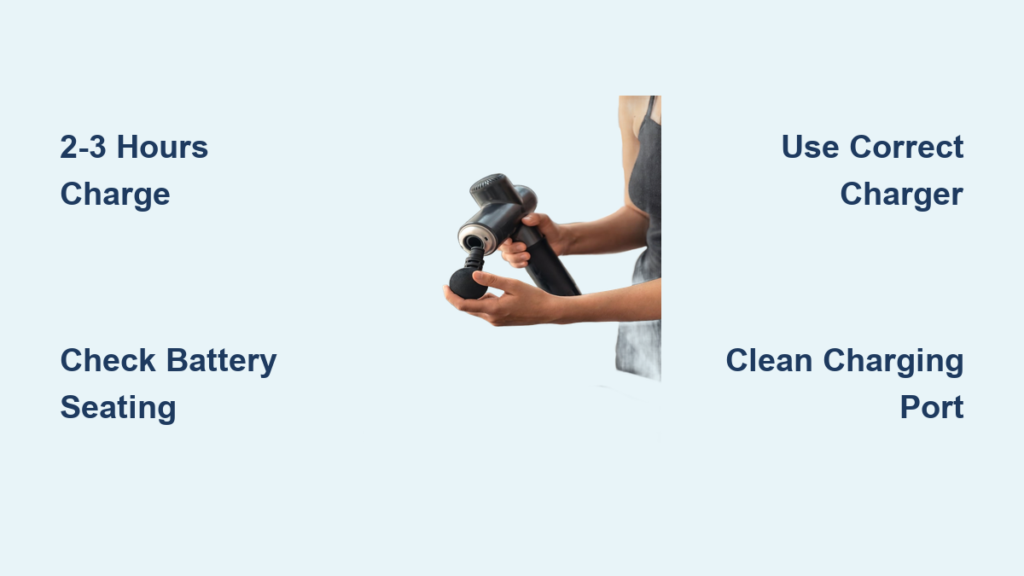
You’re ready for your post-workout recovery session, but your massage gun is dead. How long until it’s ready to go? Most massage guns need 2 to 3 hours for a full charge, but the exact time depends on your specific model and charging conditions. Skip the guesswork—this guide delivers precise charge times for popular models like Theragun Pro, Hypervolt 2 Pro, and TRAKK Roller, plus critical troubleshooting tips when your device isn’t charging properly. Discover why your massage gun might take longer than expected and how to ensure it’s always ready when you need it.
Theragun Pro Full Charge Time: Why 2 Hours Isn’t Always Enough

Your Theragun Pro should reach full power in approximately 2 hours when using the manufacturer’s charging dock, but many users experience delays due to a simple yet critical factor: battery seating. The charging dock requires the battery to be fully seated with an audible “click” to establish proper contact. Without this secure connection, the charging indicator may pulse misleadingly while the battery receives no charge at all.
The Hidden Seating Problem That Wastes Your Time
Physical therapists and regular users report leaving their Theragun Pro charging overnight only to find it completely dead the next morning. This frustrating scenario happens when the battery appears connected but lacks the proper seating. Follow this verification process:
- Firmly press the battery into the charging dock until you hear a distinct “click”
- Check that the charging indicator light shows a steady pulse (not intermittent)
- Wait 15 minutes, then gently wiggle the battery—if it moves, it’s not properly seated
- If charging still doesn’t progress, remove and reseat the battery completely
Professional Therapist Charging Protocol
Medical professionals who use the Theragun Pro in clinical settings have developed a reliable charging routine. They recommend plugging in the device immediately after each use, regardless of remaining battery life. This “top-up” approach prevents deep discharge cycles that strain the lithium-ion battery. For pre-session preparation, they allow a minimum 2-hour charging window but verify battery status visually before client appointments.
TRAKK Massage Roller: Why This Device Needs 3 Full Hours

Unlike massage guns, the TRAKK Multi-Speed Deep Tissue Massage Roller requires a consistent 3-hour charge to reach full capacity. This extended charging time stems from its unique battery configuration designed for continuous 3-hour runtime. Don’t confuse this roller device with traditional massage guns—its charging specifications differ significantly.
Critical Roller vs. Gun Distinction
Many users mistakenly apply massage gun charging expectations to rollers, leading to frustration. The TRAKK roller’s charging process follows these specific patterns:
- First 80% charges relatively quickly (about 2 hours)
- Final 20% enters trickle charge mode (additional 1 hour)
- LED indicator changes from red to solid blue when fully charged
- Unlike some massage guns, it lacks interchangeable batteries
Charging Light Tricks: When Your Massage Gun Shows Charging But Isn’t
That pulsing red light on your massage gun might be lying to you. Multiple users across Theragun and Hypervolt models report charging indicators showing activity while the battery receives no actual charge. This deceptive behavior most commonly occurs when:
- The charging port has accumulated dust or debris
- The cable isn’t fully inserted at either end
- The battery isn’t properly seated (especially in Theragun models)
- You’re using a non-manufacturer charger
Three-Step Verification Process
Don’t trust the indicator light alone—verify actual charging with this method:
- Note the current battery level (if visible) or how long the device runs before charging
- Charge for 30 minutes using a verified working setup
- Test runtime—significant improvement confirms actual charging
If your device shows no improvement after 30 minutes of verified charging, the issue likely involves battery degradation or internal circuit problems requiring professional service.
Battery Capacity Secrets: Why 2500mAh vs. 5000mAh Changes Charge Time

Your massage gun’s battery capacity directly determines minimum charging time. Most consumer models range from 2000mAh to 5000mAh, with professional units trending toward higher capacities. Here’s how this translates to real-world charging:
- 2000-2500mAh battery: 1.5-2 hours with standard charger
- 3000-3500mAh battery: 2-2.5 hours
- 4000-5000mAh battery: 2.5-3+ hours
Charger Output Matters More Than You Think
That phone charger in your drawer might be sabotaging your massage gun’s charging speed. Most massage guns require specific amperage to achieve manufacturer-stated charge times:
- Standard 1A charger: Double the expected charge time
- 2A charger: Matches most manufacturer specifications
- 3A “fast” charger: May reduce charge time by 20-30% (if supported)
Critical warning: Never use chargers with higher voltage than specified—this can permanently damage your battery or create fire hazards. Always match the voltage (typically 5V or 9V) while increasing amperage cautiously.
Charger Compatibility Checklist: Avoid These 3 Charging Mistakes
Using the wrong charger creates the most common charging delays. Follow this checklist to ensure optimal charging performance:
- ✅ Match voltage exactly (usually 5V or 9V printed on device)
- ✅ Use at least 2A amperage (higher is safe if voltage matches)
- ✅ Verify cable quality (thin, frayed cables reduce charging speed)
- ❌ Avoid power strips (use direct wall outlet for consistent power)
- ❌ Skip cheap chargers (poor regulation damages battery over time)
The Temperature Trap
Charging your massage gun in extreme temperatures dramatically increases charge time. Lithium-ion batteries charge inefficiently below 50°F (10°C) and above 95°F (35°C). If your device feels unusually hot or cold, let it reach room temperature before charging—this single step can cut 30+ minutes off your charge time.
First-Time User Guide: Getting Your Massage Gun Fully Charged for Day 1
Your initial charge sets the foundation for battery performance. Don’t skip these critical first-time steps:
- Charge for the full manufacturer-specified time (even if indicator shows “full” earlier)
- For Theragun models, verify battery seating with the audible “click” confirmation
- Avoid using the device while charging for the first cycle
- After first full charge, discharge to 20% before next recharge
Pro tip: Many users report better long-term battery performance when they complete 3 full charge/discharge cycles during the first week of ownership. This helps calibrate the battery management system.
Battery Health Warning Signs: When Charge Times Suddenly Increase
All rechargeable batteries degrade over time, but you can spot problems before they leave you without a working device. Watch for these red flags:
- Extended charge times (2-hour charger now takes 3+ hours)
- Reduced runtime (device dies much faster than when new)
- Physical swelling (battery casing feels distorted)
- Overheating (device becomes uncomfortably hot during charging)
Most massage gun batteries last 300-500 charge cycles before significant degradation. If you use your device daily, plan for potential battery replacement after 1-2 years of regular use.
Therapist-Approved Charging Tips: Maximize Your Device’s Lifespan
Physical therapists who use massage guns professionally have developed charging practices that extend device longevity. Implement these expert techniques:
- Avoid 0% discharges—recharge when battery reaches 20%
- Unplug after full charge—don’t leave connected for days
- Store at 50% charge for extended periods of non-use
- Clean charging ports monthly with a soft, dry brush
Critical maintenance step: Every 3 months, perform a full calibration cycle—discharge completely, then charge uninterrupted to 100%. This resets the battery management system and maintains accurate charge indicators.
Cold Weather Charging: Why Your Massage Gun Takes Longer in Winter
Low temperatures significantly impact lithium-ion battery performance. If you store your massage gun in an unheated space during winter, expect these charging challenges:
- Charge times increase by 25-50% in cold conditions
- The device may shut down prematurely during use
- Battery indicators show inaccurate levels
Quick fix: Bring your massage gun indoors 30 minutes before charging. For frequent cold-weather users, consider keeping a dedicated indoor storage spot for your device and charger.
How to Troubleshoot When Your Massage Gun Won’t Charge
When your massage gun refuses to power up, follow this systematic troubleshooting approach before contacting support:
Step 1: Verify the Power Source
- Test the outlet with another device
- Try a different wall socket (avoid power strips)
- Confirm the charging block works with another device
Step 2: Inspect Physical Connections
- Check for debris in charging port (use toothpick gently)
- Examine cable for fraying or damage
- For removable batteries, clean contact points with isopropyl alcohol
Step 3: Battery Reset Procedure
- Remove battery (if possible) for 60 seconds
- Press and hold power button for 15 seconds
- Reinsert battery firmly
- Attempt charging with verified working setup
If these steps fail after 2-3 attempts, contact the manufacturer—your battery or charging circuit likely needs professional attention.
Final Charging Protocol: Ensure Your Massage Gun Is Always Ready
Your massage gun’s charging time depends on model-specific factors, battery health, and charging practices. The Theragun Pro typically needs 2 hours with proper seating, while the TRAKK Roller requires 3 full hours. Remember these key takeaways:
- Always verify physical connections before assuming charging is working
- Match charger specifications exactly—don’t improvise with phone chargers
- Battery degradation will gradually increase charge times over 1-2 years
- Store devices at 50% charge in temperature-controlled environments
Implement these professional charging practices, and your massage gun will consistently deliver reliable recovery sessions without unexpected downtime. When in doubt, consult your specific model’s manual—manufacturers occasionally update charging specifications for newer versions.