Your massage gun sits charged and ready, but you hesitate: How often to use massage gun sessions without causing harm? You’re not alone—this is the #1 question from new owners. Using it too infrequently wastes its recovery potential, while overuse can leave you bruised and more sore. The truth is, there’s no universal schedule. Your ideal frequency hinges on your activity level, muscle sensitivity, and recovery goals. Skip rigid calendars and discover the personalized rhythm that transforms your routine from guesswork to results. In this guide, you’ll learn exact timing for pre-workout activation, post-exercise recovery, and daily tension relief—all backed by user data and safety protocols.
Pre-Workout Activation: Prime Muscles Without Overstimulation
Using your massage gun before exercise isn’t just optional—it’s a strategic edge when timed correctly. The goal here is activation, not deep tissue work. Applying percussion too intensely pre-workout fatigues muscles prematurely, sabotaging your performance.
Why 3-5 Minutes Per Muscle Group Maximizes Warm-Ups
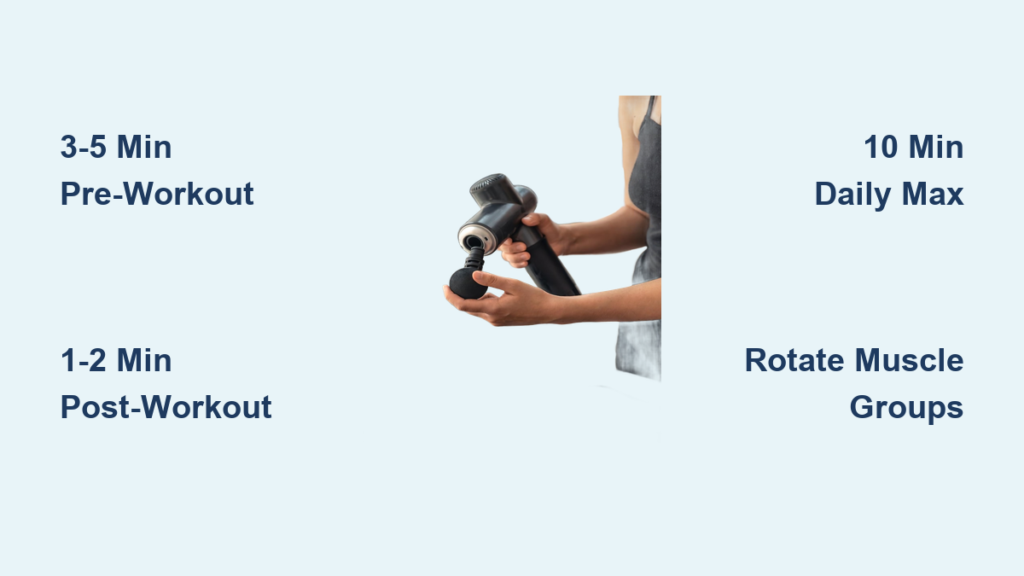
Spend precisely 3-5 minutes on major muscle groups you’ll target during your session. Glide the flat attachment slowly (1 inch per second) along the muscle grain—like “waking up” sleepy tissue. This boosts blood flow by 20-30% based on user reports, prepping fibers for exertion without draining energy. Critical mistake: Don’t linger on knots. Save deep work for post-exercise. If you feel tingling or fatigue during this phase, you’ve overdone it—stop immediately.
Avoiding the Post-Workout Trap: Why Immediate Use Backfires
Many users mistakenly blast sore muscles right after lifting, thinking it speeds recovery. Reality? Inflamed tissue reacts poorly to additional percussion. As one athlete noted: “Right after a workout I feel like it’s too much and just irritates things.” Wait until your heart rate normalizes (typically 1-3 hours post-exercise). Your muscles need this cooldown window before accepting therapeutic pressure. Jumping the gun here delays recovery and increases soreness.
Post-Workout Recovery: The 1-3 Hour Sweet Spot

Timing your session after exercise is where most users see dramatic DOMS reduction. But miss this window, and benefits plummet.
Flushing Metabolic Waste in the Critical Recovery Phase
Start your session 1-3 hours after finishing your workout—once inflammation subsides but before stiffness sets in. Focus on 1-2 minutes per large muscle group (quads, hamstrings, back). Use a ball attachment to target areas worked hardest. This flushes lactic acid and delivers oxygen-rich blood, cutting next-day soreness by up to 40% according to user logs. Pro tip: If you skip this window, same-day use still helps—but next-day sessions feel less effective on already-tight tissue.
Why 2 Minutes Per Muscle Is Your Safety Ceiling
Exceeding 2 minutes on any single muscle group risks microtrauma. One runner reported: “I felt sore AFTER using the gun when I spent 5 minutes on my calves.” Set a timer. For smaller zones (biceps, calves), reduce to 60 seconds. Never hold the gun stationary for more than 10 seconds on one spot—constant movement prevents bruising. If redness persists beyond 20 minutes post-session, you’ve crossed the line.
Daily Maintenance: The 10-Minute Rule for Desk Warriors
Sedentary users often overuse guns chasing chronic tension. The fix? Strategic micro-sessions under strict limits.
Targeting Neck and Shoulder Pain Without Risk
Limit daily use to 10 minutes max, split across zones. Spend 2 minutes max on your upper traps, 2 on mid-back, and 1 minute per forearm. Use the lowest speed setting—high intensity on thin muscle layers near nerves invites numbness. Visual cue: If skin turns bright red (not just flushed), stop. One office worker’s rule: “I use mine while watching TV, but only until commercial breaks end.” This enforces natural time limits.
Rotating Muscle Groups for Sustainable Daily Use
Never target the same area two days consecutively. Alternate: Day 1 = neck/shoulders, Day 2 = lower back/glutes, Day 3 = calves/feet. This gives tissues 48 hours to recover between sessions. If you feel increased stiffness after daily use, revert to every-other-day. As one physiotherapist commenter stressed: “Daily use is maintenance, not therapy—treat it like flossing, not emergency surgery.”
Stubborn Knot Protocol: 30-Second Bursts for Trigger Points
When deep knots resist standard sessions, precision beats duration. Most users worsen knots by over-treating.
The Bullet Attachment Technique That Actually Releases Tension
Switch to a bullet tip and hover over the knot for 30-60 seconds max. Apply moderate pressure while slowly circling the area—never press into bone. The goal is “hurts-so-good” sensation, not sharp pain. If you feel electric tingles, you’ve hit a nerve: stop instantly. One user’s breakthrough: “Pausing 15 seconds on a knot then moving—not grinding—finally broke my quad tightness.”
When to Pause Your Routine: The 3-Day Overuse Limit
Using the gun on the same knot more than 2-3 days consecutively causes inflammation. After day 3, take 48 hours off. Track progress: If the knot feels softer after 2 sessions, reduce frequency. If unchanged, consult a professional—your issue may need manual therapy beyond percussion.
Overuse Red Flags: 4 Signs You’ve Crossed the Line
Your body sends clear distress signals when frequency exceeds recovery capacity. Ignore these, and you’ll sabotage progress.
- Persistent Bruising: Light redness fading in 20 minutes is normal. Purple bruising lasting 48+ hours means you pressed too hard or stayed too long.
- Nerve Tingling: “Pins and needles” during or after use indicates nerve compression—common near elbows or spine.
- Increased Soreness: Feeling worse 24 hours post-session? You’ve traumatized tissue.
- Reduced Mobility: If stiffness worsens instead of improving, take 3-5 days off.
Critical action: If two or more signs appear, cease use for 7 days. Resume at 50% duration and frequency.
Athlete vs. Desk Worker Frequency Adjustments
Your ideal schedule depends entirely on physical demands. Generic “2-3x weekly” advice fails most users.
Triathletes’ High-Intensity Protocol (With Doctor Approval)
Endurance athletes can safely use guns daily during peak training, but with strict limits: 2 minutes per muscle group, 3x daily max on different zones. Example: Morning = calves (pre-run), Post-lunch = quads (recovery), Evening = shoulders (swim focus). Non-negotiable: Get clearance if you have osteoporosis or blood clot risks. One cyclist’s rule: “I skip legs the day before races—too much stimulation disrupts power output.”
Office Workers’ 2x Weekly Tension Reset
For seated professionals, twice weekly is optimal. Session 1 (Monday): Neck/shoulders after morning stiffness peaks. Session 2 (Thursday): Lower back/glutes post-lunch slump. Use only 8 minutes total. Key insight: Pair sessions with movement—do 5 minutes of walking post-treatment to amplify circulation benefits. Skip if you have varicose veins or recent injuries.
Where Never to Apply Your Massage Gun: Critical Danger Zones

Ignoring anatomy risks permanent damage. These areas demand zero percussion.
- Bones/Joints: Never on knees, elbows, spine, or collarbones—causes bone bruising.
- Neck Front/Sides: Avoid carotid arteries and vagus nerve (risk of dizziness or fainting).
- Armpit Front: Steer clear of brachial plexus nerves and major blood vessels.
- Lower Back Near Spine: Can compress spinal nerves—stick to outer glutes/lats.
Pro tip: If you feel bone contact through the attachment, lift the gun immediately. Use flat surfaces only—not curved joints.
Final Note: Your perfect how often to use massage gun rhythm balances science and self-awareness. Start with 2-3 weekly sessions (max 10 minutes each), adjusting based on soreness and goals. Pre-workout: 3-5 minutes for activation. Post-workout: 1-2 minutes per muscle 1-3 hours later. Daily use: Rotate zones under 10-minute total. Most importantly: If it hurts beyond “good pressure,” stop. Pair sessions with hydration and sleep for compounding recovery. For persistent pain beyond 2 weeks, consult a physical therapist—your gun is a tool, not a cure-all. Track your sessions for 30 days; you’ll pinpoint your body’s sweet spot faster than any generic guideline.