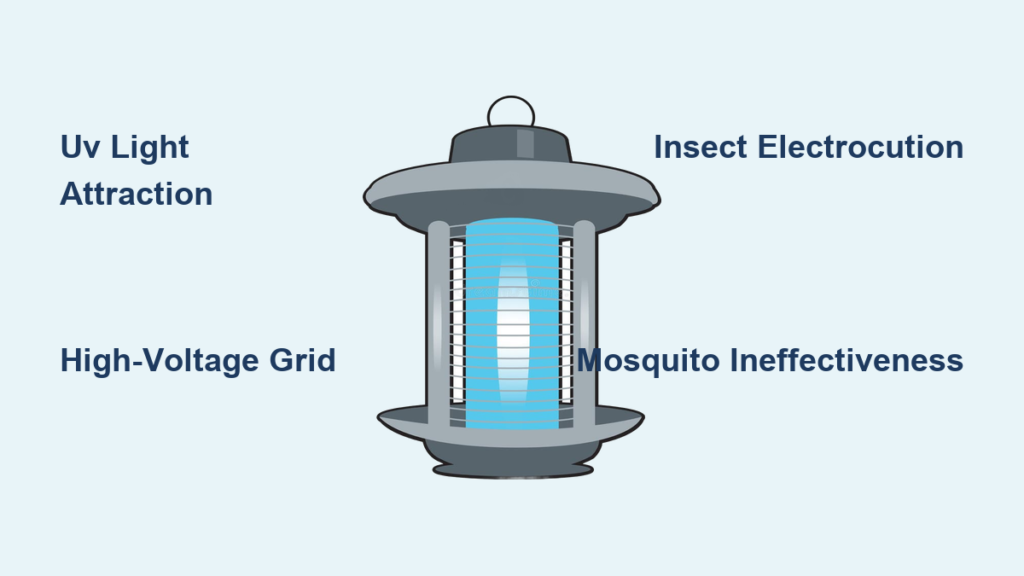
That sharp zzzt cutting through your backyard silence isn’t just summer ambiance—it’s the unmistakable sound of a bug zapper doing its job. But if you’ve ever wondered how do bug zapper lights work to turn flying pests into charred debris, you’re not alone. Millions rely on these glowing devices to protect patios and gardens, yet few understand the precise mechanics behind their lethal attraction. At its core, a bug zapper combines ultraviolet light deception with high-voltage execution in a deceptively simple two-step process. While they effectively eliminate moths and flies, their notorious failure against mosquitoes reveals critical limitations you need to know before hanging one near your dinner table.
The confusion around how do bug zapper lights work stems from their misleading name—they don’t actually “zap” bugs through light alone. Instead, the UV glow serves as bait, while an electrified grid delivers the fatal shock. This distinction matters because it explains why these devices excel against some pests but become virtually useless against others. By the end of this guide, you’ll understand exactly what happens when insects meet that blue-violet glow, why mosquitoes ignore your zapper, and whether this decades-old technology deserves a spot in your pest control arsenal.
Why UV Light Is the Ultimate Bug Magnet
The secret starts with that distinctive blue-violet glow you see emanating from bug zappers. This isn’t ordinary light—it’s Ultraviolet-A (UV-A) radiation at approximately 365 nanometers, invisible to humans but blazingly bright to many insects. Unlike our eyes, which see only the faint visible spill from this spectrum, nocturnal bugs perceive UV-A as an intense beacon mimicking two critical survival signals: open sky corridors for navigation and UV patterns on flowers indicating nectar sources.
How Insect Vision Turns Light Into a Death Trap
- Navigation Hijacking: Many flying pests like moths and beetles use natural UV light from the moon and stars to maintain flight paths. The zapper’s concentrated UV-A beam creates an artificial “sky” that disrupts their navigation, causing them to spiral toward the light source.
- Flower Mimicry: Bees and moths rely on UV-reflective patterns on petals to locate food. Bug zappers exploit this by emitting the same wavelength, tricking insects into thinking they’ve found a giant, irresistible flower.
- Dawn/Dusk Vulnerability: Since UV light is most intense during twilight hours when many pests are active, the timing aligns perfectly with insect behavior patterns—making your patio light a 24/7 dinner bell.
This UV attraction mechanism works so effectively because it targets phototactic insects—those instinctively drawn to light sources. House flies, fruit flies, and most moths will abandon other activities to investigate, often flying directly into the device’s kill zone within seconds of activation.
How the Electrified Grid Delivers a Lethal Shock (Without Harming You)

While the UV light handles attraction, the real execution happens in the device’s inner grid—a cage-like structure of parallel wires spaced just millimeters apart. Here’s where understanding how do bug zapper lights work separates myth from reality: the light itself doesn’t kill; it’s the high-voltage circuit between those grids that does the job.
The Physics of Instant Insect Elimination
When an insect bridges the gap between oppositely charged grids, its conductive body completes a circuit carrying 2,000+ volts at extremely low amperage. This creates a miniature lightning bolt through the bug’s exoskeleton, causing three immediate effects:
1. Instant neural shutdown from the electrical surge
2. Internal dehydration as moisture vaporizes
3. Structural collapse of the insect’s body
Crucially, the low amperage (typically under 0.03 amps) ensures human safety—while the voltage is high enough to jump the tiny grid gap via an insect, it can’t penetrate human skin resistance. Never test this by touching the inner grid, as moisture or cuts could create a dangerous path. Modern zappers add protective outer cages specifically to prevent accidental contact, but always unplug before cleaning.
Step-by-Step: The Bug Zapper’s 5-Stage Execution Process
Your bug zapper isn’t randomly zapping—it follows a precise sequence every time an insect approaches. Understanding this cycle explains both its effectiveness and limitations.
Stage 1: UV Beacon Activation
The moment you power on the device, UV-A lamps flood the area with 365nm light. Within minutes, this creates an invisible “insect highway” drawing phototactic pests from up to 100 feet away. Larger units with multiple bulbs increase coverage to several thousand square feet.
Stage 2: Inevitable Grid Contact
Drawn by the light, insects fly straight into the grid cage. Their erratic flight patterns guarantee contact with multiple wires—especially since the grid spacing (typically 3-8mm) matches common insect body widths.
Stage 3: Circuit Completion and Discharge
As the bug bridges two charged grids, electricity surges through its body. The audible “zap” you hear is actually superheated air expanding from the micro-explosion—often accompanied by a visible blue flash as the current ionizes the air.
Stage 4: Instantaneous Insect Destruction
The high-voltage current (not the heat) causes immediate death through electrocution. Larger insects like June bugs may fragment violently, while smaller gnats vaporize almost completely. This explains why you’ll find varying debris levels in the collection tray.
Stage 5: Debris Containment
Dead insects fall into the removable tray below, preventing clogs and containing remains. Units without trays allow carcasses to scatter—contributing to the “splatter zone” problem discussed later.
Why Mosquitoes Ignore Your Bug Zapper (The CO2 Factor)

Here’s the critical flaw most users discover too late: bug zappers are nearly useless against mosquitoes. Scientific studies consistently show mosquitoes comprise less than 0.13% of insects killed by standard UV zappers. The reason? Female mosquitoes (the biters) navigate using completely different signals.
The Attraction Mismatch Explained
- Mosquitoes hunt via CO2 plumes: They detect carbon dioxide from 50+ feet away—your breath is their primary target, not UV light.
- Body heat and odor override light: Lactic acid, octenol, and skin bacteria create chemical trails mosquitoes follow relentlessly. A zapper’s UV glow can’t compete with these biological signals.
- UV actually repels some mosquitoes: Certain species like Aedes aegypti (dengue carriers) are photophobic—they avoid bright light, making zappers counterproductive.
This fundamental mismatch means your bug zapper might kill harmless moths while ignoring the mosquitoes feasting on your ankles. Worse, it can draw additional insects into your yard, creating a localized pest hotspot near your seating area.
The Hidden Cost: How Bug Zappers Harm Beneficial Insects
While eliminating nuisance flies feels satisfying, bug zappers indiscriminately slaughter ecologically vital species. This collateral damage creates ripple effects you won’t see until it’s too late.
Three Ecosystem Impacts You Can’t Ignore
- Pollinator massacre: Moths comprise 30-50% of zapper casualties. Many are nocturnal pollinators for crops like papaya and agave—species that never recover from nightly electrocution.
- Predator depletion: Beneficial insects like ladybugs and lacewings (natural aphid controllers) get zapped alongside pests, worsening garden infestations.
- Food chain disruption: Birds and bats rely on moths and beetles for food. One study found zappers reduce local bat foraging by 25% due to diminished prey.
Ironically, by killing the insects that eat mosquito larvae (like dragonflies), zappers may indirectly increase mosquito populations over time. This ecological trade-off makes them particularly problematic near gardens or natural habitats.
Dealing with the “Splatter Zone”: Why Bug Zappers Create Messy Debris
That satisfying zap comes with a hidden consequence: the violent electrocution of larger insects creates bioaerosols. When a beetle or fly explodes on contact, it releases microscopic particles containing insect fragments, bacteria, and potential pathogens into the air within a 2-foot radius.
Health and Cleanup Implications
- Allergen exposure: Fragmented insect exoskeletons (chitin) become airborne, triggering asthma in sensitive individuals.
- Pathogen dispersal: Bacteria from insect guts (like E. coli in houseflies) can contaminate nearby surfaces or food.
- Sticky residue: Oily insect remains coat nearby furniture and plants, requiring frequent wiping.
Units with sealed collection trays minimize this issue, but open-grid designs turn your patio into a contamination zone. Always position zappers at least 15 feet from eating areas and seating—never directly above dinner tables.
Do Bug Zappers Actually Reduce Biting Insects? The Research Verdict
After decades of use, scientific consensus is clear: bug zappers fail as primary mosquito control. Field studies show UV traps kill <1% of biting pests while slaughtering 99% of harmless or beneficial insects. For meaningful mosquito reduction, you need technology that mimics human presence.
What Actually Works for Mosquito Control
- CO2 traps: Devices releasing carbon dioxide (from propane or canisters) combined with octenol lures catch 10x more mosquitoes than UV zappers.
- Standing water elimination: 80% of mosquito control happens by removing breeding sites (clogged gutters, birdbaths).
- Targeted repellents: EPA-registered sprays with picaridin or oil of lemon eucalyptus create personal protection zones.
Bug zappers earn their place for fly and moth control in barns or patios—but they belong in the “general nuisance reducer” category, not the “mosquito solution” toolkit. Manage expectations accordingly.
Smart Placement Tips to Maximize Your Bug Zapper’s Effectiveness
Positioning determines whether your zapper becomes a pest magnet or a solution. Follow these evidence-based guidelines:
- Distance from people: Hang 15-20 feet from seating areas to avoid attracting insects toward you
- Height matters: Mount 4-6 feet above ground—optimal for intercepting flying pests
- Avoid competing light: Place away from porch lights or windows that could dilute UV attraction
- Wind considerations: Position upwind of gathering areas so insects approach from behind you
- Never indoors: UV light attracts bugs through windows, making indoor use counterproductive
For patios, hang units at the perimeter edge rather than above tables. In gardens, place between vegetable beds and wooded areas to intercept incoming pests before they reach crops.
Bug zappers work by exploiting insect navigation systems with UV-A light, then electrocuting victims on high-voltage grids—a process that’s brutally efficient for moths and flies but fundamentally flawed for mosquitoes. Understanding how do bug zapper lights work reveals why they should be viewed as broad-spectrum flying insect reducers, not targeted pest solutions. For true mosquito control, prioritize CO2 traps and habitat management while using zappers selectively for non-biting pests. Always position units strategically to minimize splatter contamination, and never rely on them as your sole defense against biting insects. When used with realistic expectations and proper placement, bug zappers can be a valuable part of your summer pest strategy—but they’re far from the magic bullet many believe them to be.