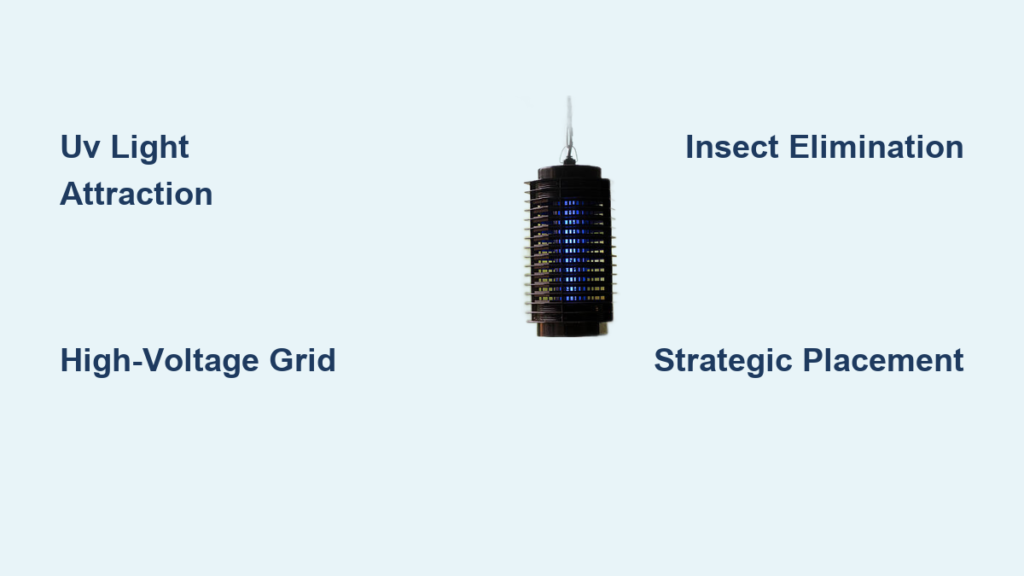
You’ve heard that unmistakable ZZZZT-POP! sound on summer evenings—the signature noise of an electric bug zapper at work. But what’s really happening inside that glowing device that makes it such an effective pest controller? Understanding how does an electric bug zapper work reveals a fascinating interplay of light science and high-voltage physics that’s been perfected over decades. This seemingly simple backyard tool operates on principles that exploit insects’ natural behaviors while delivering a lethal but safe electrical jolt.
Unlike chemical repellents that merely discourage pests, bug zappers actively eliminate them through a three-stage process that begins long before the satisfying zap. The magic starts with an invisible light spectrum that humans can’t see but insects find irresistible. When properly positioned and maintained, these devices can reduce flying insect populations in your outdoor space by up to 70% according to entomological studies. Let’s explore the precise engineering that makes this common backyard appliance such an efficient pest control solution.
The UV Light Attraction: Why Bugs Can’t Resist That Blue Glow
The first critical phase in how does an electric bug zapper work begins with its invisible beacon—ultraviolet (UV) light. While humans see the blue glow, insects perceive something entirely different. Most flying pests have photoreceptors specifically tuned to UV-A wavelengths between 350-400 nanometers, which happens to be exactly what bug zappers emit.
House flies, moths, and many other common pests evolved to navigate using moonlight and starlight, which contain significant UV-A components. When your bug zapper lights up, insects within a 40-foot radius mistake it for natural celestial navigation aids. Nocturnal insects like moths will fly toward the light source in what scientists call “transverse orientation”—a navigation technique where they maintain a constant angle relative to a distant light source.
Why Certain Bugs Respond More Than Others
Different insect families react to specific UV wavelengths:
– House flies show peak attraction to 340-360nm UV-A light
– Night-flying moths respond most strongly to 365-400nm wavelengths
– Mosquitoes demonstrate moderate attraction to 365-400nm, though they’re more drawn to CO₂ and body heat
This explains why your zapper collects mostly moths and flies but few mosquitoes—the UV light simply isn’t their primary attractant. Advanced models address this limitation by adding chemical attractants like octenol (which mimics human breath) and lactic acid to boost mosquito capture rates by up to 35%.
Inside the Grid: How 2,000-5,000 Volts Instantly Eliminate Insects

The moment an insect bridges the gap between the charged wires, the second phase of how does an electric bug zapper work springs into action. Inside the unit, a specialized transformer (typically a flyback transformer) converts standard 120V household current into a high-voltage, low-amperage DC current. This electrical conversion is crucial—it creates the lethal zap while maintaining safety for humans.
Residential bug zappers typically operate between 2,000-3,000 volts with 5-15 milliamps of current, while commercial models can reach 5,000 volts with 30 milliamps. The parallel metal wires are spaced precisely 2-4mm apart—close enough for small insects to bridge the gap but too far for fingers or paws to make contact. This specific spacing ensures the electrical circuit only completes when an insect lands on the grid.
The Physics of Instant Insect Elimination
When an insect contacts both polarities simultaneously:
1. Its conductive body creates a low-impedance path between wires
2. High-voltage current (10-30mA) surges through its thorax
3. Instantaneous Joule heating occurs (reaching 100-200°C internally)
4. Cellular structures rupture due to rapid thermal expansion
5. The insect dies within milliseconds before it can even register pain
This entire process happens so quickly that the insect doesn’t have time to release pheromones that might warn others—a critical design feature that prevents repelling additional pests.
Why Bug Zappers Kill More Moths Than Mosquitoes

One of the most misunderstood aspects of how does an electric bug zapper work involves its effectiveness against different pests. Research shows that standard UV-based zappers kill primarily non-biting insects—only about 0.25% of insects captured are female mosquitoes, the ones that actually bite humans.
The Mosquito Attraction Paradox
Mosquitoes rely primarily on carbon dioxide (CO₂) and body heat to locate hosts, not UV light. While they do respond somewhat to UV-A (60-75% attraction rate depending on species), they’re far more drawn to:
– CO₂ concentrations of 400-450 ppm (mimicking human breath)
– Body heat signatures (32-37°C)
– Octenol compounds at 4mg/hr emission rates
– Lactic acid derivatives found in human sweat
Specialized mosquito traps incorporate these elements alongside UV light, increasing mosquito capture rates by 3-5 times compared to standard bug zappers. For pure mosquito control, these advanced models represent a more targeted solution.
Safety Systems: How Bug Zappers Protect You While Zapping Pests

Understanding how does an electric bug zapper work wouldn’t be complete without examining its critical safety features. Despite operating at thousands of volts, modern units incorporate multiple safeguards:
- Ground fault circuit interrupters that cut power within milliseconds of detecting unintended current flow
- Integrated grid covers with openings smaller than 10mm to prevent finger contact
- Capacitor discharge delay circuits that ensure no residual charge remains after shutdown
- Overheat protection that automatically shuts down units exceeding 70°C
Residential models follow strict UL 588 safety standards requiring that no part of the grid be accessible with a standard ⅛-inch diameter probe. This engineering ensures that while the grid delivers a lethal jolt to insects, it poses minimal risk to humans and pets when used as directed.
Strategic Placement: Maximizing Your Bug Zapper’s Effectiveness
The positioning of your bug zapper dramatically impacts how does an electric bug zapper work in your specific environment. Incorrect placement can render even the most advanced unit nearly useless.
Optimal Location Guidelines
- Position at least 15-25 feet away from seating areas to draw pests away from people
- Place downwind of your activity zone so insects get zapped before reaching you
- Install at head height (5-6 feet) for maximum exposure to flying insects
- Avoid competing light sources—porch lights can reduce effectiveness by 20-60%
- Never place directly above food preparation areas (dead insect particles can contaminate food)
For backyard use, position your zapper between insect breeding areas (like gardens or standing water) and your living space. This creates a protective barrier that intercepts pests before they reach you.
Maintenance Secrets: Keeping Your Bug Zapper Operating at Peak Performance
A neglected bug zapper loses up to 40% of its effectiveness according to entomological studies. Regular maintenance is crucial to understanding how does an electric bug zapper work at its best.
Essential Cleaning Procedure
- Unplug and wait 30 minutes to ensure capacitor discharge
- Remove collection tray and dispose of insect remains
- Clean grid with compressed air (never water while assembled)
- Wipe UV tube with 90% isopropyl alcohol to remove residue
- Replace UV lamp after 8,000 hours (typically 1-2 seasons)
Pro Tip: Clean your zapper weekly during peak season. A thin layer of insect residue on the UV tube can reduce light output by 25%, significantly diminishing attraction power. Always wear rubber gloves during cleaning to protect against any residual charge.
Smart Zappers vs. Traditional Models: Technology Evolution
Modern bug zappers have evolved significantly from simple UV lights and grids. Understanding how does an electric bug zapper work today reveals sophisticated technology:
- Photocell activation that automatically turns on at dusk (5-10 lux threshold)
- Motion sensors that conserve energy when no insects are present
- Variable frequency UV emission that targets specific pest spectra
- IoT connectivity for remote monitoring of catch rates
- Solar-powered options with energy storage for off-grid use
Advanced agricultural models even incorporate pheromone dispensers and infrared sensors to count captured insects, providing valuable pest population data. These smart features represent the next evolution in understanding how does an electric bug zapper work for targeted pest management.
What Bug Zappers Can’t Do: Understanding Their Limitations
Despite their effectiveness against many pests, bug zappers have specific limitations you should know. Understanding how does an electric bug zapper work includes recognizing where it falls short:
- No residual protection: Only kills insects that contact the grid
- Limited range: Effective zone typically 10-40 feet radius
- Non-selective killing: Eliminates beneficial insects like moths and beetles
- Poor mosquito control: Standard models capture few biting females
- Weather dependent: Wind speeds over 5m/s reduce effectiveness by 30%
For comprehensive pest control, combine your bug zapper with other methods—citronella candles for localized protection, fans to disrupt insect flight, and eliminating standing water to reduce breeding sites.
The distinctive ZZZZT-POP! of a bug zapper represents a sophisticated interplay of light physics and electrical engineering designed specifically to exploit insect behavior. By understanding how does an electric bug zapper work—from the UV attraction through the high-voltage elimination—you can position and maintain yours for maximum effectiveness against the pests that bother you most. Remember that while these devices excel at controlling moths, flies, and gnats, specialized solutions work better for mosquitoes. Regular maintenance and strategic placement transform your bug zapper from a simple backyard gadget into a precision pest control tool that keeps your outdoor spaces more enjoyable all season long.