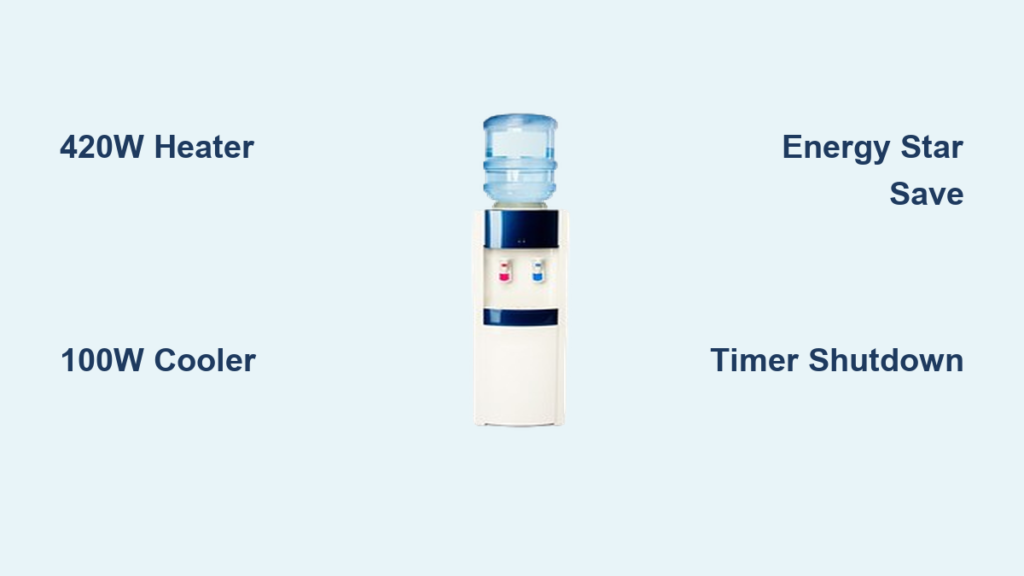
That refreshing glass of ice-cold water or steaming cup of tea from your office cooler comes with a hidden cost you might not consider. While water coolers seem like minor appliances, their constant operation adds up on your electricity bill—especially when running 24/7. If you’ve ever wondered why your energy costs feel unexpectedly high despite careful conservation, your water cooler could be the silent culprit. This guide reveals exactly how much power standard hot-and-cold units consume, breaks down real-world costs, and provides actionable fixes to slash your bill. You’ll discover why a typical cooler uses 420W for heating and 100W for cooling, how usage patterns dramatically impact costs, and why ENERGY STAR models save you $15+ annually.
Why Your Water Cooler’s 420W Heater Drains More Power Than You Think
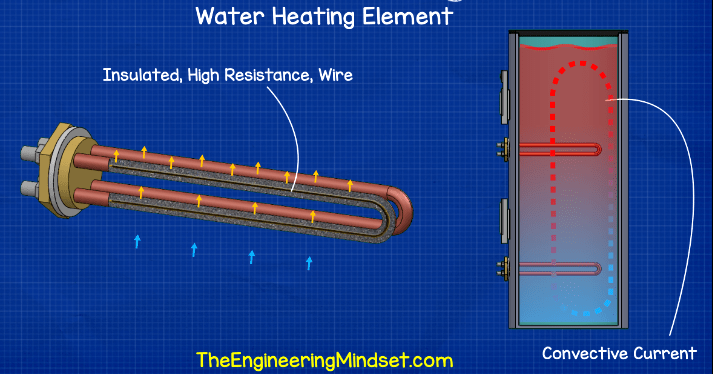
Most office water coolers operate two independent systems that activate based on your usage—not continuously. The hot water tank relies on a 420W heating element that only engages when water temperature drops below its set point, while the cooling system uses a 100W compressor or thermoelectric unit that cycles on to maintain chill. Crucially, both systems can run simultaneously after heavy use, spiking total power draw to 520W. This isn’t a marketing trick—it’s physics. When someone fills a mug of hot tea right after grabbing cold water, the depleted tanks trigger both systems to work at once. But because these cycles last minutes rather than hours, your actual daily consumption depends entirely on how often people drink from it.
How Simultaneous Heating and Cooling Trip Your Breaker
Picture this: It’s 10 AM in a busy office. Five people line up for coffee, depleting the hot tank. Before the heater finishes reheating, three others pour cold water for lunch. Now both systems activate together, drawing 520W—enough to trip a weak circuit if other devices share the outlet. This peak load explains why coolers occasionally cause nuisance breaker trips in older buildings. The solution? Plug your cooler into a dedicated circuit. Better yet, stagger high-usage times—encourage tea drinkers to fill carafes early rather than making repeated trips during peak hours. Pro tip: Listen for the distinct click-hum of the heater and the whirr of the compressor. If you hear both sounds overlapping frequently, your unit is working harder than necessary.
Wattage vs. Watt-Hours: The Critical Difference That Saves You Money
Seeing “420W” on the label doesn’t mean your cooler guzzles that much hourly—it’s the maximum rate when actively heating. Actual energy use is measured in watt-hours (Wh), which tracks consumption over time. Think of wattage like your car’s speedometer (current rate) and watt-hours like the odometer (total distance traveled). A 420W heater running for 30 minutes consumes just 210Wh (0.21 kWh), not 420Wh. This distinction matters because non-certified coolers waste 40% more energy during idle periods than ENERGY STAR models. If your unit feels warm to the touch even when unused, it’s bleeding power through poor insulation—a sure sign you’re paying for standby waste.
Real Office Cooler Energy Costs: From $0.15/Day to $100/Year

Your water cooler’s annual cost isn’t fixed—it swings wildly based on usage, location, and model efficiency. A certified ENERGY STAR unit in standby mode (no one drinking) uses just 0.74 kWh daily to maintain temperatures. But add actual use, and costs climb fast. In a 20-person office where five people make hot tea and 15 grab cold water daily:
- Heating system (420W) runs ~30 minutes: 0.21 kWh
- Cooling system (100W) runs ~2 hours: 0.20 kWh
- Standby consumption: 0.74 kWh
- Total daily use: 1.15 kWh
At the U.S. average rate of 13¢/kWh, that’s $0.15 per day or $55 yearly. But here’s the shocker: A non-certified model in a hot warehouse could cost $90–$100 annually due to inefficient cycling and ambient heat forcing the compressor to overwork. For perspective, that’s more than a modern LED TV ($40/year) and nearly double a laptop charger ($30/year). The worst offenders? Units placed near coffee makers or sunny windows—these can double energy use by fighting external heat.
Why Your Home Cooler Costs Less Than the Office Model
A single-person home office cooler using only cold water might cost $25/year because:
– Minimal heating cycles (no hot water demand)
– Lower ambient temperatures (cool basement vs. sunny office)
– Fewer usage-triggered cooling cycles
But if you keep it running 24/7 in a garage during summer, costs jump 30%. Always unplug home units overnight—they lack office-grade timers, so idle consumption becomes pure waste.
Energy Star vs. Standard vs. Evaporative Coolers: The Wattage Breakdown
Not all “water coolers” are equal—some sip power while others gulp it. Here’s how common types compare:
| Cooler Type | Heating (W) | Cooling (W) | Daily kWh (Avg) | Annual Cost |
|---|---|---|---|---|
| ENERGY STAR Bottled | 420 | 100 | 0.95 | $45 |
| Standard Bottled | 420 | 100 | 1.3 | $62 |
| Evaporative “Swamp” | N/A | 50-200* | 1.8 | $85 |
* Evaporative coolers use fans/pumps for AIR cooling—not drinking water. Their 50-200W draw varies wildly with humidity and fan speed.
Critical insight: ENERGY STAR models cut standby waste by 25% through better insulation and smart thermostats. But evaporative coolers (marketed as “water coolers” for rooms) are energy hogs—they run fans continuously and guzzle power in dry climates where evaporation works poorly. Avoid them for drinking water; they’re irrelevant for this comparison. Stick to bottled or plumbed units for accurate cost analysis.
3 Hidden Habits That Double Your Water Cooler’s Electricity Bill
You might think usage is the only factor—but these often-overlooked issues silently inflate costs:
- The “Sunbaked Cooler” Effect: Placing your unit in direct sunlight or near a radiator forces the cooling system to work 3x harder. A cooler in a 90°F room uses 40% more energy than one in 70°F. Move it to a shaded corner—you’ll feel the compressor run less often.
- Mineral Buildup Sabotage: Hard water creates limescale on heating elements, acting like insulation. A scaled-up heater takes 20% longer to reheat water, burning extra watts. Descale annually with vinegar (1 cup heated, then flushed).
- The Weekend Vampire Drain: Units without timers run heaters 48 hours straight during office closures. That idle consumption adds $15–$20 yearly for zero benefit.
Warning: Compressor-based models (common in commercial coolers) suffer most from dusty coils. Vacuum the rear vents monthly—a grimy coil reduces efficiency by 15%, spiking costs.
Slash Costs 50% With These 4 Proven Fixes (No New Purchase Needed)
You don’t need to replace your cooler to save. Implement these immediately:
Install a $10 Timer for Automatic Night/Weekend Shutdown
Plug your cooler into an outlet timer set to turn off at 6 PM and restart at 7 AM. This eliminates 60% of standby waste. For a standard unit, you’ll save $18/year—enough to cover the timer’s cost in 2 months. ENERGY STAR models with built-in timers (like the Avalon Q5) do this automatically.
Optimize Placement in 60 Seconds
Move your cooler away from:
– Direct sunlight (windows)
– Heat-generating appliances (microwaves, printers)
– Exterior walls in summer
Even shifting it 3 feet from a window can cut cooling costs by 25%.
Train Users to Reduce Cycle Triggers
Post a simple sign: “Fill one large bottle instead of multiple cups!” Fewer dispensing events mean fewer heating/cooling cycles. In tests, this cut active energy use by 18% in offices.
Descale Quarterly (Especially in Hard Water Areas)
Mineral buildup forces heaters to overwork. Do this:
1. Unplug the cooler
2. Pour 1 cup white vinegar into the hot tank
3. Let it sit 30 minutes (heated by the element)
4. Flush thoroughly with clean water
This restores efficiency and prevents $10–$15 in wasted annual costs.
Final Verdict: Your Water Cooler’s True Cost Per Glass
A typical office water cooler costs less than 0.5¢ per glass—but those pennies add up to $55+ yearly for minimal convenience. The real waste comes from idle operation and poor placement, not the cooling process itself. By switching to an ENERGY STAR model ($20–$50 pricier upfront) and adding a timer, you’ll recoup costs in under 18 months while saving 200+ kWh annually. For existing units, strategic shutdowns and descaling deliver 30–50% savings immediately. Remember: If your cooler hums constantly even when unused, it’s time for intervention. In most cases, simple adjustments make this “vampire appliance” a negligible line item—not a budget drain. Check your unit tonight: Feel if the compressor is running unnecessarily, and unplug it if unused for 12+ hours. Tomorrow, you’ll already be saving.