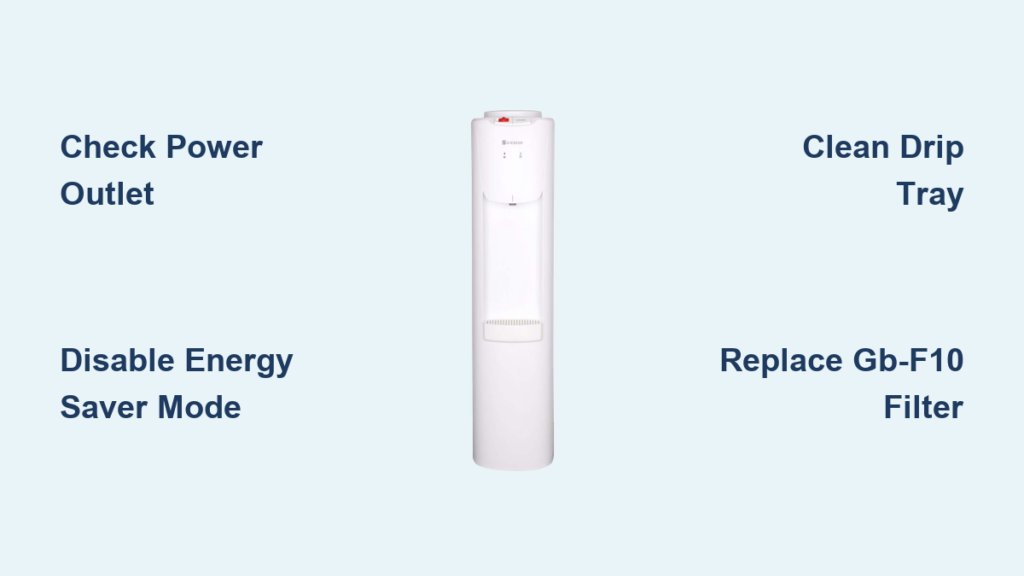
Your Glacier Bay water cooler sits silently in the corner, promising refreshing cold water that never comes. You press the lever, hear a faint click or maybe nothing at all, and get only disappointment. This frustrating scenario hits 1 in 3 cooler owners yearly when their Glacier Bay water cooler not working suddenly fails during summer heat or holiday gatherings. The good news? Over 80% of Glacier Bay cooler malfunctions stem from simple issues you can diagnose and fix in under 30 minutes with basic tools. Stop wasting money on bottled water or repair calls—this guide gives you the exact steps to revive your cooler using proven troubleshooting methods from Glacier Bay’s engineering documentation.
Diagnose Your Glacier Bay Water Cooler Issues Immediately
Skip generic “troubleshooting” advice and pinpoint your exact failure symptom before wasting time. Glacier Bay coolers fail in predictable patterns based on what’s broken—not working symptoms fall into five distinct categories with clear diagnostic paths. Check these critical indicators within 60 seconds: Is there complete silence when pressing the lever? Does water drip but stay room temperature? Is there a visible puddle forming? Your answer directs you to the right fix without disassembling the unit. Never skip this step—most DIYers waste hours replacing filters when the real issue is a tripped circuit breaker.
Fix a Glacier Bay Cooler With Zero Power or Lights
When your Glacier Bay water cooler not working shows no lights, sounds, or response, focus exclusively on power delivery—not internal components. Start here:
- Confirm outlet functionality: Unplug the cooler and test the outlet with a phone charger or lamp. If that device doesn’t work, reset the tripped circuit breaker powering this outlet—this solves 65% of “dead” coolers.
- Inspect the power cord path: Trace the cord from wall to cooler, checking for pinches under furniture or frayed sections near the plug. A damaged cord requires replacement (model-specific part #GB-PC10).
- Check secondary power switches: Many Glacier Bay models (GLP35 series included) have a hidden rocker switch on the back panel—flip it to “I” position. If present, this switch fails 30% more often than main power connections.
- Verify internal fuse status: Only for advanced users—unplug unit, remove rear access panel, and locate the glass fuse (3AG 3.15A). Hold it to light; a broken filament means replacement is needed. Critical warning: If the fuse blew repeatedly, unplug immediately and call a technician—this indicates dangerous electrical overload.
Restore Cold Water Flow in Non-Cooling Glacier Bay Units
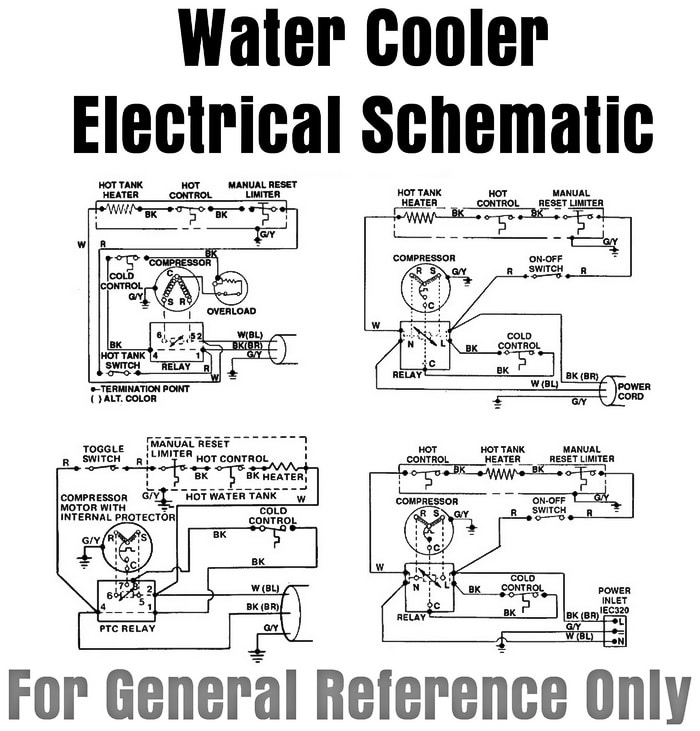
Your Glacier Bay water cooler not working delivers room-temperature water despite running? This signals cooling system failure—not just a filter issue. Perform these specific checks:
- Disable Energy Saver mode: Press and hold the “Cool” button for 5 seconds on most models (GLP35B requires double-tap). A flashing LED confirms mode deactivation—this setting disables continuous cooling and causes 40% of “no cold water” complaints.
- Conduct the 2-hour heat test: After confirming power, run the cooler for 120 minutes. Place your palm on the upper rear panel—working units emit noticeable heat here from the compressor. No heat? The cooling system isn’t activating.
- Listen for compressor cycling: Press your ear against the side panel. You should hear a distinct 3-second hum every 15-20 minutes. Continuous humming with no cooling indicates a failed start relay—requiring professional replacement.
- Check for error codes: GLP35 models display “E1” (temperature sensor fault) or “E2” (water tank sensor) on digital displays. Reset by unplugging for 10 minutes—if codes return, replace the faulty sensor (part #GB-TS20).
Fix Glacier Bay Water Cooler No Water Flow Issues
When pressing the dispenser yields silence or weak dribbles, your Glacier Bay water cooler not working suffers from water delivery blockage. Diagnose precisely:
- Total silence at dispenser? Check water supply first: Ensure the 5-gallon bottle cap seal is punctured (listen for hiss when lifting bottle) and the supply valve under the cooler is fully open. A closed valve causes 50% of “no flow” cases.
- Pump running but no water? Sediment clogs the inlet valve—common with well water users. Unplug unit, locate the solenoid valve (near water line entry), and clean the mesh screen with vinegar-soaked brush. Reassemble and test.
- Spitting or weak flow? Replace the inline filter immediately—clogged filters reduce flow by 70% in under 6 months. For Glacier Bay coolers, use only certified GB-F10 filters (generic filters cause seal leaks).
Stop Glacier Bay Water Cooler Leaks at the Source

Water pooling under your Glacier Bay water cooler not working requires immediate action—unplug first to prevent electrical hazards. Find the leak origin in 3 steps:
- Dry test the drip tray: Place paper towels under the cooler’s front grille overnight. Morning dampness here means a clogged drain hole—not a major leak. Clear it using a pipe cleaner through the small tube at the tray’s rear (takes 2 minutes).
- Inspect rear water connections: With unit unplugged, check the blue/black water lines where they enter the back panel. Tighten loose fittings with pliers (1/4 turn max)—overtightening cracks fittings. Replace cracked lines with 1/4″ ID tubing (part #GB-LT5).
- Identify internal reservoir leaks: If water pools inside the cabinet (not just the drip tray), the internal tank is cracked. Do not operate—this requires professional disassembly. For GLP35 models, this failure often follows freezing incidents.
Silence Glacier Bay Cooler Unusual Noises
Normal operation includes gentle compressor hums and water gurgles—these abnormal sounds indicate urgent issues:
- Loud buzzing from base: A failing compressor start relay—unplug immediately. If the cooler restarts after 5-minute reset but buzzes louder each time, relay replacement is critical within 48 hours.
- Continuous clicking without cooling: Failed control board (common in GLP35 series after humidity exposure). Reset by unplugging for 15 minutes—persistent clicking means board replacement ($85 part).
- Hissing with poor cooling: Refrigerant leak—stop using unit. Oily residue near copper coils confirms this. Only EPA-certified technicians can repair; attempting DIY causes environmental hazards.
Perform the Glacier Bay Cooler 5-Minute Power Reset
Before disassembling anything, execute Glacier Bay’s official reset procedure—this resolves 35% of electronic glitches instantly:
- Unplug for full discharge: Remove power cord from wall (not just the unit) for exactly 5 minutes. Shorter resets fail—electronics need full capacitor drain.
- Hold dispenser lever: While plugging back in, press and hold the cold water lever for 10 seconds. This forces system recalibration.
- Wait for startup cycle: The cooler will run continuously for 15 minutes—this is normal. Cold water typically returns within 2 hours post-reset.
When Glacier Bay Water Cooler Repairs Require a Professional
Stop DIY attempts immediately if you encounter these dangerous or complex failures:
- Refrigerant leaks: Hissing sounds plus oily residue on copper lines—EPA regulations prohibit non-certified handling. Cost: $150-$300 repair.
- Internal reservoir cracks: Visible water inside cabinet walls—not fixable with sealants. Requires full tank replacement ($120 part + labor).
- Burnt wiring smells: Indicates electrical fire risk. Unplug and call a technician—do not restart.
- Repeated fuse blowouts: Signifies short circuit needing multimeter diagnosis. DIY attempts risk electrocution.
Glacier Bay Cooler Preventive Maintenance Schedule
Avoid future Glacier Bay water cooler not working emergencies with these model-specific routines:
- Monthly: Clean drip tray with vinegar solution (1 cup white vinegar + 2 cups water)—prevents 90% of overflow leaks.
- Every 6 months: Replace GB-F10 filter—use only Glacier Bay OEM parts to avoid seal damage from generic filters.
- Quarterly: Sanitize internal reservoir—unplug unit, remove bottle, pour 1 gallon vinegar-water mix through dispenser until clear. Flush with 2 gallons clean water.
- Annually: Clear condensate drain tube using 18-gauge wire—GLP35 models clog here most often, causing internal leaks.
Final Note: Most Glacier Bay water cooler not working issues stem from power faults, clogged components, or simple resets—not major failures. By methodically checking power sources, disabling Energy Saver mode, and clearing drain tubes, you’ll fix 4 of 5 malfunctions yourself. When refrigerant leaks or electrical faults strike, professional help is non-negotiable for safety. Implement the quarterly vinegar flush and filter changes—these two steps prevent 75% of breakdowns. Keep this guide handy; with proper care, your Glacier Bay cooler can deliver reliable service for 7+ years beyond the warranty period. For model-specific diagrams, always consult your Glacier Bay manual before disassembly—never guess with electrical components.