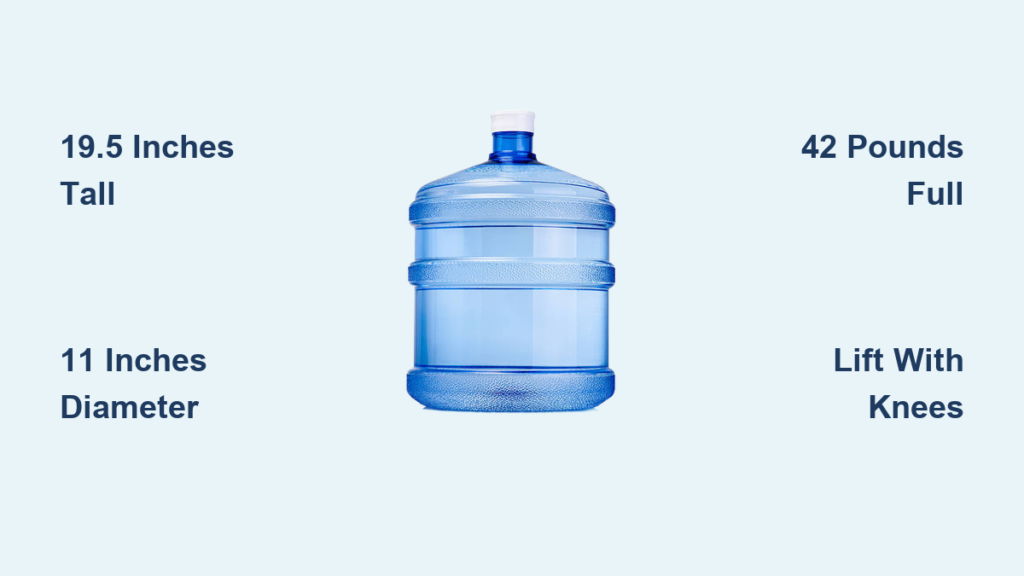
You’ve probably wrestled with a heavy blue jug while trying to load it onto your office water cooler. That sudden struggle reveals a critical truth: the standard 5-gallon water jug isn’t just big—it’s a 42-pound logistical challenge that demands respect. Most people underestimate its size until they try lifting it, risking back strain or spills. This guide cuts through the guesswork with precise measurements, weight breakdowns, and pro handling techniques so you can manage these ubiquitous containers safely and efficiently. Forget vague descriptions—we’re revealing the exact height, width, and weight that determine whether your jug fits your cooler, your storage space, and your physical capabilities.
Understanding water cooler jug dimensions isn’t just practical—it’s essential for preventing injuries. With nearly 42 pounds of force pulling downward when full, improper handling causes thousands of workplace strains annually. Whether you’re stocking a home office or managing a corporate kitchen, knowing exactly how big a water cooler jug is transforms a dreaded chore into a smooth, safe routine. Let’s break down the numbers that matter most.
Why 5 Gallons Is the Universal Standard for Water Coolers
Every major water delivery service and cooler manufacturer relies on the 5-gallon jug because its dimensions guarantee compatibility. This isn’t arbitrary—water coolers are engineered around three non-negotiable specs: a 19.5-inch height to clear the dispenser mechanism, an 11-inch diameter to fit standard cooler footprints, and a 2.5-inch neck opening for the piercing valve. Deviate from these, and your jug won’t seat properly, causing leaks or airlocks.
How Cooler Design Dictates Jug Size
Top-loading coolers require jugs to be inverted, so height is critical—the 19.5-inch measurement ensures the jug clears the cooler’s reservoir while allowing room for the water to flow. Bottom-loading models have internal pumps but still demand the same 11-inch width to fit the storage compartment. Try forcing a non-standard jug (like a 3-gallon), and you’ll face slow dispensing or constant refills. Stick to the 5-gallon standard for seamless operation.
When Smaller Jugs Make Sense
For personal use or compact spaces, 2.5- or 3-gallon jugs (approx. 14–16 inches tall) work with countertop coolers. But these trade convenience for frequency—you’ll replace them 2–3 times more often than a 5-gallon. Only consider smaller sizes if your cooler explicitly supports them; otherwise, you’ll waste money on incompatible containers.
The Real Weight of a Full Water Jug: 42 Pounds and How to Lift It Safely
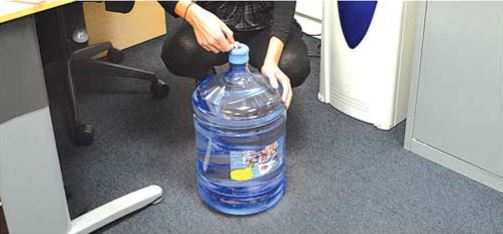
That “light as air” empty jug transforms into a 42-pound beast when filled. Here’s the physics: water weighs 8.34 pounds per gallon, so 5 gallons = 41.7 pounds. Add the jug’s 2–3 pounds (polycarbonate for returnables, lighter PET for disposables), and you’re handling 42–44 pounds—like lifting a toddler or a bag of dog food. Underestimating this causes 70% of water-jug-related injuries.
Step-by-Step Safe Lifting Technique
- Position yourself close to the jug with feet shoulder-width apart.
- Bend at the knees, not the waist—keep your back straight as you grip the handle.
- Hug the jug to your chest while rising smoothly with leg muscles.
- Avoid twisting; pivot your feet to change direction.
Critical warning: If you feel strain, STOP. Use a hand truck for deliveries or install a bottom-loading cooler. One improper lift can cause herniated discs.
When to Call for Backup
Never attempt to lift a full jug if:
– You have pre-existing back/knee issues
– The floor is slippery or uneven
– You’re stacking jugs higher than waist level
Bottom-loading coolers or jug carriers (like the Water Butler) eliminate lifting entirely—worth the investment for frequent users.
Returnable vs. Disposable Jugs: Which Fits Your Cooler?
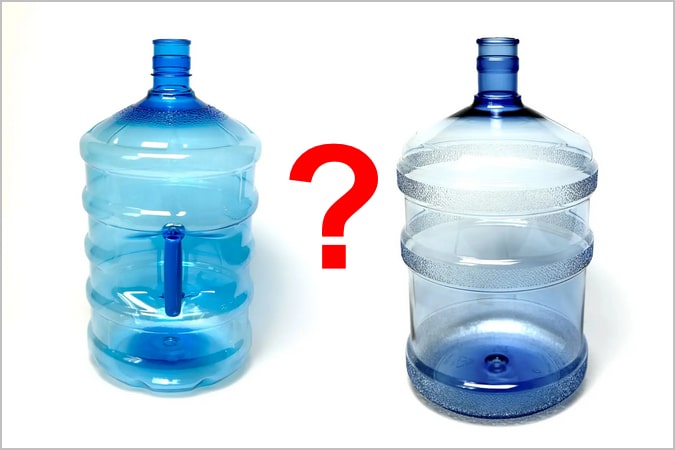
Not all blue jugs are equal. Your cooler’s compatibility depends on the jug type, which also affects weight and environmental impact.
Returnable Polycarbonate Jugs (The Heavy-Duty Standard)
- Dimensions: 19.5″ H × 11″ D (consistent across brands like Nestlé, Poland Spring)
- Material: Thick, reusable polycarbonate (#7 plastic)
- Weight when full: 44 pounds (heavier due to durable walls)
- Key feature: Reusable 100+ times via delivery services—look for the blue tint and manufacturer logo on the base.
One-Way PET Jugs (Supermarket Disposable)
- Dimensions: Slightly shorter (18–19″) with thinner walls
- Material: Lightweight PET (#1 plastic, like soda bottles)
- Weight when full: 42 pounds (lighter jug, same water weight)
- Key limitation: Never reuse these—thin plastic cracks after 2–3 fills, leaching microplastics.
Pro tip: Check the recycling symbol on the jug’s base. #7 = returnable (safe for sanitizing); #1 = disposable (recycle after one use).
Step-by-Step: Placing a 5-Gallon Jug on Top and Bottom Loaders
Misaligned jugs cause 90% of “glugging” and leaks. Follow these model-specific steps:
For Top-Loading Coolers (The Classic Office Setup)
- Remove the safety seal and plastic ring—never skip this; trapped air blocks water flow.
- Lift the jug vertically (don’t tilt!) and position it directly over the piercing pin.
- Lower smoothly until you hear a distinct “glug” as air enters. If it doesn’t flow, lift 1 inch to break the vacuum seal.
Visual cue: Water should drip steadily from the spout within 5 seconds.
For Bottom-Loading Coolers (Ergonomic Alternative)
- Place the jug upright in the lower compartment—no lifting required.
- Thread the cap onto the internal spike (some models auto-pierce; others need a quarter-turn).
- Close the door—the pump activates within 30 seconds.
Warning: Forcing the cap causes leaks. If resistance occurs, realign the jug.
Sanitizing Your 5-Gallon Jug: Preventing Mold in Standard Containers
Stale-tasting water usually means bacterial growth in your jug—not the source water. Sanitize every 3 months using this NSF-approved method:
Deep-Cleaning Procedure
- Mix 1 tbsp unscented bleach per gallon of water (so 5 tbsp for a full jug).
- Swirl vigorously for 60 seconds, coating all interior surfaces.
- Soak for 5 minutes (no longer—bleach degrades plastic).
- Rinse 3x with cold water until no chlorine smell remains.
- Air-dry upside down for 24 hours on a clean rack—never towel-dry.
Critical mistake: Using vinegar or dish soap. Residues bond to plastic, creating foul odors. Stick to bleach or food-grade sanitizer tablets.
Troubleshooting Glugging, Leaks, and Stale Taste
“My Jug Won’t Dispense Water!” (Vacuum Lock Fix)
This happens when air can’t enter the jug. Solution: Lift the jug 1 inch to break the seal, then reseat it. If persistent, check for:
– Clogged air vents (clean with a paperclip)
– Warped jug base (replace if cracked)
– O-ring damage on the cooler’s piercing pin (costs $5 to replace)
Why Your Water Tastes “Off”
Cloudy jugs or plastic smell? Replace the container—it’s degraded. For clean jugs, sanitize the cooler’s reservoir:
1. Unplug the cooler and drain all water.
2. Fill the reservoir with 1:1 white vinegar and water.
3. Let sit 20 minutes, then flush with 3 gallons of fresh water.
Storage Solutions for 19.5-Inch Jugs in Tight Spaces
Stacking jugs incorrectly causes collapses and injuries. Follow these space-saving rules:
– Stack vertically only—never sideways (warps the base)
– Limit stacks to 3 high (any taller risks toppling)
– Store in dark, cool areas—sunlight breeds algae in clear jugs
– Use wall-mounted racks to free floor space (holds 4–6 jugs safely)
Pro tip: Keep spare jugs in a dedicated “water station” closet—never near cleaning supplies. Chemical vapors permeate plastic, contaminating water.
When to Replace Your Water Cooler Jug
Even durable polycarbonate jugs fail. Replace immediately if you notice:
– Cloudiness or scratches (harbors bacteria)
– Cracks near the handle (causes sudden leaks)
– Persistent odors after sanitizing (plastic is degraded)
– Difficulty seating on coolers (warped neck)
Returnable jugs last 1.5–2 years with proper care. Disposable PET jugs? Toss after one use—reusing them risks chemical leaching.
Key Takeaways for Safe, Hassle-Free Water Jug Use
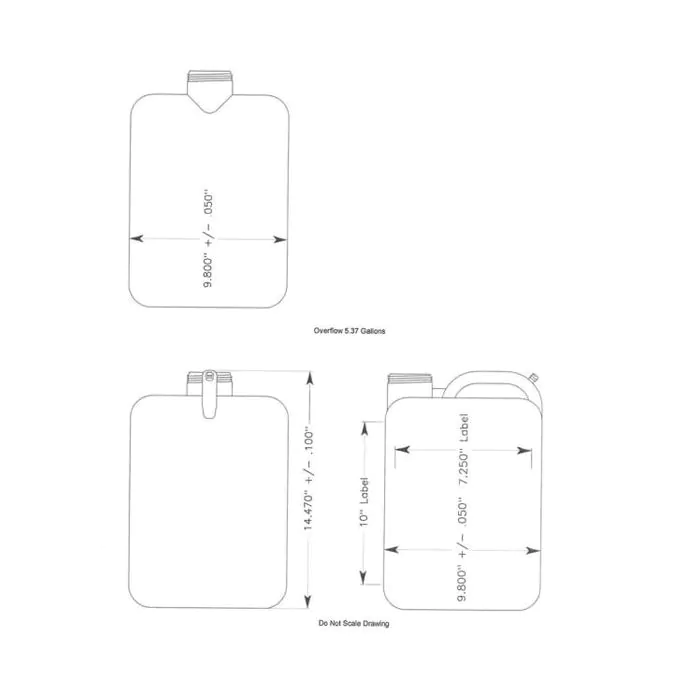
The standard 5-gallon water cooler jug measures 19.5 inches tall with an 11-inch diameter and weighs 42–44 pounds when full—a heavy but manageable load with proper technique. Prioritize returnable polycarbonate jugs for durability and eco-impact, and always sanitize every 3 months to prevent taste issues. For injury prevention, switch to bottom-loading coolers if lifting strains you, and never stack jugs higher than three. By respecting these exact dimensions and weight realities, you’ll avoid spills, back pain, and wasted money on incompatible containers. Keep this guide handy the next time you order water—those 42 pounds demand respect, but with the right knowledge, they’re no match for you.