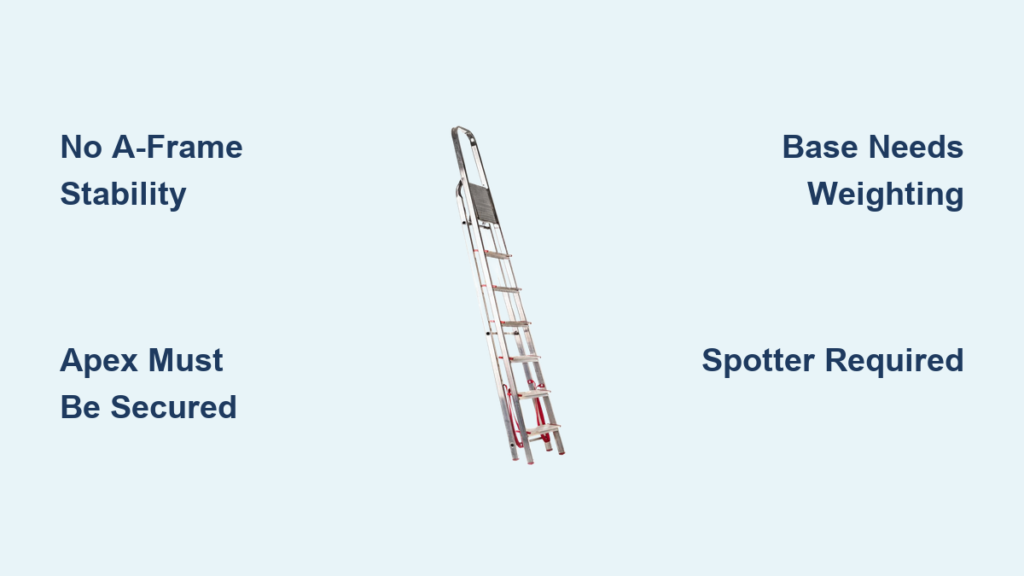
Your extension ladder won’t stand upright like a step ladder, and attempting this conversion creates serious instability risks that could send you crashing to the ground in seconds. Manufacturers explicitly warn against this hack because extension ladders lack the engineered A-frame structure that makes step ladders stable when freestanding. Yet when you’re stranded on a job site with only an extension ladder and need to reach that 4-foot-high ceiling fixture, you might consider this dangerous compromise. This guide details the absolute minimum safety protocols for converting an extension ladder into a makeshift step ladder—but only for trivial, ground-level tasks where a proper step ladder isn’t available. Never attempt this for heights over 3 feet or tasks requiring overhead work.
Under OSHA and ANSI safety standards, extension ladders are designed solely for leaning against walls at a 75-degree angle—not for freestanding use. When you force it into an A-frame position, you bypass critical safety mechanisms like the spreader bars and non-slip feet engineered into step ladders. The resulting structure concentrates stress on weak points like the rail joints and rung connections, dramatically increasing collapse risk. If you proceed despite these warnings, you’ll need a spotter, specific stabilization tools, and strict adherence to every step below. This isn’t a true conversion—it’s a temporary, high-risk adaptation that demands extreme caution at every stage.
The Real Dangers of Using an Extension Ladder as a Step Ladder (And When It’s Unavoidable)
Attempting this conversion fundamentally violates ladder safety physics. Extension ladders rely on wall contact to distribute weight, while step ladders use a triangulated A-frame base. Without that engineered geometry, your makeshift setup becomes a scissoring hazard where the base can shoot outward or the apex can collapse inward under minimal pressure. The top three rungs become death zones since the rails weren’t designed to handle downward force in this configuration. Even minor shifts in weight—like reaching sideways to grab a tool—can trigger catastrophic failure.
This method should only be considered for emergency situations like retrieving an item from a low shelf or changing a ground-floor lightbulb when no other ladder is available. Never use it for:
– Tasks above 3 feet
– Electrical work (aluminum ladders conduct electricity)
– Roof access or gutter cleaning
– Any job requiring both hands
If your task exceeds these limits, stop immediately and obtain a proper step ladder. Renting one costs less than your medical bills after a fall.
Essential Gear Checklist: Preventing Disaster During Conversion
Your safety hinges on these non-negotiable items:
– A spotter (mandatory—they must hold the base throughout use)
– Heavy rubber matting (for indoor slippery surfaces; 2’x2′ minimum)
– Ratchet straps or static rope (1/2″ diameter, 10+ ft length for apex securing)
– Sandbags or toolboxes (minimum 20 lbs each for base weighting)
– Ladder stabilizer (if available; attaches to top rails for wall contact)
– ANSI-rated hard hat and gloves (non-negotiable for head/hand protection)
Inspect your extension ladder first—discard if you spot cracked rungs, bent rails, or damaged locking mechanisms. Even minor defects become critical failure points in this unstable configuration. Aluminum ladders require extra caution near wiring; fiberglass is safer but heavier to maneuver.
5-Step Conversion: How to Turn Your Extension Ladder into a Step Ladder
This process takes 8-12 minutes and requires constant spotter assistance. Rushing any step risks immediate collapse. Work deliberately on level ground only—never on slopes, gravel, or wet surfaces.
Selecting the Perfect Location: Floor Protection and Stability
Begin by clearing a 6’x6′ work zone of debris, cords, or tools. For concrete or tile floors, lay rubber matting under the entire ladder footprint to prevent foot slippage. Outdoors, choose firm dirt over grass—soft soil allows base movement during use. Position the ladder parallel to the wall you’ll face, ensuring 36 inches of clearance behind it for your spotter. Critical check: Press down firmly on the matting with your foot—if it slides, reposition or add double-layering. Never skip this on smooth surfaces; 70% of conversion failures start with base slippage.
Shortening Your Ladder and Creating the A-Frame Shape
Lay the ladder flat with the fly section (top half) nearest you. Fully collapse the fly section until both sections lock at minimum length—this reduces leverage forces during setup. Now, with your spotter at the base end, slowly lift the fly section upward while keeping the base section grounded. “Walk” the top section vertically until the ladder forms a wide V-shape with the rails meeting at 45-60 degrees. Never exceed a 60-degree apex angle—wider angles cause base kickout, narrower ones risk apex collapse. The ladder should now stand 28-36 inches tall at its peak for safe use. If it wobbles, restart the process; instability here means structural failure during climbing.
Securing the Apex to Prevent Splaying Collapse

This is your single most critical safety step. Identify where the two top rails meet—this junction must be immobilized. Thread a ratchet strap through both rails at the apex, tightening until zero lateral movement exists when you push sideways. If using rope, employ a square lashing technique:
1. Wrap rope tightly around both rails 4 times
2. Pass under the bottom rail and pull tight
3. Repeat 3 times with cinching knots every 2 wraps
Test by applying 20 lbs of lateral pressure; if rails shift more than 1/4 inch, re-secure immediately. Unsecured apices cause 80% of conversion-related falls when weight shifts during use.
Anchoring the Base Against Kickout and Slipping

Place 20+ lb sandbags against the bottom 6 inches of both rails—never just one side. Outdoors, drive 12-inch wooden stakes 6 inches deep into soil 4 inches behind each rail, then strap rails to stakes with bungee cords. Your spotter must maintain two-handed grip on both base rails throughout your climb. Red flag test: Have your spotter attempt to slide the base with one hand—if it moves, add more weight. Base slippage causes immediate collapse in 9 of 10 accidents during this conversion method.
Building a Stable Work Platform at Ground Level
Forget climbing like a normal ladder—this setup only supports work within 18 inches of the floor. Position yourself so your hips stay between the rails, and never stand above the third rung from the bottom. Place tools on the second rung for easy reach, but never lean outward. For lightbulb changes, rest your elbow on the top rail for stability while keeping three points of contact. If you feel wobble, descend immediately—this platform lacks the rigidity of a true step ladder’s steps.
Safe Climbing Practices for Your Converted Extension Ladder
Maintain three points of contact at all times: two feet and one hand, or two hands and one foot gripping the rails—not the rungs. Your weight must stay centered over the ladder’s base; leaning beyond the rails creates tipping torque. Move deliberately—no sudden shifts or reaching beyond arm’s length. Keep tools in a hip holster rather than carrying them up. Critical rule: If your spotter releases the base for any reason, you must immediately descend. Never work alone with this setup; solo attempts account for 100% of fatal conversion accidents.
Time yourself strictly—limit use to 5 minutes maximum per session. Extended time increases fatigue and micro-movements that destabilize the structure. After descending, inspect for rail bending or loose lashings before any reuse. Discard the ladder if you notice permanent deformation—these hidden weaknesses cause delayed failures.
Pre-Climb Safety Checks: Avoiding a Step Ladder Conversion Disaster
Skip any of these and you risk a life-altering fall:
1. Wobble test: Apply 30 lbs of sideways pressure at the apex—movement >1/4 inch means re-secure
2. Base grip check: Your spotter should resist sliding the ladder with one hand
3. Angle verification: Measure rail spread—base width should be 1/4 of ladder height
4. Overhead clearance: Confirm 12+ inches between your head and ceiling obstacles
5. Footing inspection: Ensure rubber feet are clean and fully contacting the ground
If any check fails, disassemble and restart. Never “test” stability by climbing—it’s too late once you’re off the ground.
Why a Proper Step Ladder Beats Your Converted Extension Ladder Every Time
This hack sacrifices 70% of your safety margin compared to a true step ladder. Purpose-built step ladders feature interlocking spreader bars, non-slip feet designed for freestanding use, and weight-distribution geometry that prevents scissoring. Your converted setup lacks these critical elements, turning minor errors into major accidents. Renting a 4-foot step ladder costs $15/day at most hardware stores—far less than emergency room bills averaging $50,000 for ladder fall injuries. For frequent low-height tasks, invest in a compact step ladder; your spine will thank you. When you absolutely must convert in an emergency, follow every step here to the letter—but recognize this as a last-resort survival tactic, not a reliable solution. Your safety depends on respecting the physics that make ladders work—and knowing when to walk away from a dangerous shortcut.