You’re watching the Iditarod on TV—the snow flies, the crowd roars, and a team of lean dogs rockets across the finish line. But have you ever paused to wonder: how much do sled dogs weigh? That exact number isn’t random—it’s a precision-tuned balance of speed, endurance, and survival. For Alaskan Huskies powering 1,000-mile races, every ounce matters. Too heavy, and they overheat; too light, and they lack energy reserves. This guide cuts through the confusion with exact weight ranges for every major breed, explains why 35-65 lbs dominates competitive racing, and reveals how top mushers maintain the elusive “fighting weight” that keeps dogs healthy and fast.
Sled dogs aren’t pets—they’re elite canine athletes engineered for extreme conditions. Their weight directly impacts how efficiently they convert calories into forward motion across frozen trails. While casual observers might assume all sled dogs are massive, the reality is counterintuitive: the fastest racers often weigh less than your average Labrador. Understanding these nuances helps explain why certain breeds dominate specific races and how improper weight management can sideline even the strongest dog.
Alaskan Husky Weight: Why 35-60 lbs Dominates Competitive Racing
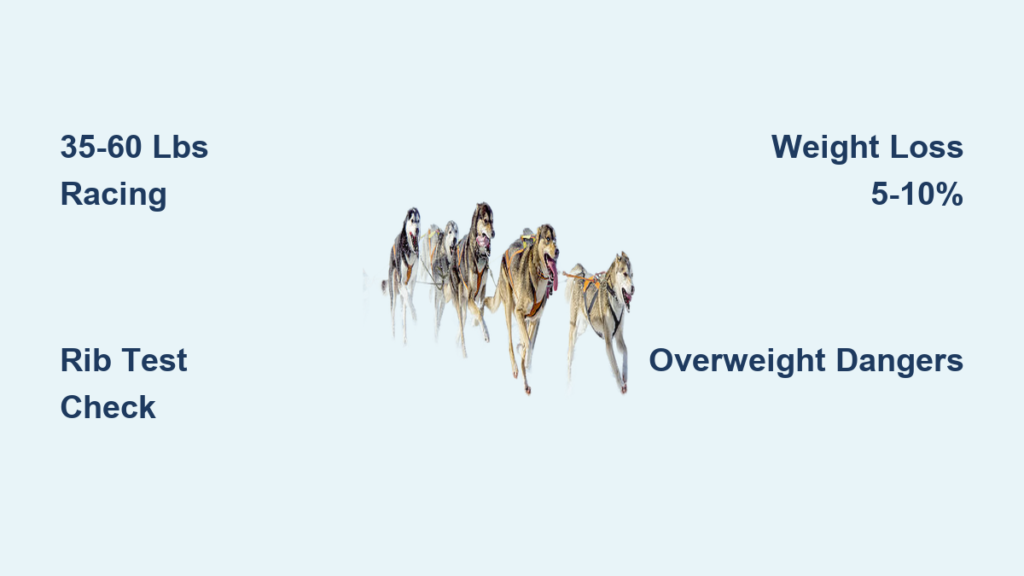
The Alaskan Husky isn’t a purebred—it’s a performance-bred “type” honed for speed and efficiency. These dogs typically weigh 35-60 lbs (16-27 kg), with sprint racers clustering at the lower end (40-45 lbs) and long-distance specialists at 50-60 lbs. Their lean, long-limbed build maximizes power-to-weight ratio, like a marathon runner’s physique. Unlike show-bred dogs, Alaskan Huskies prioritize function over form: visible rib tuck, minimal fat cover, and deep chests for oxygen intake.
How Weight Affects Sprint vs. Distance Performance
- Sprint Racing (Under 30 Miles): Dogs under 45 lbs accelerate faster and maneuver icy turns with less drag. A 40-lb dog burns 15% fewer calories per mile than a 50-lb counterpart at high speeds.
- Mid-Distance (100-300 Miles): Ideal weight jumps to 45-55 lbs—enough muscle for sustained effort but light enough to avoid overheating.
- Long-Distance (Iditarod/Yukon Quest): Top teams use 50-60 lb dogs. They carry slightly more fat for insulation during sub-zero nights but stay lean to conserve energy over 1,000+ miles.
Mushers constantly adjust weights seasonally. During summer training, dogs may hit 65 lbs building muscle, then shed down to 48-52 lbs by race day. The scale alone is useless—palpating ribs for a thin fat layer (the “rib test”) confirms healthy leanness.
Siberian Husky vs. Alaskan Malamute: Why Breeds Dictate Weight
:max_bytes(150000):strip_icc()/alaskan-malamute-vs-siberian-husky-infographic-03f173975a294b8c9d851d44f26c959b.png)
Confusing Siberian Huskies with Alaskan Malamutes is common—but their weight differences reveal their distinct roles. Siberian Huskies, bred for endurance, weigh 35-60 lbs (16-27 kg) with males averaging 45-60 lbs. Their compact frames and thick coats suit steady 25-30 mph runs but limit top speed. Alaskan Malamutes, the freight haulers, weigh 75-95 lbs (34-43 kg)—nearly double the Siberian. Their massive bone structure and muscle mass move heavy sleds at 5-10 mph over rough terrain.
Critical Mistake: Using Malamutes for Speed Racing
Malamutes’ weight becomes a liability in sprint races. A 90-lb Malamute requires 40% more calories than a 50-lb Alaskan Husky to cover the same distance at 20 mph. Their dense fur also traps heat, risking overheating in races above 20°F. In the 2022 Knik 200 sprint race, teams mixing Malamutes with Huskies dropped out 3x faster due to exhaustion—proof that breed-specific weight ranges aren’t arbitrary.
Why Wheel Dogs Must Weigh 75+ lbs for Heavy Hauling

Position in the sled team directly correlates with weight requirements. Wheel dogs—the pair closest to the sled—bear the brunt of shock absorption and initial “breakout” force when starting. They need 75+ lbs (34+ kg) of muscle mass to handle this stress, which is why Malamutes or large Canadian Eskimo Dogs (66-88 lbs) excel here. Smaller dogs in wheel position risk shoulder injuries from the sled’s sudden lurch.
How to Identify an Overloaded Wheel Dog
- Visual Cue: A dog straining with its head down and back hunched instead of driving from the hindquarters.
- Sound Clue: Excessive panting within the first mile, indicating unsustainable effort.
- Recovery Failure: Takes >24 hours to regain energy after a 20-mile run (healthy dogs rebound in 12 hours).
Mushers rotate dogs weekly to prevent chronic strain. If a 60-lb dog shows these signs in wheel position, they’re moved to swing team roles where 50-65 lbs is optimal.
Fixing Underweight Sled Dogs: High-Calorie Diet Hacks
An underweight sled dog lacks fat reserves for insulation and energy during races. Common causes include parasites, dental issues, or “hard keeper” genetics. The fix isn’t just more food—it’s strategic calorie density. Top mushers use these proven methods:
- Add 20% Rendered Fat: Mixing 1 cup of beef tallow into kibble boosts calories by 1,800 without increasing volume (dogs won’t eat larger portions).
- Frozen Fish Blocks: Thawed salmon or herring provides omega-3s for coat health while adding 400+ calories per 4 oz serving.
- Pre-Race Carb Loading: Sweet potatoes or oats 48 hours pre-race build glycogen stores without digestive upset.
Critical Warning: Never force-feed underweight dogs. A 2021 Iditarod incident saw a dog collapse after being fed 12,000 calories in 4 hours—stick to gradual increases of 500 calories/day.
Avoiding Obesity: Joint Stress and Overheating Dangers
Overweight sled dogs face silent threats. Every extra 5 lbs increases knee joint stress by 25% during high-speed turns, accelerating arthritis. Worse, fat insulation traps heat—obese dogs overheat at temperatures where lean dogs thrive. In a 2020 study, dogs at 10% over ideal weight slowed by 1.2 mph in 25°F conditions due to thermoregulation failure.
The 3-Step Overweight Intervention
- Verify with Body Condition Score (BCS): Run hands along the spine. If you can’t feel individual vertebrae under a thin fat layer, the dog is overweight.
- Cut Fillers, Not Protein: Replace 50% of kibble with lean meat (chicken, venison) to maintain muscle while reducing carbs.
- Add Hill Intervals: 10-minute uphill sprints burn fat faster than flat-ground running with less joint impact.
Pro Tip: Sled dogs should have a visible waistline when viewed from above—like an hourglass shape. No waist? Start the intervention.
How Mushers Determine Race Weight: The Rib Test Explained
The “fighting weight” isn’t on a scale—it’s felt with the hands. Mushers use the rib test daily: place flat palms on the dog’s ribcage. You should easily feel ribs (like knuckles on a closed fist) with no visible protrusion but a slight fat cushion. This indicates 15-18% body fat—the sweet spot for energy storage without drag.
Why Scales Lie During Race Season
In long races like the Iditarod, dogs lose 5-10% body weight despite eating 10,000+ calories/day. This is mostly water and glycogen depletion, not fat loss. Weighing mid-race causes dangerous stress. Instead, mushers check:
– Hydration: Pinch the scruff—if it snaps back slowly, the dog needs electrolytes.
– Energy Levels: A dog refusing high-fat snacks (like frozen butter balls) is hitting calorie deficit.
– Gait Analysis: Shortened stride indicates fatigue from weight loss.
Post-race, dogs regain weight in 7-10 days with 5,000-calorie recovery meals.
Iditarod Weight Loss: Why Dogs Drop 5-10% During the Race

During the Iditarod’s grueling 1,000 miles, even perfectly conditioned dogs shed 5-10% body weight. This isn’t starvation—it’s physics. At -20°F, maintaining core temperature burns 30% more calories than running in milder conditions. Dogs burn through fat reserves first, then tap muscle glycogen. The weight loss stabilizes around day 5 as metabolism adapts.
Recovery Protocol: The 72-Hour Critical Window
- Hour 0-24: Warm broth with electrolytes to rehydrate without shocking the system.
- Hour 24-48: High-fat meals (55% fat content) to rebuild insulation layers.
- Hour 48-72: Light walking to stimulate appetite; forced rest causes bloat.
Dogs losing >12% weight are disqualified. In 2023, 8 teams withdrew due to excessive weight loss—all had skipped pre-race fat-loading.
Sled Dog Weight Statistics: What the Numbers Reveal
Collective team weight determines sled design and race strategy:
– A 12-dog sprint team (500-600 lbs total) uses 40-50 lb dogs for explosive starts.
– A 16-dog Iditarod team (800-1,000 lbs) relies on 50-60 lb dogs for endurance.
– Critical Insight: The fastest teams average 48-52 lbs per dog—proving speed requires leanness, not bulk.
The data confirms that the ideal sled dog isn’t the biggest, but the fittest within its breed’s range. Malamutes hauling 1,000 lbs of cargo need 85+ lbs, while Alaskan Huskies racing 30 mph thrive at 45 lbs.
Final Note: Your sled dog’s perfect weight hinges on breed, role, and race length—not a universal number. Monitor with the rib test, not just scales, and adjust nutrition seasonally. For sprint dogs, prioritize 40-45 lbs; for long-distance, 50-60 lbs. Never force weight loss—health trumps speed. If your dog struggles to maintain weight, consult a canine sports nutritionist before race season. Remember: a dog at fighting weight doesn’t just run fast—it runs happy, with bright eyes and eager tail wags at the harness. That’s the true mark of peak condition.