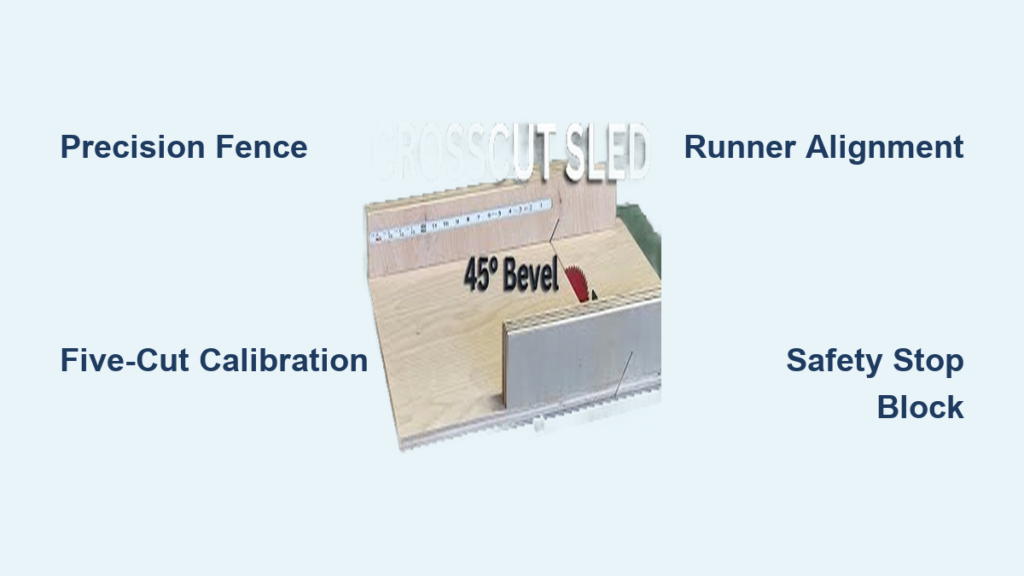
Struggling with gaps in your picture frames or mitered boxes? You’re not alone. Most woodworkers waste hours trying to achieve flawless 45-degree joints with standard miter gauges, only to end up with visible gaps that ruin the professional look of their projects. The solution? A precision 45-degree table saw sled—a specialized jig that guarantees perfect miter cuts every time. Unlike regular crosscut sleds designed for 90-degree cuts, this custom jig holds your workpiece at the exact 45-degree angle needed for tight-fitting miter joints. In this guide, you’ll learn exactly how to build, calibrate, and use a 45-degree table saw sled that delivers professional results, whether you’re crafting picture frames, shadow boxes, or frame-and-panel assemblies.
Building your own 45-degree table saw sled isn’t just about convenience—it’s about achieving accuracy that factory miter gauges simply can’t match. With proper construction and the five-cut calibration method (the professional’s secret for eliminating errors), your sled will consistently produce joints so precise they’ll eliminate sanding and fitting time. This comprehensive guide covers everything from selecting the right materials to advanced calibration techniques that ensure your miter joints close perfectly without gaps. By the end, you’ll have a reliable tool that transforms your table saw into a precision miter-cutting station.
Selecting the Right Materials for Your 45-Degree Sled Build
Choosing appropriate materials determines whether your sled will deliver years of precision or become a frustrating source of inaccurate cuts. The base must remain perfectly flat despite humidity changes and regular use, while the fence needs to maintain a precise 45-degree angle without shifting during operation.
Critical material specifications:
* Sled Base: ¾” Baltic birch plywood is the gold standard—its stability and resistance to warping outperform regular plywood. MDF works too but requires edge sealing and is heavier. Avoid particleboard at all costs.
* Fence Construction: Use ¾” thick material matching your base for consistency. Hardwood (like maple or oak) provides durability, but stable plywood with a laminate face offers excellent performance for most woodworkers.
* Runners: Hard maple or UHMW plastic strips (¾” x ¾”) ensure smooth, consistent travel in your miter slots. Never use softwoods—they compress and create play over time.
* Fasteners: Flat-head #6 x 1¼” screws with counterbored holes prevent snagging and maintain a smooth underside.
Must-have tools for construction:
* Precision digital angle gauge (0.1° accuracy)
* High-quality combination square or drafting triangle
* Digital calipers for the five-cut calibration method
* Forstner bit for clean counterbores
* Reliable clamping system (minimum four 6″ bar clamps)
Precision Construction Process for Perfect 45-Degree Cuts

Mill and Install Perfectly Fitting Runners
Your sled’s accuracy begins with runner installation—this is where most DIY sleds fail. Start by cutting runner stock slightly oversized (about ¾” x 13/16″). Test fit in your table saw’s miter slots, then hand-plane or sand the runners until they slide with “smooth but no-slop” movement—tight enough to prevent lateral play but loose enough to move without binding. Mark each runner for its specific slot (left and right) since miter slots often vary slightly. Attach runners to the sled base using flat-head screws with counterbored holes, ensuring they’re perfectly parallel. A 0.002″ gap between runners creates optimal movement—test by sliding the assembly across your saw table before final screwing.
Cut and Position Your Critical 45-Degree Fence
The fence angle determines your sled’s entire accuracy—this is where the five-cut method becomes essential. Cut your fence material to 18-24″ long, then use a digital angle gauge to mark a precise 45-degree line from one edge. Cut this angle carefully on your table saw (using your standard miter gauge), then position the fence on the sled base. The critical alignment point: the long point of the 45-degree cut must align perfectly with the saw blade’s rotation axis. Temporarily clamp the fence in position, leaving room for micro-adjustments during calibration. Pro tip: Position the fence so the blade cuts through the fence material about 1″ above the sled base—this prevents tear-out while maintaining stability.
Master the Five-Cut Calibration Method
This professional technique magnifies tiny errors for precise correction. You’ll need a 12″ square test piece with two factory edges at perfect 90°:
- Make your first cut along one factory edge
- Rotate the piece 90° left, placing the freshly cut edge against the fence
- Make the second cut
- Repeat for cuts three and four on the remaining sides
- For the fifth cut, return to the first side and cut a narrow strip
Measure the final strip’s width at both ends with digital calipers. The difference between measurements indicates your error: multiply by 12 and divide by strip length to get error per foot. Tap the fence minutely with a dead-blow hammer (use a block of wood as a buffer) and repeat until both ends measure within 0.001″. This method eliminates cumulative errors that standard square alignment misses.
Add Essential Safety and Precision Features

Never operate your 45-degree sled without these critical components:
- Safety Stop Block: Install a bolt-mounted stop that prevents the sled from passing the blade’s center point—this eliminates kickback risks during miter cuts. Position it so the workpiece clears the blade but the sled body stops short.
- Workpiece Hold-Downs: Add T-track with toggle clamps or cam clamps along the fence. These prevent workpiece movement during cutting—a common cause of inaccurate miters and safety hazards.
- Zero-Clearance Insert: Create a recess in the sled base for a 1/8″ hardboard insert. Raise the blade through it (with power off!) to form a perfect slot that supports delicate materials and prevents tear-out.
Operating Your 45-Degree Sled for Professional Results
Safety Protocols Every Woodworker Must Follow
Miter cuts create unique kickback risks compared to standard crosscuts. Always:
* Clamp workpieces securely—never rely on hand pressure alone
* Keep hands at least 6″ from the blade path
* Verify your safety stop block prevents the sled from traveling past the blade center
* Use a riving knife or splitter with your sled setup
* Check that your hold-downs maintain constant pressure throughout the cut
Critical mistake to avoid: Never cut miters on workpieces shorter than 8″—small pieces easily become kickback projectiles. For smaller pieces, create a dedicated sacrificial fence that extends your holding surface.
Material-Specific Cutting Techniques
Different materials require specific approaches for clean 45-degree cuts:
- Hardwoods: Use a sharp 80-tooth crosscut blade and slow, consistent feed rate. Apply masking tape along the cut line to prevent tear-out on figured woods.
- MDF and Composites: Expect increased dust—maximize your dust collection and wear proper respiratory protection. A zero-clearance insert is mandatory.
- Laminated Materials: Tape the show face along the cut line, then score with a utility knife before cutting to prevent chip-out.
- Thin Stock (under 1/4″): Always use a sacrificial fence—a thin piece of scrap material clamped to your main fence.
Maintenance and Calibration Schedule for Long-Term Accuracy
Your 45-degree sled requires regular attention to maintain precision. Implement this maintenance routine:
Daily:
– Wipe runners and miter slots clean of sawdust
– Apply a light coat of sled-specific wax to runners
– Verify hold-downs function properly
– Check for any loose fasteners
Weekly:
– Perform a quick accuracy check using a precision square
– Inspect zero-clearance inserts for wear
– Clean all T-tracks and hardware
Monthly:
– Complete a full five-cut calibration
– Check runner parallelism with dial indicators
– Replace worn zero-clearance inserts
Pro Tip: Keep a dedicated calibration log noting measurements from each five-cut test. This reveals subtle trends in your sled’s performance before they affect your projects.
Advanced Techniques for Production Work
For woodworkers making multiple picture frames or mitered boxes:
- Install a flip stop system for repeatable cuts—mark your first perfect cut, then create a stop block for identical subsequent pieces
- Add dual zero-clearance inserts: one for standard blades, another for dado stacks when cutting rabbets on frame backs
- Create a dedicated dust collection port that attaches directly to your sled’s cut line
- For production runs, use a sacrificial fence that you replace after every 20-30 cuts to maintain zero-clearance
When building multiple frames, cut all four pieces from one workpiece before moving to the next—this minimizes seasonal movement differences between frame components. Always label mating pieces (A, B, C, D) as you cut them to ensure proper assembly sequence.
A properly built and maintained 45-degree table saw sled transforms frustrating miter joints into precision craftsmanship. By following these detailed construction steps and calibration techniques, you’ll create picture frames with invisible seams and mitered boxes that fit together perfectly on the first try. Remember: the five-cut method isn’t just a calibration technique—it’s your guarantee of accuracy. Commit to regular maintenance, and your sled will deliver professional results for years to come. The next time you face a mitered project, you’ll reach for your custom sled instead of struggling with imprecise alternatives.