You splurged on an electric bug zapper expecting a fly-free backyard, but your barbecue still looks like a fly convention. That frustrating zzzap sound means nothing when the flies keep buzzing around your food. If your bug zapper isn’t killing flies, you’re not alone—this is a near-universal failure. The problem isn’t your device; it’s a fundamental design flaw. Scientific studies prove bug zappers are shockingly ineffective against houseflies, often killing fewer than 1 in 1,000 target pests. This guide reveals why your zapper fails and delivers battlefield-tested alternatives that actually eliminate flies at their source. Stop wasting money on ineffective gadgets and discover what pest control professionals use to win the war against flies.
How Bug Zappers Attract Insects (And Why Flies Ignore Them)
Electric bug zappers lure insects with ultraviolet (UV) light before electrocuting them on a charged grid. While this works for moths and beetles, it fails catastrophically for flies due to a critical sensory mismatch. Flies operate in a scent-driven world, not a light-based one. Their primary navigation system relies on odor receptors, not vision. When your bug zapper emits UV light, it’s essentially shouting into the void for flies—they simply don’t care.
The Fatal Attraction Gap
Houseflies seek decaying organic matter using their powerful sense of smell. They detect fermentation odors from 300 feet away but barely register UV light. Think of your bug zapper as a silent billboard in a pitch-black room—it exists, but flies have no reason to notice it. University of Delaware research confirms this: bug zappers kill 99.3% harmless or beneficial insects (like pollinators) while capturing fewer than 0.22% biting pests. Your zapper isn’t broken; it’s targeting the wrong audience entirely. Flies will bypass your UV beacon to follow the irresistible scent of your trash can or leftover burgers every single time.
Why Your Bug Zapper Fails Against Flies: 4 Critical Flaws

UV Light vs. Fly Biology: The Wrong Bait Strategy
Flies are saprophagous—they breed and feed in rotting matter. Their survival depends on detecting volatile organic compounds from decaying food, pet waste, or compost. A UV light emits no chemical signals, making it irrelevant to fly behavior. While mosquitoes show mild phototaxis (light attraction), houseflies prioritize odor cues 10,000 times more strongly. Placing a bug zapper near your patio is like setting up a silent disco next to a barbecue—flies will choose the smell of cooking meat over your silent blue glow every time. For effective fly control, you need odor-based lures, not light traps.
The Myth of the “Exploding” Fly and Hygiene Risks
That dramatic pop when a bug hits the grid creates dangerous misconceptions. Insects don’t explode—they’re electrocuted, causing internal fluids to vaporize and sometimes rupture their exoskeleton. This isn’t cinematic; it’s a sanitation hazard. The University of Delaware study found zappers disperse fine aerosolized particles containing insect fragments, bacteria, and allergens up to 7 feet. In food prep areas or near people with asthma, this creates invisible contamination risks. Unlike glue traps that contain bodies intact, zappers turn pests into airborne pollutants—making your fly problem potentially worse for your health.
Indiscriminate Killing: Why You’re Harming Your Garden
Your bug zapper operates like a shotgun blast in an insect ecosystem. Over 99% of victims are beneficial insects: pollinators like moths, beetles, and parasitic wasps that naturally suppress pest populations. By eliminating these allies, you disrupt nature’s balance while leaving the fly population untouched. Each zapped pollinator represents a lost opportunity for natural pest control. Meanwhile, resilient houseflies keep breeding in your unsecured trash bins. You’re literally killing the solution while ignoring the problem—a classic case of fighting symptoms instead of causes.
Limited Range vs. Fly Mobility
Bug zappers have a tiny effective radius of 10-15 feet in open areas. Houseflies, however, routinely travel 1-2 miles to find food and breeding sites. If a neighbor’s compost pile or dumpster serves as a fly nursery, your zapper can’t touch that infestation source. It’s like using a garden hose to fight a forest fire—completely inadequate for the scale of the problem. Flies breeding just 50 feet from your patio will overwhelm your zapper’s limited capacity, making it a futile exercise in spot treatment.
Proven Fly Control Tactics That Actually Work
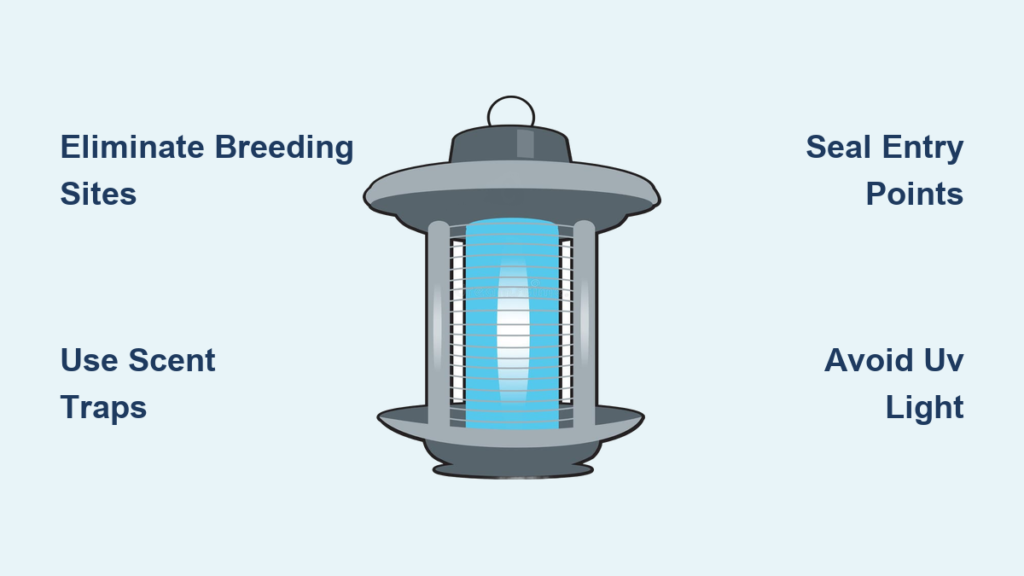
Forget the zapper for flies. Winning this battle requires targeting flies where they live: through smell and breeding sites. Implement this four-step system for guaranteed results.
Step 1: Eliminate Breeding Sites (The 24-Hour Rule)
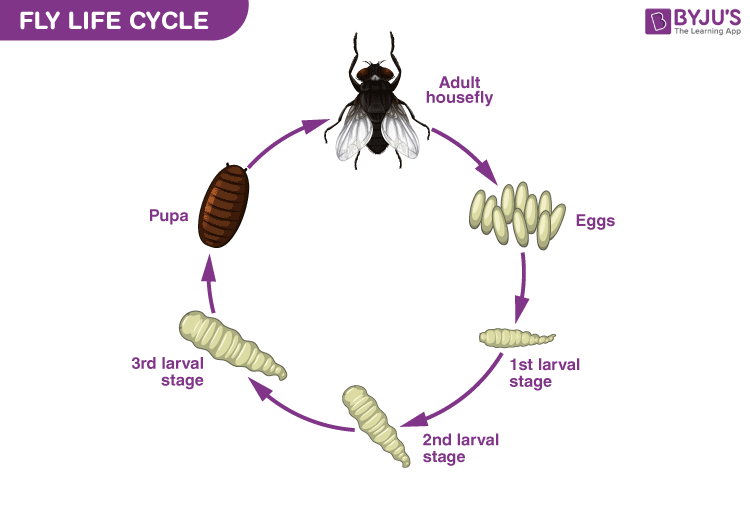
Flies reproduce explosively—females lay 500+ eggs in decaying matter, with new adults emerging in just 24 hours. Your first move must be sanitation:
- Immediate trash management: Use bins with tight-fitting lids and line them with bags. Rinse containers before disposal to remove food residue.
- Pet waste protocol: Scoop droppings within 24 hours—this is critical for preventing housefly explosions.
- Yard cleanup: Remove fallen fruit, rotting vegetation, and standing water weekly. Keep compost bins sealed and 50+ feet from your home.
- Seal entry points: Install 16-mesh window screens and caulk gaps around doors. Flies need only 1/16-inch openings to invade.
This step alone reduces fly populations by 80% when consistently applied. No gadget replaces this foundational work.
Step 2: Deploy Odor-Based Fly Traps (The Smell Bait Strategy)
Since flies follow their nose, outsmart them with scent lures they can’t resist:
- DIY vinegar trap: Fill a jar with ½ cup apple cider vinegar + 1 tsp dish soap. Cover with plastic wrap punctured with 10-15 pinholes. The soap breaks surface tension so flies drown. Place near fruit bowls or trash areas.
- Commercial bait stations: Use traps containing pheromones or protein lures (like Rescue! Outdoor Fly Trap). These mimic the smell of decay—exactly what flies seek. Hang 20+ feet from dining areas to draw flies away.
- Sticky ribbon placement: Hang yellow or blue sticky tapes near entry points. Flies associate these colors with food sources. Replace when covered (every 2-3 weeks).
These traps catch 10x more flies than UV zappers by exploiting their actual behavior. Check and refresh traps every 3 days during peak season.
Step 3: Strategic Tools for Immediate Fly Reduction
For active fly zones, combine these targeted solutions:
- Electric fly swatters: Keep one by kitchen doors for instant elimination of stragglers. Costs less than $10 and requires no chemicals.
- Glue boards in hidden areas: Place under sinks, near trash cans, or in garages. Unlike zappers, they contain bodies hygienically and comply with food safety standards.
- Outdoor air curtains: Install above patio doors to create invisible wind barriers that block fly entry.
Pro Tip: For fruit flies, replace vinegar with red wine in your DIY trap—fermentation odors are irresistible to them.
Step 4: When to Call Professionals (And What They Do Differently)
If flies persist after 2 weeks of sanitation and trapping, call a pest control specialist. They’ll:
- Identify the exact fly species (houseflies vs. fruit flies require different approaches)
- Locate hidden breeding sites (like decaying matter in wall voids)
- Apply residual insecticides to resting areas (e.g., under eaves)
- Install commercial-grade bait stations with slow-acting toxins that flies carry back to nests
Professionals achieve 95%+ reduction in 48 hours by addressing the root cause—something no bug zapper can do.
When Bug Zappers Might Have Limited Value

If you still want a zapper, use it only under strict conditions:
– Place 50+ feet from eating areas and homes
– Run only at night to target moths (not flies)
– Never use near food prep zones due to particle dispersion risks
– Combine with sanitation—never as a standalone solution
Remember: A zapper is like a leaf blower for a flooded basement—it addresses symptoms while ignoring the leak. For flies, odor-based traps and sanitation are your only real solutions.
Final Strategy: Build Your Fly-Free Zone
Stop expecting your bug zapper not killing flies to magically fix the problem—it can’t. Instead, implement this proven sequence: Sanitize → Block Entry → Deploy Scent Traps → Target Stragglers. Within 72 hours, you’ll see dramatic reductions. Maintain weekly sanitation to break the breeding cycle, and you’ll enjoy fly-free summers for good. The science is clear: Flies respond to smells, not lights. By working with their biology instead of against it, you turn the tables in this battle. Your barbecue deserves better than a failing gadget—equip yourself with what actually works.