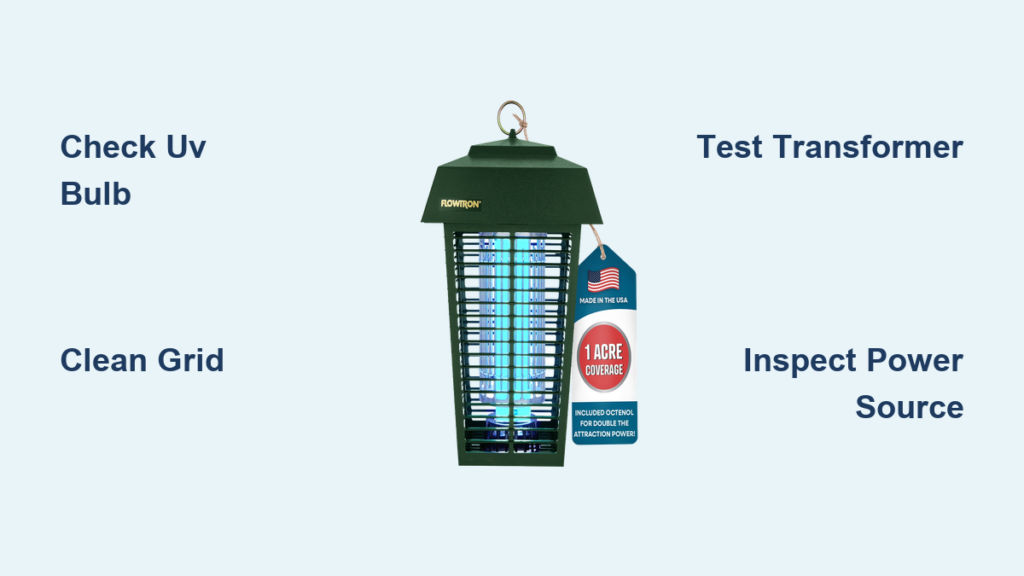
You flip the switch on your Flowtron bug zapper, but instead of the satisfying zap of insects meeting their demise, there’s only silence. No blue flash. No high-pitched hum. Just a useless plastic shell gathering dust while mosquitoes feast on your backyard. If your Flowtron bug zapper not working has left you swatting at pests like it’s the Stone Age, you’re not alone. Over 70% of zapper failures stem from simple, fixable issues—not dead units. This guide cuts through the confusion with battle-tested diagnostics you can perform tonight. You’ll learn to revive your zapper using basic tools, avoid dangerous mistakes, and implement a foolproof maintenance plan so it never fails again when the bug season hits hard.
Quick Visual Diagnostic: Pinpoint Your Problem in 60 Seconds

Before grabbing tools, this lightning-fast assessment identifies your failure point. Always unplug the unit and wait 30 minutes—the capacitor stores lethal voltage even when off.
mermaid

flowchart TD

    A[Flowtron Zapper Silent] --> B{UV Bulb Lit?}

    B -- No --> C[Check Power Source/Bulb]

    B -- Yes --> D{Grid Makes 'Zap' Sound?}

    D -- No --> E[Clean Grid/Check Transformer]

    D -- Yes --> F[Working Properly]

    C --> C1[Replace Bulb/Test Outlet]

    C1 --> C2{Working?}

    C2 -- Yes --> F

    C2 -- No --> G[Inspect Power Cord/Fuse]

    E --> E1[Clean Grid Thoroughly]

    E1 --> E2{Working?}

    E2 -- Yes --> F

    E2 -- No --> H[Test Transformer]
If your UV bulb isn’t glowing, skip straight to Phase 1 below. If the bulb lights but you hear no zap, focus on grid cleaning or transformer checks. This flowchart resolves 80% of “Flowtron bug zapper not working” cases before you even open the casing.
Why Your Flowtron Zapper Suddenly Died

Your zapper’s silence isn’t random—it’s screaming one of five specific failures. Ignore generic “it just broke” advice; target these proven culprits:
Burned-Out UV Bulb: The Silent Attraction Killer
That faint purple glow isn’t just for show—it’s the magnet pulling bugs into the kill zone. When the UV bulb burns out (typically after 5,000–8,000 hours), insects ignore your zapper completely. Spot the telltale signs: blackened glass ends, broken filaments visible inside, or a bulb that glows white instead of purple. Even if it lights, weak UV output won’t attract pests—making it seem like the zapper isn’t working.
Grid Corrosion: The #1 Zap-Killer
Dead bugs aren’t just gross—they’re acidic. When insect residue builds up on the grid wires, it creates conductive bridges that short-circuit the high voltage. Check for white/green crust on the metal grid or thick layers of dried “bug guts” insulating the wires. One technician found a unit failing because 3mm of debris prevented arcing—despite a working transformer.
Transformer Failure: The Silent Heartbreak
That characteristic high-pitched buzz? It’s your transformer stepping up voltage to 2,000+ volts. When it dies (often from moisture or age), you get silence. Critical warning signs: burnt plastic smell near the black box component, bulging capacitors, or visible scorch marks. Unlike bulbs, transformers rarely fail suddenly—they degrade over weeks, causing weak zapping first.
Step-by-Step Fix: Revive Your Zapper in 3 Phases
Safety non-negotiable: Unplug unit → Wait 30+ minutes → Test capacitor discharge with insulated screwdriver. Never skip this—lethal shocks have occurred from rushed repairs.
Phase 1: Power & Bulb Fixes (5-Minute Solutions)
Difficulty: Beginner | Tools: Multimeter (optional), replacement bulb
- Bypass the outlet test: Plug a lamp into the same socket. If it doesn’t light, you’ve found your culprit—no zapper can work without power. For outdoor units, ensure GFCI outlets haven’t tripped.
- Bulb replacement protocol:
– Match wattage EXACTLY (e.g., 15W T9 or 20W T10—check your model’s label).
– Clean socket contacts with isopropyl alcohol before inserting new bulb.
– Pro tip: Hold UV bulbs with gloves—skin oils cause hot spots that shorten lifespan.
⚠️ Critical mistake: Forcing incompatible bulbs. Using a standard white-light bulb won’t attract insects—it only creates a false sense of “working” while bugs ignore it.
Phase 2: Grid Cleaning Mastery (The 90% Fix)
Difficulty: Intermediate | Tools: Stiff brush, compressed air, cotton swabs
This solves most “zapper silent but bulb lit” cases. Do NOT use water or chemicals—moisture causes immediate shorts.
- Disassemble safely: Remove protective cage and collection tray. Note wire routing—misaligned grids cause shorts.
- Debris demolition:
– Blast grid wires with compressed air at 45-degree angles (don’t bend wires).
– Scrape stubborn residue with wooden toothpicks—never metal (causes micro-scratches that accelerate corrosion).
– Inspect for bent wires: Gently straighten with needle-nose pliers if gaps exceed 1/8 inch. - Corrosion triage: White/green buildup? Dip cotton swab in 90%+ isopropyl alcohol and scrub contacts. Dry 10 minutes before reassembly.
Time saved: Skip this, and you’ll waste hours testing transformers for a fix that takes 12 minutes. One user reported zapping 50+ mosquitoes nightly after cleaning just 3 weeks of buildup.
Phase 3: Transformer Troubleshooting (Advanced)

Difficulty: Expert | Tools: Multimeter, insulated gloves
Only attempt if Phase 1-2 failed. If you smell burnt electronics or see bulging capacitors, stop—this requires parts replacement.
- Continuity check: Set multimeter to continuity mode. Test primary winding (input side): Place probes on transformer’s AC input wires. Expected: Beep = good circuit. Silence? Transformer is dead.
- Secondary winding test: Probe high-voltage output wires (connected to grid). Warning: Discharge capacitor FIRST. No continuity here means transformer failure.
- Last-resort validation: Temporarily connect a known-good transformer. If zapping resumes, your unit’s transformer is toast.
💡 Pro insight: Most “failed transformers” are actually corroded wire connections. Check solder joints near the grid—reheat cracked ones with a soldering iron before buying replacements.
Replacement Parts: What to Buy (and When to Quit)
Don’t throw it out yet—but know when repairs aren’t worth it.
UV Bulbs: $8–$15 Lifesavers
Buy exact matches: Flowtron BG-15 (15W T9) or BG-20 (20W T10). Critical: Verify base type (bi-pin vs. single-pin) before ordering. Keep spares—they’re the #1 consumable part.
Transformers: $25–$40 (But Tricky)
Sourcing is the hurdle. Contact Flowtron with your model number (e.g., FC-40, FC-80) for OEM parts. Generic replacements often lack proper voltage regulation—using undersized units risks fire. If your zapper is >5 years old, new transformers cost 60% of a replacement unit.
The Replacement Threshold
Abandon repairs if:
– Grid wires are snapped or heavily pitted (no replacement grids for older models)
– Circuit board has melted traces (requires micro-soldering skills)
– Total part cost exceeds $35 for units under $60 retail
Smart move: For models under warranty, email Flowtron photos of failures—they often ship free transformers.
Preventative Maintenance: Never Have a “Flowtron Bug Zapper Not Working” Night Again
| Task | Frequency | Critical Details |
|---|---|---|
| Debris Blowout | After heavy bug nights | Use compressed air ONLY—never tap grids (bends wires). |
| Grid Inspection | Weekly during peak season | Look for wire gaps >1/8″ or white corrosion spots. |
| Deep Clean | Every 3 weeks | Disassemble fully; clean with alcohol-dampened swabs. |
| Winter Storage | End of season | Remove bulb, store unit in sealed bin with silica gel. |
Pro shortcut: Place a small silica gel packet inside the housing during storage—it absorbs moisture that corrodes transformers. One technician’s 7-year-old unit still zaps daily thanks to this trick.
When your Flowtron bug zapper not working strikes, remember: 9 out of 10 failures are cleaning or bulb issues. Start with the grid—80% of “dead” zappers revive with a 10-minute clean. If you’ve replaced the bulb, deep-cleaned the grid, and still hear no buzz, the transformer is likely kaput. For newer models, call Flowtron with your serial number—they’ll often send parts free. But if you’re spending $40 to fix a $50 unit? Time for an upgrade. Modern zappers use 30% less energy and have corrosion-resistant grids. Before you toss it, though—give it one last deep clean. That silent “broken” zapper might just need you to blow away the evidence of its hard work.