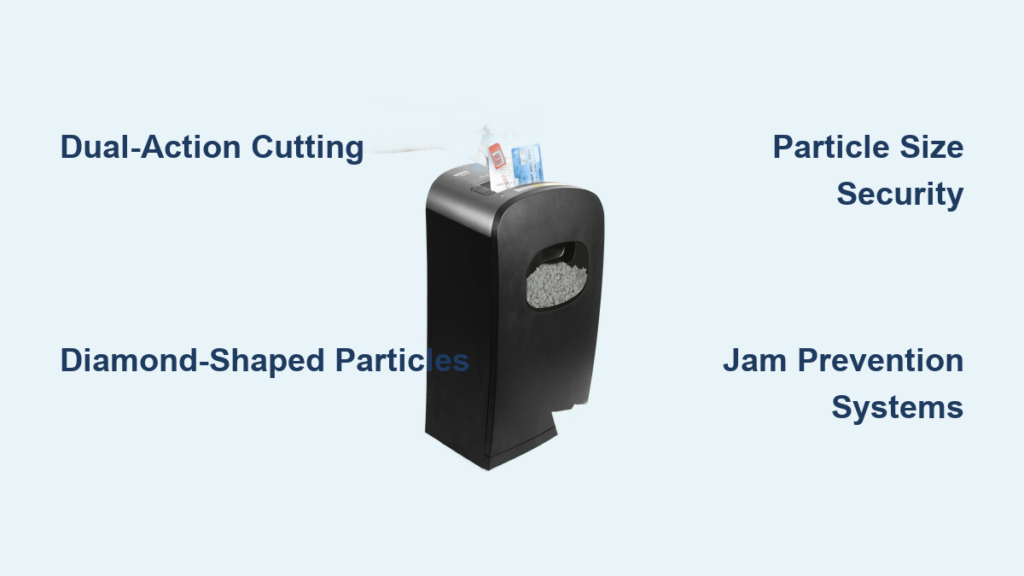
You’ve fed an important document into your shredder, pressed the button, and watched as it disappears—only to find perfectly sized confetti-like particles moments later. But how does a cross-cut paper shredder work to transform sensitive information into thousands of tiny, unreconstructable pieces? Unlike basic strip-cut models that create easily reassembled spaghetti-like strips, cross-cut shredders employ a sophisticated dual-action cutting mechanism that provides significantly higher security for your confidential documents. Understanding this process isn’t just technical curiosity—it’s essential for choosing the right security level for your sensitive information and ensuring your shredder operates effectively when you need it most.
When you feed paper into a cross-cut shredder, you’re initiating a precisely engineered destruction sequence that combines mechanical force, strategic blade placement, and timing. This article will pull back the curtain on the hidden mechanics inside your shredder, explaining exactly how rotating cutters interact with stationary blades to create those distinctive diamond-shaped particles. You’ll learn why cross-cut shredding provides superior security compared to other methods, what determines particle size and security levels, and how modern safety features prevent jams while protecting users.
The Paper Entry Process: How Your Document Gets Pulled In
The destruction journey begins the moment you insert paper into the feed slot, commonly called the “throat” of the shredder. High-performance rubber or polyurethane rollers immediately grip the document with calibrated pressure—enough to pull it through but not so much that it causes premature jams. These feed rollers are powered by a dedicated motor that works in concert with the main cutting assembly.
What Happens When You Press Start
When you activate your shredder, either manually or through auto-sensor technology, two critical processes begin simultaneously. First, the feed rollers engage and pull the paper downward with consistent force. Second, the main cutting assembly begins rotating at optimal speed—typically between 30-60 revolutions per minute depending on the model’s capacity. This synchronization prevents paper from bunching up or tearing unevenly, which could lead to jams.
Why Paper Alignment Matters for Smooth Operation
Position your document straight across the feed opening for best results—angled insertion creates uneven pressure that can cause jams. High-capacity shredders handle misaligned paper better thanks to wider feed throats and more powerful motors, but even premium models perform better with properly aligned documents. If your shredder consistently jams with properly aligned paper, it may indicate dull blades or an overloaded motor—both requiring maintenance before continued use.
Cross-Cut Shredding Mechanics: The Dual-Action Cutting System

The true innovation of cross-cut technology lies in its two-stage cutting process that transforms paper into small, diamond-shaped particles rather than long strips. This isn’t accomplished through separate cutting stages but through the precise geometric arrangement of blades on a single rotating cylinder working against a fixed blade assembly.
How Rotating Cutters Interact with Fixed Blades
Inside your shredder’s cutting head, a cylindrical drum contains multiple hardened steel cutters arranged in a specific pattern along its length. As this drum rotates, the cutters pass extremely close to stationary blades mounted on what’s called the anvil or bed knife. The gap between moving and stationary blades is meticulously calibrated—typically between 0.1-0.3mm—to create a scissor-like shearing action rather than tearing the paper.
The Critical Geometry Behind Particle Creation
What makes cross-cut shredders unique is the angular arrangement of cutters on the rotating drum. Unlike strip-cut models where cutters run parallel to the drum’s axis, cross-cut cutters are positioned at precise angles. As the drum rotates, these angled cutters first slice the paper lengthwise into strips, then immediately cross-cut those strips into small particles as the paper continues through the cutting zone. This happens in a single continuous motion—no separate cutting stages—thanks to the drum’s helical cutter arrangement.
Particle Size and Security Levels: Why Dimensions Matter
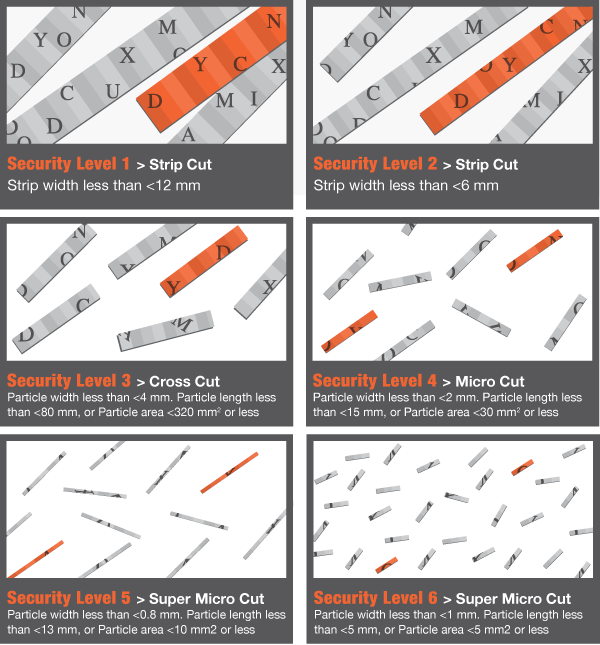
The security rating of your cross-cut shredder depends entirely on the final particle size it produces, measured in millimeters of width by length. Understanding these dimensions helps you select appropriate equipment for different security needs—from basic home use to classified government documents.
How Particle Dimensions Determine Security
- Standard Office Security (DIN Level 3-4): Produces particles around 4x40mm—suitable for most business documents but potentially reconstructable with significant effort
- High Security (DIN Level 5-6): Creates particles between 2x15mm and 1x12mm—making reconstruction virtually impossible without specialized equipment
- Top Secret (DIN Level 7): Generates micro-cut particles as small as 0.8x11mm—used for classified government and military documents
Why Smaller Particles Provide Superior Protection
Each halving of particle size increases the number of pieces per document exponentially. A single sheet shredded to 4x40mm yields approximately 400 particles, while the same sheet processed to 2x15mm creates over 2,000 particles. This dramatic increase makes reconstruction impractical—requiring not just finding all pieces but determining their original sequence among thousands of nearly identical fragments.
Motor Power and Jam Prevention Systems
The cutting process requires significant torque, especially when handling multiple pages or thicker materials like credit cards or CDs (in specialty models). Understanding your shredder’s power system helps prevent common operational issues.
Matching Motor Strength to Your Shredding Needs
Entry-level cross-cut shredders typically feature 1/5 to 1/3 horsepower motors capable of handling 6-10 sheets at once, while commercial models use 1/2 to 1 horsepower motors processing 15-25 sheets per pass. The motor connects to the cutting cylinder through hardened steel gears designed to withstand constant stress—though these components can wear over time with heavy use.
Smart Jam Prevention Technologies
Modern cross-cut shredders incorporate multiple systems to prevent and resolve jams:
- Automatic Reverse: Sensors detect increased resistance and briefly reverse the cutting cylinder to clear obstructions
- Thermal Protection: Monitors motor temperature and shuts down the unit before overheating occurs
- Load Sensors: Adjust cutting speed based on paper thickness to maintain consistent performance
- Manual Override: Allows controlled reverse operation when automatic systems can’t clear stubborn jams
Pro Tip: To minimize jams, avoid overloading your shredder beyond its rated capacity and never feed staples, paper clips, or excessively thick materials unless your model specifically supports them.
Safety Features That Protect Users and Equipment
Cross-cut shredders incorporate multiple safety mechanisms that prevent accidents while ensuring proper operation—features often overlooked until you need them.
Essential Safety Systems in Modern Shredders
- Interlock Sensors: Prevent operation if the cutting head isn’t properly seated on the waste bin
- Finger Protection: Creates a physical barrier that stops rollers from engaging when hands approach too closely
- Overheat Protection: Automatically shuts down the motor when temperatures exceed safe limits
- Automatic Shut-off: Stops the unit after a set period of inactivity to conserve energy
These features aren’t just regulatory requirements—they directly impact your shredder’s longevity and reliability. A unit without proper thermal protection will burn out its motor much faster when processing large document batches.
Waste Management: Why Cross-Cut Shredders Fill Bins Slower
One often-unnoticed advantage of cross-cut technology is its efficient waste compaction. The small, interlocking particles created by cross-cut shredding settle more densely than long strips, resulting in significantly higher bin capacity.
The Volume Reduction Advantage
Cross-cut shredded paper typically occupies 30-40% less volume than strip-cut shreds from the same amount of paper. This means fewer bin emptying interruptions during large shredding sessions and less frequent replacement of waste bags. The irregular diamond shapes nest together tightly as they fall into the bin, creating minimal air gaps between particles.
Maximizing Bin Capacity Without Jams
For optimal performance, empty your shredder bin when it reaches 75% capacity. Overfilling creates back pressure against the cutting assembly that can cause jams or strain the motor. Most commercial models include transparent windows or sensors that indicate when the bin needs emptying before performance is affected.
Maintenance Practices for Long-Lasting Performance
Your cross-cut shredder’s cutting effectiveness depends on regular maintenance—particularly keeping the blade assembly clean and properly lubricated.
Essential Lubrication Techniques
Hardened steel blades require periodic oiling to maintain cutting efficiency and prevent paper dust buildup. Use only shredder-specific lubricating oil (not standard machine oil), applying it directly to the cutting assembly according to manufacturer instructions—typically every 15-30 minutes of continuous use or after 500-1,000 sheets.
Cleaning the Cutting Assembly
Paper dust accumulation between cutters reduces cutting precision over time. Monthly cleaning with a small brush through the feed slot removes most debris, while some models feature removable cutting assemblies for deeper cleaning. Never use compressed air directly on the cutting assembly—it can force particles deeper into mechanisms.
Choosing the Right Cross-Cut Shredder for Your Security Needs
Not all cross-cut shredders provide equal security. Understanding particle size specifications helps match equipment to your document sensitivity requirements.
Matching Shredder Specifications to Document Types
- Financial Records & Personal Documents: DIN Level 3 (4x40mm particles) provides adequate security
- Business Proprietary Information: DIN Level 4-5 (2x15mm to 1.9x15mm) offers stronger protection
- Healthcare Records (HIPAA): Requires minimum DIN Level 4
- Government/Military Classifications: Demands DIN Level 6-7 with particle sizes under 1x10mm
When purchasing, look for independent certification (like DIN 66399) rather than manufacturer claims alone—this ensures the stated security level has been verified by third-party testing.
Understanding how does a cross-cut paper shredder work transforms you from a passive user to an informed operator who maximizes security while minimizing frustrations. The dual-action cutting mechanism—where rotating cutters interact with stationary blades to create precisely sized particles—provides significantly higher security than strip-cut alternatives through sheer particle quantity and complexity. By recognizing the importance of particle dimensions, maintaining proper lubrication, and matching your shredder’s capabilities to your security needs, you ensure sensitive information stays protected through proper document destruction. For ongoing reliability, follow manufacturer maintenance guidelines, avoid overloading beyond capacity ratings, and replace your shredder when cutting performance noticeably declines—typically after 3-5 years of regular office use.