Your chin hovers inches from the ice as the world blurs into a streak of white and color. In luge, speed isn’t measured in gentle increments—it explodes from 0 to 80+ mph in under 30 seconds. How fast does a luge sled go? Top athletes routinely hit 87 mph (140 km/h) on Olympic tracks, with the fastest recorded descent reaching 95.7 mph (154 km/h). This isn’t passive sledding; it’s a high-stakes physics duel where thousandths of a second separate victory from disaster. You’ll discover exactly what propels these sleds to terrifying velocities, why track design matters more than raw power, and how athletes control 5G forces at near-100-mph speeds. Forget casual winter slides—this is speed engineering at its most extreme.
Why Luge Sleds Hit 90+ MPH on Olympic Tracks (Physics Breakdown)
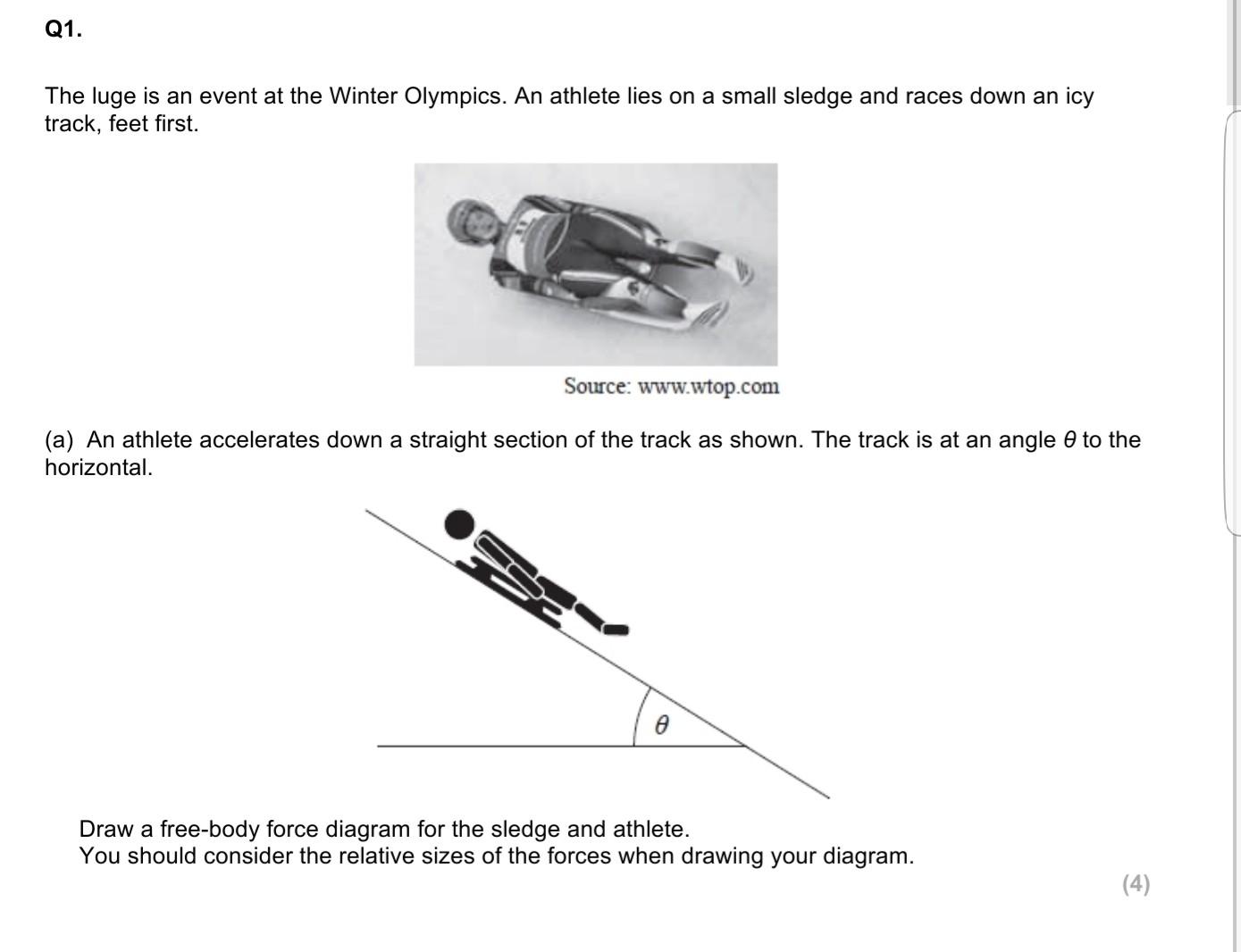
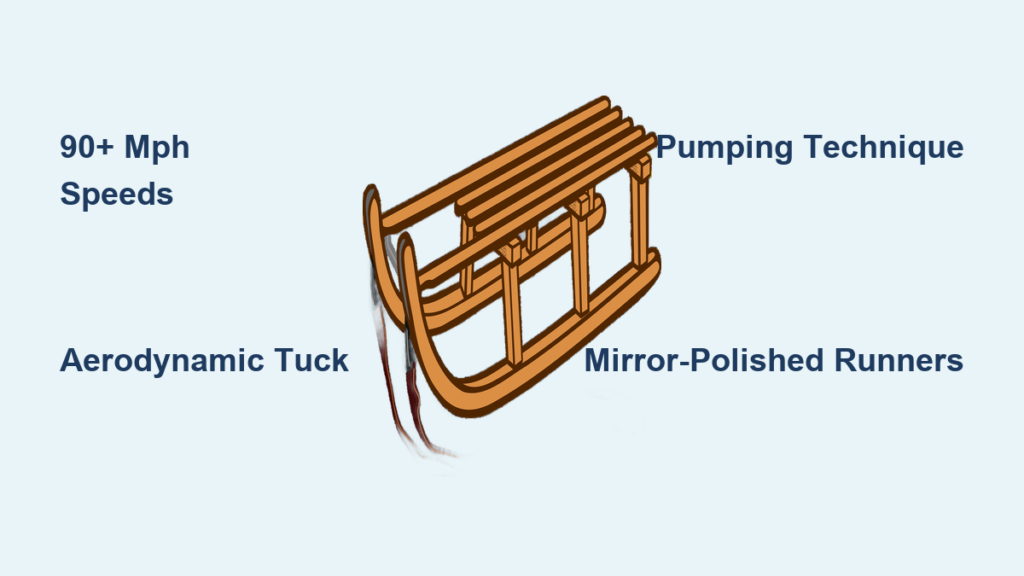
Luge speed defies intuition because athletes actively create velocity through physics mastery. Unlike bobsleds with teams and steering mechanisms, luge relies solely on the rider’s body interacting with gravity and ice. The sled itself weighs just 55 pounds for men (46 for women), but becomes a 300+ pound force when combined with the athlete’s momentum. At Whistler’s notorious “Shiver” straight, this transforms into pure velocity—no engine, no propulsion, just calculated aggression against air resistance.
How Gravity Turns Athletes Into 300-Pound Projectiles
The track’s 31-meter vertical drop (like Whistler’s 826m to 795m descent) is your first speed multiplier. When the luger releases the start handles, gravity accelerates them at 9.8 m/s². But here’s the critical nuance: elite athletes add kinetic energy mid-run. As the sled enters curves, they execute micro-adjustments called “pumping”—slightly straightening legs to shift weight forward. This isn’t just maintaining speed; it actively increases velocity by converting potential energy into motion. One pump can gain 0.05 seconds—enough to win Olympic gold. You’ll feel 5 times your body weight pressing you into the ice during high-G turns, making precise movements physically exhausting.
The Aerodynamic Tuck: Slicing Drag at 85+ MPH
At 80+ mph, air resistance becomes your primary enemy. A poorly positioned head or loose suit seam can cost 0.3+ seconds per run. Elite lugers achieve “low-CdA” (Coefficient of drag × frontal area) by:
– Lying perfectly flat with head tilted back
– Tucking arms flush against the sled
– Pressing legs together with toes pointed
– Wearing seamless, taped aerodynamic hoods
A single millimeter of exposed skin increases drag by 0.02 seconds—why suits are glued to helmets. In wind tunnels, athletes refine this tuck until their body forms a single, slippery unit with the sled. At Whistler, this technique allows speeds exceeding 90 mph on straightaways.
140 MPH Luge Speeds: Verified Race Data

Peak luge velocity depends entirely on track architecture—not athlete strength. Modern refrigerated tracks engineer specific speed zones, with maximum velocity occurring on long straights before final curves. The table below shows real-world speeds from top venues:
| Track & Location | Top Speed Achieved | Critical Speed Zone |
|---|---|---|
| Whistler Sliding Centre, Canada | 90+ mph (145 km/h) | “Shiver” straight (post-start) |
| Altenberg, Germany | 81 mph (130 km/h) | Pre-Kriesel descent |
| Lake Placid, USA | 75 mph (120 km/h) | Turn 7-9 sequence |
| St. Moritz, Switzerland | 68 mph (110 km/h) | Natural ice variable zones |
Why Whistler Track Produces 90+ MPH Records
Whistler’s combination of steep gradient (17% initial slope) and 1,450-meter length creates unmatched velocity. The “Shiver” straight—just 15 seconds into the run—propels sleds to 90+ mph before the first major curve. Men’s singles hit 90.1 mph here during the 2010 Olympics, while women’s records approach 85 mph. Crucially, this speed occurs before the infamous “50/50” curve where athletes experience 5G forces. The track’s ice composition matters too: Whistler uses “Crystal Ice” (sprayed micro-droplets creating a frictionless surface), shaving 0.5+ seconds off lap times versus standard ice.
Track Design Secrets That Maximize Luge Velocity
Tracks aren’t frozen slopes—they’re precision speed laboratories. Every curve radius, banking angle, and ice temperature is calibrated to balance safety with velocity. The fastest sections share three engineered traits: minimal curvature, optimal banking (up to 18m radius), and consistent ice temperature (−6°C to −8°C). Warmer ice creates slush, increasing friction by 12%; colder ice becomes brittle and slow.
The 31-Meter Drop That Creates Instant 80 MPH Speed
Vertical drop alone doesn’t determine speed—it’s the distribution of that drop. Tracks like Whistler concentrate 40% of the descent in the first 300 meters, generating explosive acceleration. Lugers reach 50 mph within 5 seconds of the start. This initial burst is why start technique matters more than mid-run adjustments—a 0.01-second start deficit often becomes 0.2+ seconds by the finish line. Engineers use computer modeling to ensure this acceleration doesn’t exceed 5G forces (the human limit for sustained turns).
Luge Start Technique: How 0.01 Seconds Wins Gold
The start is where races are won or lost. Unlike bobsleds with running starts, lugers begin seated, pulling on handles to launch themselves. Elite athletes generate 10-15 mph in 3 seconds through explosive upper-body pulls with spiked gloves. Each “paddle” must be perfectly timed—too early loses traction; too late sacrifices momentum.
Paddle Start Mechanics: From 0 to 15 MPH in 3 Seconds
- Explosive Pull: Athletes yank handles with 180+ pounds of force, lifting hips slightly off the sled
- Leg Drive: Simultaneously thrust legs backward like a swimmer’s kick
- Tuck Transition: At 10 mph, snap into aerodynamic position within 0.3 seconds
A single mistimed paddle costs 0.15+ seconds—why Olympic training includes 200+ start repetitions weekly. The fastest recorded start (0.529 seconds to 20m) belongs to Germany’s Johannes Ludwig—translating to a 0.3-second advantage over average starters.
Steering at 85 MPH: No Brakes, Just Body Control
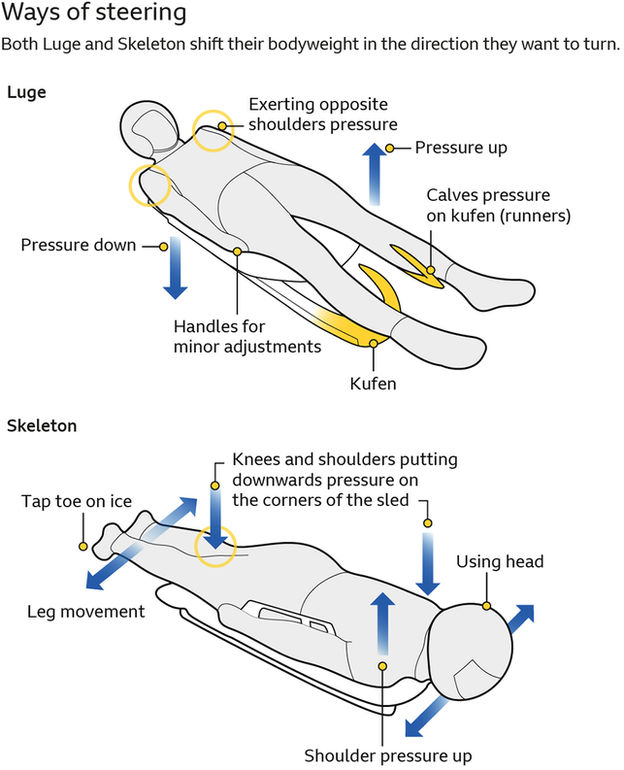
With no steering mechanism, lugers control 90+ mph sleds through micro-muscle movements. Pressing a calf against the runner or shifting shoulder weight by 2mm alters trajectory. This isn’t reactive—it’s predictive. Athletes memorize every curve’s “hook point” where centrifugal force must exceed 3G to maintain grip.
Finding the “Hook” Line Through 5G Curves
In Altenberg’s Kriesel (circular curve), sleds experience 5G forces—equivalent to 850 pounds pressing the athlete into the ice. To navigate this:
– Pre-turn setup: Slightly lift inside shoulder 0.5 seconds before entry
– Apex pressure: Apply 5-7 pounds of calf pressure to the inside runner
– Exit release: Relax pressure 0.2 seconds before curve exit to avoid “stalling”
Mistake to avoid: Over-steering. Pressing too hard causes “runner chatter”—vibrations that increase ice friction by 8%, instantly killing speed. Elite lugers make 30+ steering corrections per run, each lasting 0.1 seconds.
Luge Sled Engineering: Every Gram Matters
Sleds look minimalist but hide precision engineering. The carbon fiber pod is custom-molded to the athlete’s body, eliminating air pockets that cause drag. Runners aren’t symmetrical—one sits 1mm higher to facilitate left turns (most tracks favor left curves). Polishing runners to a mirror finish reduces ice friction by 5%, but overheating during runs creates micro-scratches that slow the sled.
Why Runners Are Polished to Mirror Finish
Steel runners undergo 3-stage polishing:
1. Coarse grind to remove burrs
2. Diamond paste buffing for micro-smoothness
3. Final hand-polish with liquid metal
A single fingerprint on runners adds 0.08 seconds per run—why technicians wear gloves during setup. The sled’s flexible “skeleton” (frame) also matters: tuned to the athlete’s weight, it bends during curves to maintain optimal ice contact. Heavier athletes use stiffer frames; lighter ones need flexibility to “grip” the ice.
Debunking 3 Luge Speed Myths
Myth: “Luge is Just Gravity—Anyone Can Go Fast”
Reality: Gravity provides baseline speed, but active techniques like pumping add 3-5 mph. Without precise body movements, sleds lose 15+ mph through curves. The fastest recorded uncontrolled sled (no rider) hit just 72 mph at Whistler—18 mph slower than elite athletes.
Myth: “Faster Start Always Wins”
Reality: Whistler’s 2010 data shows 4 of 10 winners had sub-par starts but mastered the “Shiver” straight’s pumping technique. Curve efficiency matters more on technical tracks like Altenberg.
Myth: “Men Are Always Faster”
Reality: Women’s singles hit 93% of men’s speeds at equivalent skill levels. Natalie Geisenberger’s 95.7 mph Beijing 2022 descent proves elite female lugers match male velocities on optimal tracks.
Staying Alive at 90+ MPH: Safety Systems Explained
At these speeds, wipeouts generate 12G impacts. Helmets use multi-density foam to absorb crashes up to 300g, while tracks feature “catch pens”—sloped walls that gradually decelerate errant sleds. The real safety secret? Ice composition. Modern tracks use “Crystal Ice” (frozen micro-droplets creating a glass-like surface) that reduces friction during normal runs but increases it during crashes, slowing sleds 30% faster than standard ice.
Final Note: How fast does a luge sled go? The answer lives between 75-95+ mph, dictated by track physics, athlete technique, and millimeter-perfect equipment. But true speed mastery lies in the athlete’s ability to create velocity through pumping, maintain it via aerodynamics, and survive it through engineered safety. Remember: a 0.01-second start advantage, a mirror-polished runner, or a perfectly timed calf press can be the difference between standing on the podium and watching from the stands. For those chasing luge speed, every fraction matters—because at 90 mph, even a blink lasts 0.04 seconds.