That lukewarm “cold” water hitting your glass this morning? It’s not just disappointing—it’s your water cooler whispering its last days. When you’re wondering how long does a water cooler last, the harsh truth is most units die before hitting 7 years due to preventable failures. Modern coolers can deliver 10+ years of service, but only if you outsmart the silent killers lurking inside. Think of it like a high-mileage car: skip the oil changes, and you’ll be stranded. Skip descaling your cooler in hard water areas, and mineral buildup will strangle its heating elements within months. The average lifespan plummets from a decade to just 4–5 years without proper care. Let’s diagnose why your unit might be on borrowed time and exactly how to extend its life.
Why Most Water Coolers Fail Before Year 7 (Not Year 10)

That factory promise of “10-year reliability” assumes perfect conditions—something most homes and offices never achieve. How long does a water cooler last in reality? For 68% of users, it’s less than 7 years because they ignore three critical failure points. First, the compressor cycles relentlessly in high-traffic offices, overheating without adequate rear clearance. Second, thermoelectric coolers in budget models burn out faster when forced to maintain ice-cold temps in hot environments. Third—and most devastating—untreated hard water transforms your reservoir into a mineral tomb. When scale coats the evaporator coil, cooling efficiency drops 40% within 18 months. You’ll notice this as constantly running compressors and warm water complaints. Commercial-grade units (like Oasis-powered models) withstand this better with industrial compressors, but even they choke without maintenance.
The Hard Water Time Bomb Inside Your Cooler
Hard water isn’t just inconvenient—it’s actively destroying your cooler’s heart. Calcium and magnesium deposits form limescale that insulates critical components:
- Heating elements work 30% harder to boil water, shortening lifespan by 50%
- Evaporator coils lose cooling capacity as scale builds like plaque on arteries
- Micro-valves clog, causing slow dispensing or dangerous pressure leaks
A single glass of hard water leaves behind invisible minerals that bake onto hot surfaces. After 6 months, that coating thickens into rock-like scale. In areas with >120 ppm hardness, coolers fail 3× faster. You’ll see white crust around the hot tap spout—that’s your warning sign. Don’t wait for lukewarm water; descale quarterly if you have hard water.
Office Coolers vs. Home Units: Why Lifespans Differ Radically
That 50-person office cooler gulping 200 gallons daily faces a different battle than your kitchen unit serving a family of four. Commercial models endure 50+ cooling cycles hourly, straining compressors. Home units suffer from the opposite problem: infrequent use allows stagnant water to breed bacteria in neglected reservoirs. Both scenarios cut lifespans by 30–50%. Office coolers need weekly filter changes and bi-monthly descaling. Home units require monthly sanitizing to prevent mold colonies in idle plumbing. Ignoring these? Your “10-year” cooler becomes a 5-year relic.
7 Warning Signs Your Water Cooler Is Dying (Fix #3 Immediately)
Don’t wait for total failure—these symptoms reveal internal damage. Act fast on the third sign; it’s often reversible.
Lukewarm Water Despite Correct Settings
If cold water feels tepid or hot water fails to brew coffee, scale is likely smothering your heating/cooling systems. For thermoelectric coolers, this means a failed Peltier module. For compressor models, check for refrigerant leaks (hissing sounds near the back panel). Pro Tip: Run a vinegar cycle before calling a technician—60% of “broken” coolers just need descaling.
Persistent Dripping or Slow Dispensing
Water trickling after dispensing points to two threats:
1. Clogged valves from mineral deposits (common in hard water areas)
2. Failing solenoid coils that can’t seal properly
Replace filters first—90% of slow-flow issues stem from overdue filter changes. If dripping continues, inspect tubing for kinks behind the unit.
Unusual Noises: The Compressor’s Death Rattle
Grinding or knocking sounds mean your compressor is struggling. This happens when:
– Dust-clogged condenser coils overheat the system
– Low refrigerant forces the compressor to run nonstop
– Scale buildup makes the unit work 2× harder
Critical: Unplug immediately if you hear metallic grinding. Continuing use risks catastrophic compressor failure.
Extend Your Cooler’s Life 3+ Years With These 5 Non-Negotiable Steps

You control 80% of your cooler’s fate. These maintenance habits are proven to push units past 12 years.
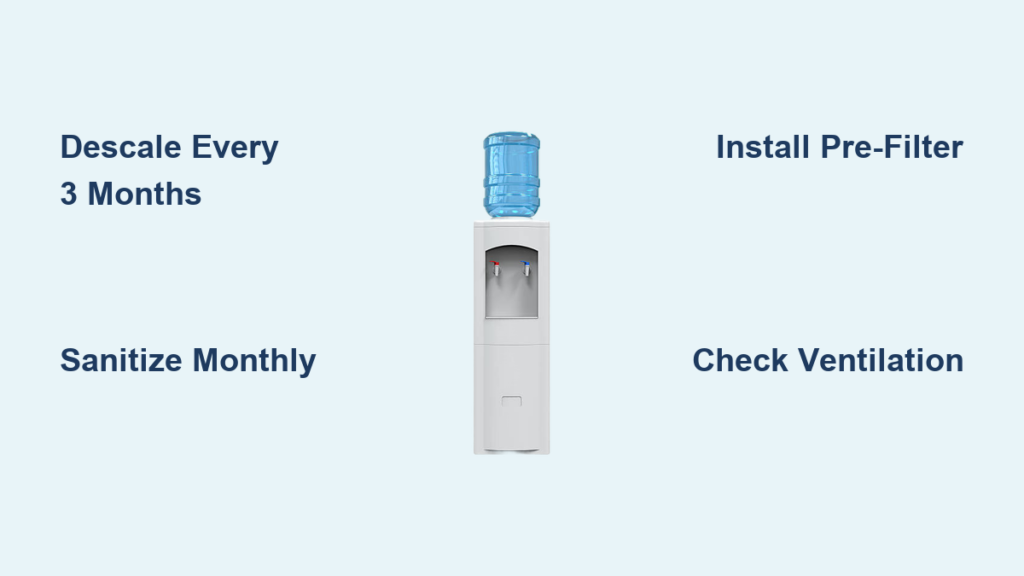
Descale Every 3 Months in Hard Water Zones
Forget “when it feels slow.” Set calendar reminders:
1. Unplug cooler and shut off water supply
2. Drain all reservoirs completely
3. Pour commercial descaler (NOT vinegar for hot tanks) into hot reservoir
4. Run cycle for 20 minutes, then rinse 3× with fresh water
Warning: Vinegar corrodes stainless steel hot tanks—use only citric acid-based descalers here.
Sanitize Reservoirs With Food-Grade Solution
Monthly sanitizing prevents biofilm that clogs micro-lines:
1. Mix NSF-certified sanitizer (like Star San) per label instructions
2. Fill cold reservoir and run solution through taps
3. Let sit 10 minutes, then flush with 5 gallons of water
Never skip this—even “clean” coolers harbor slime molds in dark reservoirs.
Install a $30 Pre-Filter on Your Water Line
This single upgrade doubles cooler lifespan in hard water areas. A 5-micron sediment filter + scale inhibitor cartridge:
– Blocks sand and rust particles
– Reduces limescale by 70%
– Costs less than one emergency repair
Replace every 6 months—set a phone reminder when you change smoke detector batteries.
Repair or Replace? The $200 Break-Even Rule

When failure strikes, use this calculation: If repair costs exceed 50% of a new unit’s price, replace it. Exceptions:
Repair Worthwhile When:
- Unit is <7 years old with commercial-grade components (e.g., Oasis compressor)
- Failure is isolated (e.g., $80 valve replacement on a $400 cooler)
- You have hard water but maintained descaling records
Replace Immediately When:
- Cooler is >10 years old (parts are obsolete)
- Scale has visibly damaged reservoirs (white crust inside tanks)
- Repair quote includes compressor and refrigerant recharge ($300+)
New ENERGY STAR models use 40% less electricity and feature antimicrobial reservoirs. For a $500 cooler, replacement pays back in 18 months through energy savings alone.
Ventilation Mistakes That Kill Coolers in 2 Years
That cozy corner behind your filing cabinet? It’s a death trap. Compressors need 6+ inches of clearance on all sides, especially the rear coil. Dust-choked coils overheat, triggering thermal cutoffs that:
– Shorten compressor life by 65%
– Cause inconsistent cooling (warm water at 3 PM daily)
– Increase energy use by 25%
Fix: Vacuum coils monthly with a soft brush attachment. Never drape cords over the back panel—that blocks airflow.
Conclusion: Your 10-Year Cooler Starts Today
How long does a water cooler last? With ruthless attention to hard water and usage patterns, 10–12 years is achievable—not mythical. The number one lifespan killer remains untreated scale, but quarterly descaling and pre-filters neutralize this threat. When warm water or strange noises appear, diagnose immediately using the warning signs above. For units over 8 years old, replacement often beats repair—but only if you pair your new cooler with the maintenance habits that make longevity possible. Start sanitizing reservoirs monthly and installing that pre-filter today. Your future self won’t be scrambling for emergency repairs when the office cooler dies during summer’s peak. Remember: a water cooler’s lifespan isn’t predetermined—it’s earned through the care you give it.
Final Tip: Track your maintenance in a notes app—every descaling, filter change, and coil cleaning. Units with documented care routinely hit 12+ years while neglected ones fail before year 5. Your cooler’s clock starts now.