You’ve just finished an intense workout, and your muscles are screaming for relief. That new massage gun sits on the counter, promising quick recovery—but how long should you actually use it? Many users make the critical mistake of applying it for too long or at excessive intensity, turning a recovery tool into a source of injury. Understanding precisely how long to use a massage gun is the difference between accelerated healing and painful setbacks. This guide cuts through the confusion with science-backed timing strategies for every muscle group and goal. You’ll discover why marathon 10-minute sessions on your quads could cause bruising, while 30 seconds on your neck delivers instant tension relief. Get ready to maximize your device’s benefits without risking tissue damage.
Massage guns work through percussive therapy—rapid pulses that increase blood flow and break up adhesions. But duration directly impacts effectiveness: too brief yields no results, while excessive use triggers inflammation. The ideal how long to use massage gun timeframe balances penetration depth with tissue tolerance. Crucially, your body part, goal, and sensitivity dictate timing—not manufacturer defaults. This isn’t about guessing; it’s about applying precise durations that match your physiology. We’ll decode exactly when to pull the trigger (literally) based on your specific needs, ensuring every second counts toward faster recovery.
How Long to Use a Massage Gun for Recovery, Tension, and Warm-Up
Your timing strategy must align with your objective. Post-workout recovery requires different protocols than chronic tension relief or pre-activity preparation. Applying uniform durations across scenarios wastes time and risks injury. Adjusting how long to use a massage gun based on your immediate goal transforms it from a generic tool into a precision recovery instrument. Always start at the lowest intensity setting and gradually increase only if needed—never begin aggressively.
Post-Workout Muscle Recovery Timing
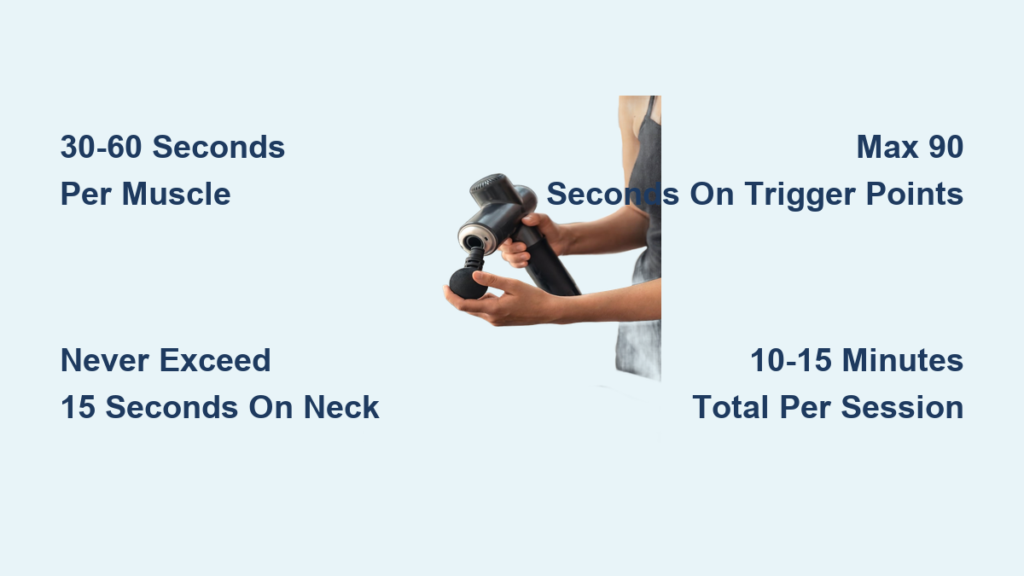
After exercise, spend 30-60 seconds per major muscle group—not continuous minutes on one spot. For example: glide the massage gun slowly over your entire quadricep for 45 seconds, then immediately switch to hamstrings. This brief exposure flushes lactic acid without overwhelming fatigued tissue. Never exceed 2 minutes total on any single muscle group post-workout. If you feel increased soreness the next day, you’ve overdone it; reduce duration by 15-second increments next session. Remember: your muscles are already stressed—this isn’t the time for deep knot work.
Chronic Tension Relief Duration
For stubborn knots in your shoulders or back, target trigger points for 60-90 seconds max at medium intensity. Never blast high-speed pulses directly onto tight spots—that causes micro-tears. Instead: find the knot, reduce speed to level 2-3, and hold static pressure for 45 seconds. If the knot doesn’t release, move to surrounding areas first to warm up the tissue, then return for another 30 seconds. Exceeding 90 seconds on chronic tension risks bruising and inflammation, counteracting your goal. You should feel release, not pain—stop immediately if discomfort spikes.
Pre-Workout Activation Timing
Before lifting or running, use ultra-brief pulses to prime muscles: 15-30 seconds per group with a broad head. For squats, glide lightly over glutes and quads for 20 seconds each side. This boosts blood flow without fatiguing fibers. Never use high intensity pre-workout—it temporarily reduces muscle activation. If you’re spending more than 30 seconds on any area, you’re overdoing it. The goal is neural wake-up, not deep tissue work. Stop if you feel tingling—this indicates nerve interference.
How Long to Use a Massage Gun on Large Muscles vs. Sensitive Areas
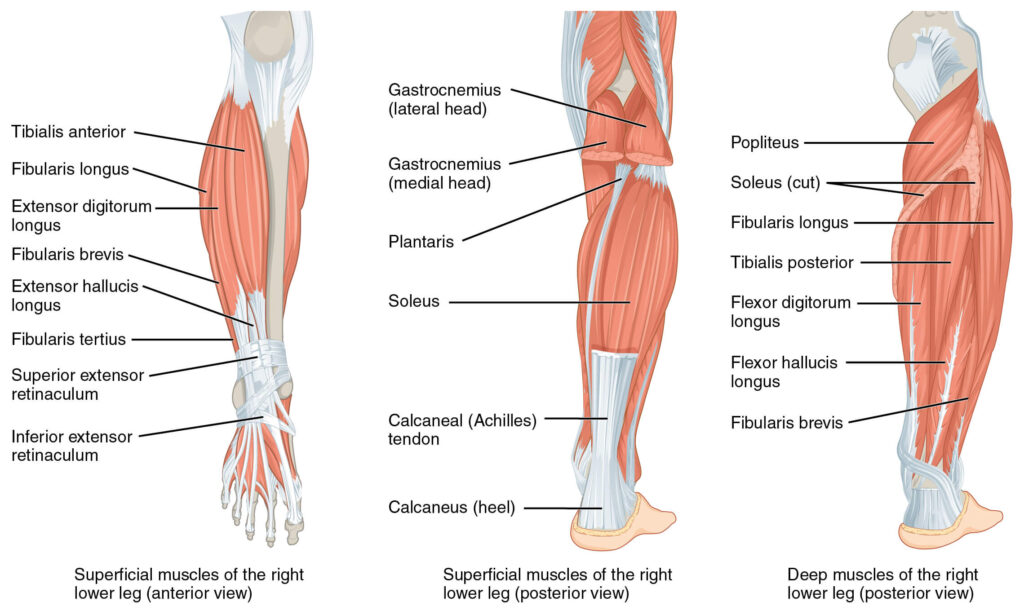
Body part sensitivity dictates safe durations more than any other factor. Ignoring anatomical differences turns recovery into injury. Large muscles tolerate longer exposure, but joints and nerves demand extreme caution. Your timing must respect these boundaries—no exceptions. Always move the gun; static application on sensitive zones multiplies risk.
Quads, Hamstrings, Glutes, and Back Durations
For powerhouse muscles like quads or lats, spend 2-5 minutes total per group using slow gliding motions—not concentrated on one spot. Example: move vertically along your hamstring for 45 seconds, then horizontally across the glute for another 45 seconds. Never press directly on the spine; stay 2 inches lateral. If using high intensity (level 4+), halve the duration. Stop immediately if you feel sharp pain near joints—this indicates bone-on-bone pressure. These areas can handle more time, but only with deliberate movement across the muscle belly.
Neck, Hands, Feet, and Joint Safety Limits
Tiny muscles and exposed nerves demand extreme brevity: never exceed 15-30 seconds per spot. For neck tension: use the lowest setting with a flat head, glide vertically along the trapezius (never on the throat or carotid artery), and stop at 20 seconds max. On feet: target arches for 15 seconds only—longer risks plantar fascia damage. Never apply directly to knuckles, knees, or elbows. If you experience tingling during use, cease immediately—you’re compressing nerves. These areas need feather-light pressure and minimal duration.
Trigger Point Precision Timing
For isolated knots (like a shoulder “hot spot”), max 30-60 seconds of direct pressure. Technique matters: find the knot, reduce speed to level 2, hold static for 30 seconds. If no release, work the surrounding area for 45 seconds, then return for another 20 seconds. Never exceed 60 seconds total on one trigger point—this causes capillary rupture and bruising. You’ll know it’s working when the knot softens; if pain intensifies, stop. Pro tip: breathe deeply during application—holding your breath increases tissue tension.
A Sample 5-Minute Full-Body Routine for Busy Schedules
No time for lengthy sessions? This efficient routine delivers full-body benefits without overuse. Stick strictly to these timings:
- Calves & Shins: 60 seconds total (30 seconds per side with slow vertical strokes)
- Quads: 60 seconds (30 seconds per leg, gliding from hip to knee)
- Hamstrings/Glutes: 60 seconds (30 seconds per side, focus on glute-to-knee movement)
- Upper Back & Lats: 60 seconds (30 seconds per side, avoid spine, use medium speed)
- Neck & Shoulders: 60 seconds (gentle glides on traps only—never throat or arteries)
Use a standard ball attachment at medium intensity. Move constantly—never static. If you finish early, rest; don’t add time. This protocol prevents overuse while covering critical recovery zones. Skip any area if you have injuries—this isn’t one-size-fits-all.
Key Signs You’re Using Your Massage Gun For Too Long

Your body sends clear overuse warnings—ignore them at your peril. These red flags mean stop immediately:
- Numbness or tingling: Indicates nerve compression. Cease use for 48 hours.
- Purple bruising or petechiae (pinpoint red dots): Caused by ruptured capillaries from excessive duration/pressure.
- Sharp, shooting pain: Signals potential nerve or tissue damage—discontinue use.
- Increased swelling or stiffness the next day: Paradoxically, overuse causes inflammation instead of reducing it.
If you see bruising, apply ice and skip massage for 3-5 days. Never work through sharp pain—this isn’t “good soreness.” These symptoms mean you’ve exceeded safe how long to use massage gun limits for your current condition.
Advanced Techniques: Static vs. Gliding Application Timing
Mastering movement techniques prevents overuse injuries while boosting effectiveness. Duration varies drastically between methods—confusing them causes most user injuries.
Static Trigger Point Holding
Holding the gun stationary on knots requires strict time limits: 30-45 seconds max per point. Why? Continuous pressure restricts blood flow, causing ischemia. Set a timer—exceeding 45 seconds risks tissue necrosis. After 30 seconds, gently move the gun in small circles for 15 seconds to restore circulation. Never use high intensity statically; level 2-3 is safest. If the knot doesn’t release, work surrounding areas first—forcing it causes bruising.
Dynamic Muscle Gliding
Moving the gun along muscle fibers allows longer exposure: 30-60 seconds per muscle group. Glide slowly (1-2 inches per second) following fiber direction—quads vertically, lats horizontally. This pumps blood without occlusion. On large groups like glutes, cover the entire area within 60 seconds; don’t linger. If you’re spending more than a minute per major muscle, you’re moving too slowly or overlapping excessively. This technique safely delivers deeper penetration than static holds.
Critical Safety Rules for Massage Gun Usage
Violating these rules negates benefits and risks serious injury—duration limits alone won’t protect you:
- Never use on head, throat, or major arteries (neck sides)—can cause stroke or nerve damage
- Always place a thin towel over skin—reduces friction burns and prevents excessive vibration transfer
- Start at lowest intensity for 15 seconds—assess tolerance before increasing
- Avoid bony protrusions (kneecaps, elbows, spine)—causes periosteal inflammation
- Skip injured or inflamed areas—increases swelling and delays healing
If you have blood thinners, neuropathy, or recent surgery, consult a physical therapist first. Your “safe duration” may be near zero. When in doubt, halve the time—you can always add sessions later.
How Long Should You Use a Massage Gun? Final Recommendations
The golden rule: 10-15 minutes total per session is the absolute maximum for healthy adults. Most users benefit more from three targeted 5-minute sessions than one marathon 20-minute session. For daily maintenance, 2-3 minutes on problem areas suffices; post-intense-workout, stick to 8 minutes max. Always prioritize quality movement over duration—slow gliding beats static blasting. If you’re consistently bruising or sore after use, reduce time by 25% immediately. Start conservatively: 30 seconds per muscle group, then adjust based on your body’s feedback. Remember, percussion therapy is a supplement—not a replacement—for stretching and hydration. When you nail how long to use a massage gun for your unique physiology, you’ll transform it from a gimmick into your fastest path to pain-free movement. Your muscles will thank you tomorrow.