Your sled push set count isn’t arbitrary—it’s a strategic decision that makes or breaks your training results. Pushing too many sets sabotages speed gains, while too few won’t build conditioning endurance. The critical mistake 90% of lifters make? Using the same set scheme for speed training as for conditioning finishers. This isn’t about finding a universal number; it’s about matching your sets to your specific objective. You’ll discover exactly how many sets of sled push deliver results for your goals—whether you’re chasing faster sprints, bigger quads, or metabolic burn.
Forget cookie-cutter recommendations. The right sled push set count depends entirely on your primary training objective. Pushing heavy for 5 sets when training for speed? You’re wasting energy that should fuel explosive power. Doing just 2 sets as a conditioning finisher? You’re missing metabolic adaptation. This guide cuts through the confusion with science-backed protocols tailored to your exact goals. By the end, you’ll know precisely how many sets of sled push optimize your training—plus critical adjustments for surface type, recovery status, and progression timing.
Why Your Sled Push Set Count Changes Based on Training Goals
Your primary objective dictates every programming variable—including how many sets of sled push you perform. Misaligning sets with goals creates wasted effort: heavy sled work before speed drills kills acceleration, while light conditioning pushes after squats undermines strength gains. The key is recognizing that sled pushes aren’t a single exercise but three distinct tools requiring different set schemes.
Speed vs. Strength vs. Conditioning: The Set Count Divide
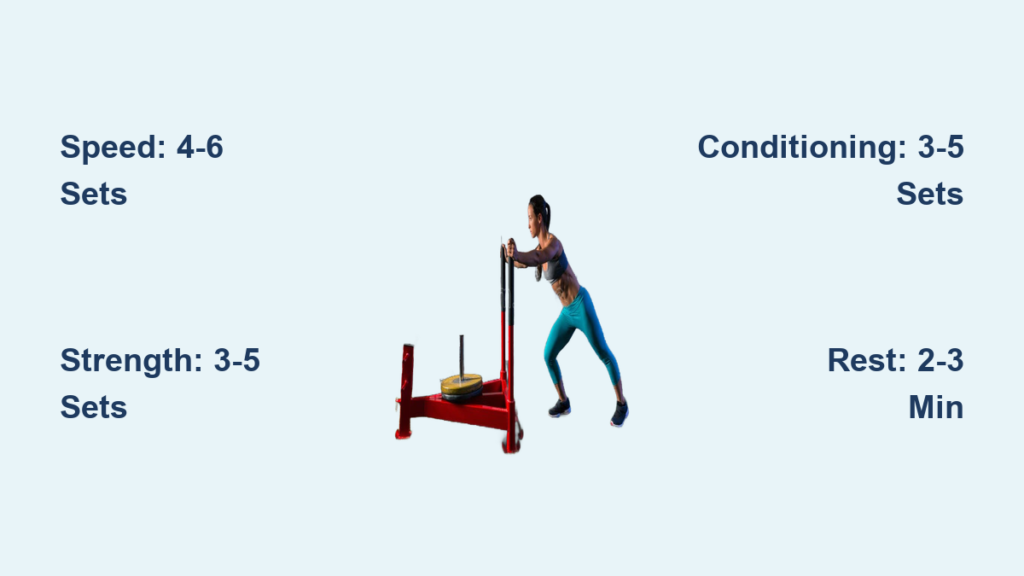
- Speed training demands low sets (4-6) with full recovery to maintain explosive output
- Strength building requires moderate sets (3-5) with heavy loads that challenge each rep
- Conditioning uses higher-frequency sets (3-5 rounds) with minimal rest to tax metabolism
Pushing 8 sets with heavy weight for “conditioning” after deadlifts? You’ll accumulate fatigue without improving work capacity. Your set count must sync with your session’s purpose—never treat sled pushes as a generic add-on.
Speed Training: How Many Sets of Sled Push for Explosive Power
For athletes needing faster acceleration or horizontal power, sled pushes must prioritize quality over quantity. This isn’t conditioning—it’s movement patterning under resistance. Performing too many sets destroys the neural drive needed for explosive starts.
Programming Your Speed Sled Push Sets
- Optimal set count: 4-6 sets of 2-4 pushes
- Critical load range: 10-20% of body weight (enough resistance without slowing sprint mechanics)
- Distance per set: 10-20 meters—short enough to maintain max intent
- Rest between sets: 2-3 minutes for full ATP-CP system recovery
Pro Tip: If your third push feels slower than the first, reduce weight or sets. Speed work fails when fatigue creeps in. Test your starting load with just the sled—add 10lb plates until you feel slight resistance but can still explode forward.
Common Speed Training Mistakes
- Mistake: Doing sled pushes after heavy squats → Fix: Place before strength work or on separate days
- Mistake: Using 40-yard distances → Fix: Shorten to 15m to maintain acceleration mechanics
- Mistake: Resting 60 seconds between sets → Fix: Wait until breathing normalizes (usually 2+ minutes)
Track your split times—if Round 4 is 15% slower than Round 1, you’ve exceeded your optimal set count for speed development.
Strength Building: Optimal Sled Push Sets for Lower Body Hypertrophy

Heavy sled pushes build freakish leg strength when programmed like a compound lift—not a finisher. The magic happens in those last 2 grueling pushes where glutes and quads scream. But wrong set counts turn this into wasted metabolic work.
Your Strength-Focused Sled Push Protocol
- Ideal set count: 3-5 sets of 3-8 powerful pushes
- Load threshold: Heavy enough that the final 1-2 pushes require maximal effort
- Distance sweet spot: 10-20 meters (longer distances shift focus to conditioning)
- Rest requirement: 2-3 minutes between sets for phosphagen system recovery
Visual Cue: Watch your stride length. If steps shorten significantly before the 8th push, the load is too heavy for your target rep range. Adjust weight—not set count—to hit 5 sets of 5 solid pushes.
When Strength Sets Backfire
Overdoing sets here is the fastest route to junk volume. If you’re adding sled pushes after squats:
– Problem: Performing 5 sets post-back squats → Solution: Cap at 3 sets to avoid CNS fatigue
– Problem: Resting 90 seconds between sets → Solution: Extend rest until you can reset bracing
– Problem: Using inconsistent distances → Solution: Mark 15m with cones for precise loading
Your set count must preserve strength quality. If your third set drops below 70% of first-set speed, stop—additional sets harm recovery without building strength.
Conditioning Finishers: Sled Push Set Schemes for Metabolic Burn

This is where most lifters misuse sled pushes—treating conditioning like strength work. For metabolic conditioning, set structure matters more than raw count. The goal isn’t moving weight but sustaining work output.
Effective Conditioning Set Templates
- EMOM Format: 10 minutes: Push 40 yards at minute start (10 total sets)
- Work:Rest Ratio: 30 seconds push / 60 seconds rest (5 sets = 7.5 minutes total)
- Distance-Based: 5 sets of 40-yard pushes with 60-second rest
- Circuit Integration: 3 rounds of 10 sled pushes + 15 kettlebell swings
Key Insight: Conditioning set count depends on load. With 30% body weight, 6 sets may destroy you; with 10%, you could do 10. Start with 3 sets and add one weekly as work capacity improves.
Avoid These Conditioning Traps
- Trap: Matching strength rest periods → Fix: Cut rest to 30-60 seconds for metabolic stress
- Trap: Using max weight → Fix: Load at 15-25% body weight for sustainable effort
- Trap: Ignoring surface → Fix: Add 1-2 sets on turf vs. concrete for equal difficulty
If you’re walking after set 2, reduce load—not sets. Proper conditioning sled work should leave you gasping but able to complete all prescribed sets.
The 3-Week Sled Push Progression: Rotate Sets for Maximum Results
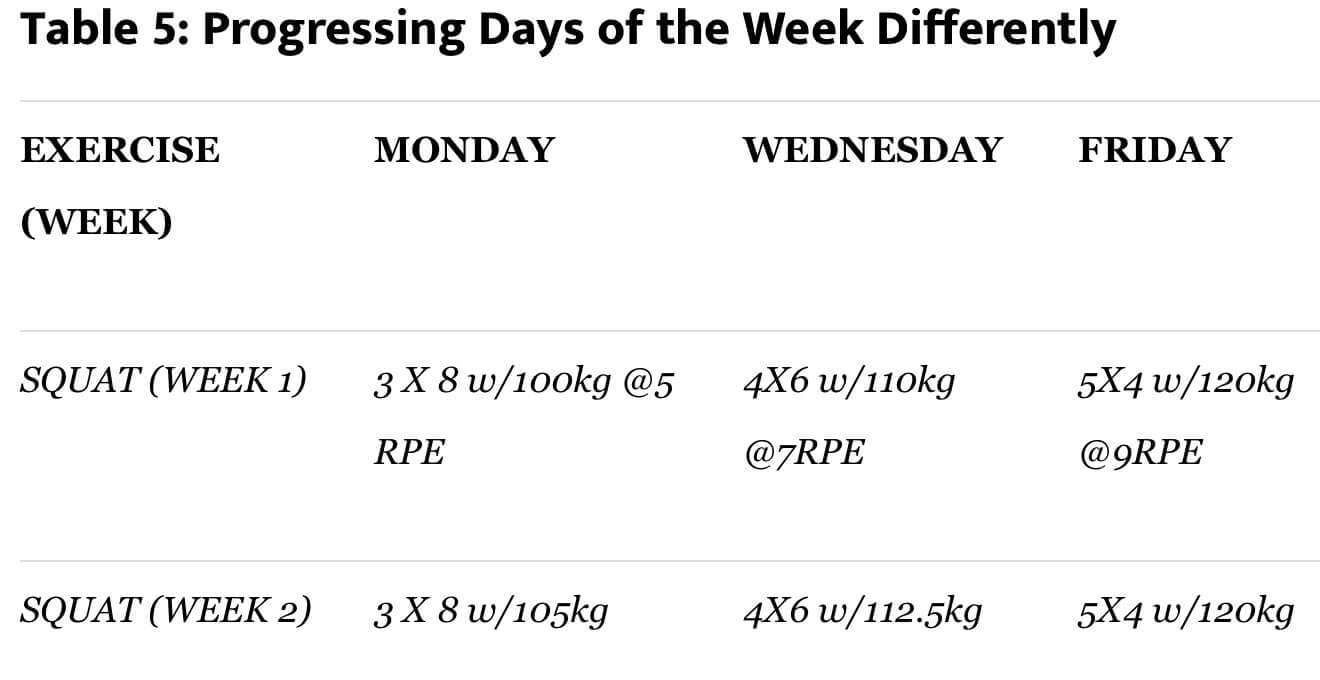
Static set counts cause plateaus. This proven wave systematically varies set volume to prevent adaptation while matching weekly goals. You’ll see faster progress than fixed-set programming.
Implement This Weekly Rotation
| Week | Focus | Sets x Pushes | Load | Distance | Rest |
|---|---|---|---|---|---|
| 1 | Strength | 4 x 4 | Heavy (RPE 8-9) | 20m | 3 min |
| 2 | Power Endurance | 5 x 6-8 | Moderate (RPE 7) | 20m | 2 min |
| 3 | Conditioning | 10 x 10 (EMOM) | Light (RPE 6) | 20m | <60 sec |
Pro Tip: On Week 3, EMOM format (Every Minute on the Minute), push 10 times per minute for 10 minutes. The decreasing rest time creates escalating metabolic demand—no extra sets needed.
How to Start Sled Pushes: Find Your First Set Count
Beginners often overdo volume, mistaking soreness for effectiveness. Your first month should prioritize movement quality over set counts. This phased approach prevents burnout while building capacity.
Your First 4-Week Progression
- Week 1: 2 sets of 3 pushes (empty sled, 15m) → focus on neutral spine
- Week 2: 3 sets of 3 pushes (add 10-20lb) → maintain stride length
- Week 3: Match Week 2 volume + 1 set if recovery allows
- Week 4: Adjust sets based on goal (speed/strength/conditioning)
Warning: If your squat drops 10% after adding sled work, reduce sets by 30%. Sled volume should complement—not cannibalize—primary lifts.
5 Critical Variables That Dictate Your Sled Push Set Volume
Your optimal set count shifts daily based on these often-ignored factors. Ignoring them turns “perfect” programming into wasted effort.
Key Adjustments Beyond Your Goal
- Surface hardness: Concrete requires 1-2 fewer sets than turf for equal effort
- Footwear: Cleats add 15% traction → add 1 set vs. running shoes
- Recovery status: Reduce sets by 25% if sleep was <7 hours
- Time of day: Morning sessions need 1 fewer set than afternoon for same output
- Hydration level: 2% dehydration cuts work capacity → drop 1 set
Pro Tip: Keep a sled log tracking these variables. When performance dips, check your notes before changing set counts.
When to Reduce Sled Push Sets: Avoiding Overtraining Signals
Sled pushes feel deceptively “easy” due to low eccentric damage—but metabolic fatigue accumulates fast. These signs mean you’ve exceeded your optimal set count:
- Performance red flags: 5+ second slower 40m sprint times in later sets
- Recovery markers: Unexplained drop in bench press or squat numbers
- Physical signals: Persistent quad tightness beyond 48 hours
Action Plan: If you see 2+ signs, cut sets by 30% for 2 weeks. For conditioning, drop from 5 to 3 sets. For strength, reduce from 4 to 3 sets. Never push through these warnings—the minimal eccentric load masks systemic fatigue.
Final Note: Your perfect sled push set count isn’t written in stone—it’s written in your training goals and recovery capacity. For speed work, 4-6 sets max with full rest preserves power output. For strength, 3-5 sets of heavy pushes build muscle without junk volume. For conditioning, 3-5 high-frequency sets torch metabolism when structured correctly. Start conservatively: 2 sets as a finisher, 3 sets for strength work. Track performance in primary lifts—if they dip, reduce sled sets immediately. Remember: the right set count today beats the “ideal” number that ruins tomorrow’s workout. Program your sled pushes with precision, and you’ll unlock explosive power, brute strength, or relentless conditioning—whichever you choose.