You’re standing on a wobbly chair trying to change a lightbulb when it hits you: “I should build my own step ladder.” It seems simple—just some wood and screws, right? Wrong. A poorly constructed ladder isn’t just inconvenient; it’s a hidden hazard that could collapse under your weight. The truth is, how to build a step ladder safely hinges on one critical factor most DIYers miss: joint design. Skip this, and you’re gambling with gravity. In this guide, you’ll learn why 90% of homemade ladders fail at the steps, how to create joints that transfer weight through wood—not just screws—and when building your own is actually riskier than buying one. Forget flimsy butt joints; we’re diving into professional-grade techniques using basic tools.
Why Your Step Ladder Collapses at the Steps (Not the Screws)
The terrifying reality? Your ladder fails because screws alone can’t hold your weight. When you stand on a step with only end-grain screws (a “butt joint”), those fasteners bear 100% of the load. Wood end grain has almost no grip—like trying to hold a heavy bag with frayed handles. This joint will fail, whether on the first use or the hundredth. The solution isn’t stronger screws; it’s redirecting weight into the wood itself. Your steps must sit on a solid shelf where the wood carries the load, while screws merely lock everything in place. Without this, you’re building a time bomb.
How to Spot a Dangerous Butt-Joint Ladder
- Check the step ends: If they’re flush with the rail’s outer edge (no overhang), it’s a death trap
- Test stability: Gently twist the ladder—if it racks or creaks, the joints are weak
- Look for splitting: Cracks radiating from screw holes mean imminent failure
The 3 Fail-Proof Joint Methods That Save Lives

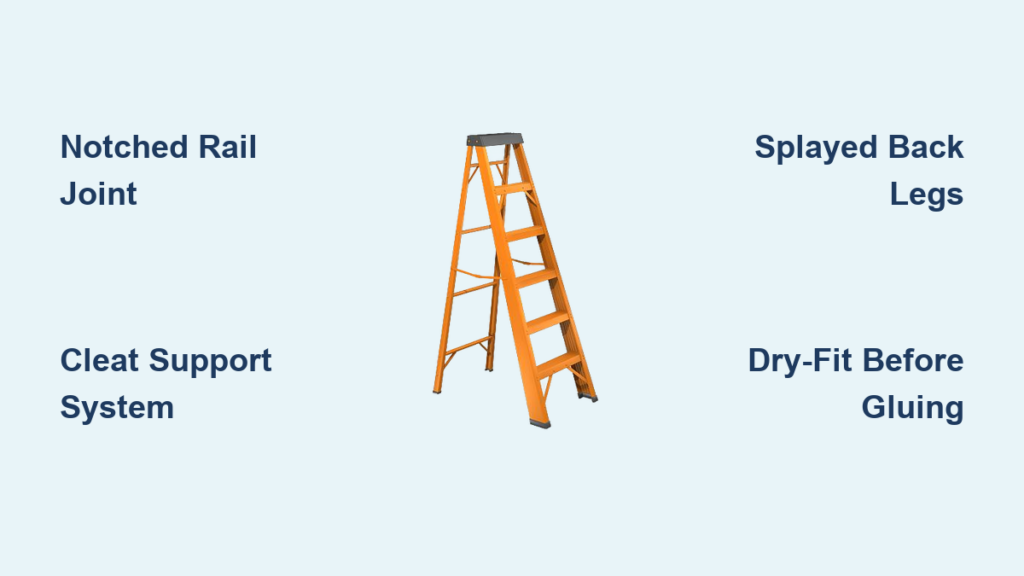
1. Notched Rail Method: Cut a ¾-inch deep groove into the rail face. The step slides in, resting on solid wood. Weight transfers directly down the rail.
2. Cleat Support System: Attach a triangular wood block under each step. The step bears down on this shelf, not the screws.
3. Through-Joint Technique: Steps extend through the rails (like traditional ladders). This creates the strongest load path but requires precision.
Pro Tip: Always use exterior wood glue with mechanical fasteners. The glue bonds wood fibers, adding 50% more strength before screws even engage.
Designing Your Step Ladder for Zero-Tip Stability

A ladder that tips backward isn’t just annoying—it’s catastrophic. Your design must counteract physics, not fight it. Start with geometry: a 7-inch rise (step height) paired with an 11-inch run (step depth) creates natural, safe footing. Now, the back legs—this is where most DIYers fail. A 90-degree vertical back leg creates a pivot point that encourages tipping. Instead, splay those legs outward to 75-80 degrees. This widens your base, anchoring the ladder against backward falls.
Why Your Top Platform Must Replace the Top Rung
That final “step” should be a 12×12-inch platform, not a narrow rung. Why? It gives you space to stand securely while reaching upward, preventing dangerous overreaching. Crucially, this platform must align with your step geometry—no awkward gaps where tools can slip. Build it as an extension of your top step, reinforced with corner braces underneath.
Cutting Side Rails: Precision Marks That Prevent Collapse
Your rails dictate everything. For a standard 6-foot closed ladder, cut two 8-foot 2x4s (use pressure-treated for outdoor use). Now, mark step positions on the inner face: Start 12 inches from the bottom (first step), then every 7 inches upward. Here’s the life-saving detail: Don’t just mark lines—measure inward 1.5 inches from the rail’s outer edge. This creates space for your step’s shoulder to seat inside the rail, not flush with the edge.
How to Cut Perfect Notches in 3 Steps
- Score first: Use a circular saw set to ¾-inch depth to cut the notch outline (don’t cut all the way through)
- Chisel clean: Remove the waste wood with a 1-inch chisel for a flat, smooth base
- Dry-fit immediately: Test each step in its notch before gluing—gaps mean weak points
Warning: Never skip dry-fitting. A 1/8-inch gap under a step concentrates your weight on screws, not wood.
Building Unbreakable Steps: Cleat Method vs. Notching
For DIYers, the cleat method beats notching for simplicity and strength. Here’s how to do it right:
Installing Cleats for Bulletproof Steps
- Cut 2×4 cleats: 3 inches long, one per step
- Position cleats: Glue and screw them flush to the rail’s bottom edge at each step mark
- Mount steps: Place 2×6 treads on cleats, pre-drill through the rail, and drive two 3.5-inch construction screws diagonally into the cleat and step end grain
Why this works: The cleat creates a shelf that bears your weight. Screws now resist lateral movement—not downward force. For extra security, add a vertical brace under the step.
Critical Mistake: Skipping Pilot Holes
End grain splits easily. Always drill a pilot hole 70% of the screw’s diameter (e.g., 3/16″ for a #10 screw). This lets the screw pull the wood tight without cracking it. No pilot hole = hidden cracks = sudden collapse.
Assembling Without Wobble: The Squareness Test

Misaligned rails cause twisting that weakens joints. Clamp rails together face-to-face before attaching steps. Use a carpenter’s square against a level surface to check alignment at three points: top, middle, and bottom. If rails aren’t perfectly parallel, your ladder will rack under load.
How to Attach Back Legs Safely
- Cut back legs from 2x4s, splayed 75-80 degrees
- Position them 18 inches from the bottom (prevents tipping)
- Secure with 1/2-inch galvanized lag bolts through both rails—not just screws
- Add a cross-brace at the top of the back legs for rigidity
Pro Tip: Test stability before finishing. Stand on the ladder on a hard surface—no rocking or creaking allowed.
Safety Upgrades That Prevent Disasters
Rubber feet aren’t optional—they’re non-negotiable. Cut 1-inch thick strips from an old tire or buy adhesive non-slip pads. Attach them to the very bottom of each leg. On smooth surfaces, this prevents slips that cause 40% of ladder falls. Then, build a tool tray: Screw a 6×12-inch scrap wood piece between the back legs at waist height. It doubles as a stabilizer and holds paint cans or tools.
Testing Your Ladder Before You Stand On It
Never assume it’s safe. Perform these checks:
1. Twist test: Grip top rails and twist side-to-side—zero flex means solid joints
2. Step test: Stand on each step with full weight—no creaking or movement
3. Level test: Place on uneven ground; legs should contact fully without rocking
If it fails any test, disassemble and reinforce joints. Your life isn’t worth skipping this step.
When Building a Step Ladder Is a Terrible Idea
Here’s the hard truth: how to build a step ladder safely for heights above 4 feet is nearly impossible at home. Commercial ladders undergo rigorous ANSI/OSHA testing—yours won’t. At 6+ feet, a collapse means broken bones or worse. Worse, if you’re injured using a homemade ladder, your homeowner’s insurance may deny the claim. Save DIY for 2-3 step stools only. For anything taller, a $100 certified ladder is cheaper than an ER visit.
The 3-Foot Safety Threshold
- ✅ Build it: For 24-inch tall step stools (e.g., reaching a shelf)
- ❌ Buy it: For 4+ feet (e.g., changing light fixtures, gutter work)
- 💡 Smart compromise: Modify a commercial ladder’s height with safe extensions
Maintaining Your DIY Step Ladder for Years of Use
Even perfect construction degrades. Before every use:
– Check for hairline cracks around joints
– Tighten all screws (loose fasteners accelerate wood fatigue)
– Sand splinters smooth—rough wood hides cracks
– Reapply exterior spar urethane annually for outdoor ladders
Discard immediately if you see any of these:
– Gaps opening between steps and rails
– Squeaks when weight is applied
– Twisting during the squareness test
Building a safe step ladder isn’t about fancy tools—it’s about respecting physics. By designing joints where wood bears the load, not screws, you create something that won’t betray you mid-task. But remember: if you’re working above 3 feet, a certified commercial ladder isn’t a luxury—it’s the only sane choice. For smaller projects, this guide gives you the blueprint to build with confidence. Now, measure twice, cut once, and never skip the glue. Your future self, standing safely on solid steps, will thank you.