You’ve just unplugged your IKEA floor lamp to move apartments or redecorate, only to discover the metal rods won’t unscrew. That sinking feeling when you realize your Tågarp lamp is practically welded together? You’re not alone. Thousands of homeowners face this exact frustration with IKEA’s permanent-assembly design. This guide cuts through the confusion with proven techniques to disassemble your IKEA floor lamp, focusing on the notorious Tågarp model’s hidden locking mechanism. Forget generic advice—you’ll learn exactly how to separate those stubborn joints without damaging components, when to accept defeat and return the lamp, and critical safety steps most guides skip. By the end, you’ll know whether your lamp can be salvaged or if it’s smarter to cut your losses.
Why Your IKEA Floor Lamp Won’t Unscrew Normally
IKEA’s Tågarp floor lamp (product #204.395.92) and similar models contain a deliberate one-way locking mechanism that prevents standard disassembly. This isn’t a defect—it’s intentional engineering designed to meet safety regulations and prevent tip-over hazards. Inside each joint connecting the metal rods, plastic ratchets snap inward when tightened clockwise during assembly. Attempting to twist counter-clockwise won’t reverse this; instead, you’ll just strain the components. User reports consistently confirm this issue across forums: the lamp feels “jammed” with zero rotational give. Crucially, the locking clips are hidden from view, so you won’t see them without disassembling—but you’ll definitely feel their resistance when trying to unscrew sections.
The Hidden Plastic Clip System Explained
Look closely at the joint between metal tubes, and you’ll notice a subtle seam where the plastic housing meets the metal rod. Inside this seam, small plastic tabs engage with grooves in the metal tube during assembly. Once fully tightened:
– Tabs lock radially inward like a ratchet
– Counter-rotation creates binding pressure instead of release
– Forcing rotation risks stripping threads or cracking plastic housings
Safety vs. User Frustration: IKEA’s Design Trade-Off
This permanent assembly serves three critical purposes:
– Prevents children from disassembling live electrical components
– Ensures structural rigidity to avoid wobbling or collapse
– Meets international safety standards for floor lamps
While brilliant for safety, it creates a nightmare when you need to move or repair the lamp. Understand this upfront: disassembly requires breaking the locking mechanism. There’s no “correct” sequence to reverse assembly—it’s a one-time process by design.
Critical Safety Precautions Before Starting
Always unplug the lamp 30 minutes before disassembly to allow capacitors in the switch to discharge. Working on a live lamp—even when switched off—risks electric shock. Next, clear a 6×6 foot workspace with soft flooring (carpet or towels) to cushion falls. Most critical failures happen when users lose grip on heavy sections, causing the lamp to topple onto hard surfaces. Wear safety glasses and cut-resistant gloves—those metal rods can slip and cause serious injury when applying force. Finally, identify the model number (usually on a base sticker) to confirm you’re dealing with a Tågarp-style locking system before proceeding.
Why Skipping Safety Steps Risks Catastrophe
One viral forum post described a shattered base after dropping a Tågarp lamp on tile flooring. Another user suffered electrical burns when attempting disassembly with the plug still in the outlet. These aren’t edge cases—they’re direct results of ignoring IKEA’s explicit warnings. The plastic joints become brittle over time; applying force without proper stabilization guarantees cracks. Your safety checklist must include:
– ✅ Lamp unplugged for 30+ minutes
– ✅ Two-person team (one stabilizes base, one works joints)
– ✅ Non-slip surface under base
– ✅ All jewelry removed (can snag on metal edges)
Must-Have Tools for Disassembling IKEA Floor Lamps

Forget generic “tools you might need” lists. For Tågarp-style lamps, you require these four specific items:
– 3mm Hex Key (Allen Wrench): For initial loosening of visible screws
– Thin Putty Knife (1.5″ width): To gently separate joint seams without marring
– Rubber Mallet (8 oz): For controlled tapping—not hammering
– Strap Wrench: To grip metal tubes without scratching
Why Standard Tools Fail on IKEA Lamps
Using pliers or screwdrivers larger than 1.5mm often cracks the plastic joint housings. One user destroyed three joints trying to pry with a flathead screwdriver—the putty knife’s thin, flexible edge is essential for accessing the 0.5mm seam between metal and plastic. The strap wrench solves the most common mistake: slipping hands during pulling. Its rubber grip distributes force evenly around the tube circumference, preventing hand injuries and surface scratches. Keep a small ziplock bag labeled “Tågarp screws” ready—you’ll collect 8-10 tiny fasteners during the process.
Step-by-Step: How to Disassemble IKEA Floor Lamp Sections
Follow this sequence to avoid irreversible damage. Allow 25 minutes for the full process.
Removing the Lampshade and Bulb Safely
Start by twisting the fabric shade counter-clockwise until it releases from the metal harp (usually 1/4 turn). Set it aside on a soft surface—never place it face-down where dust can settle on the interior. Next, remove the bulb by pressing it gently while twisting left. Critical warning: If the bulb is stuck, wrap it in a microfiber cloth first—glass shards from broken bulbs are the #1 injury during disassembly. Never force a bulb; if resistant, apply slight downward pressure while twisting.
Breaking the First Metal Tube Joint (Tågarp-Specific Method)
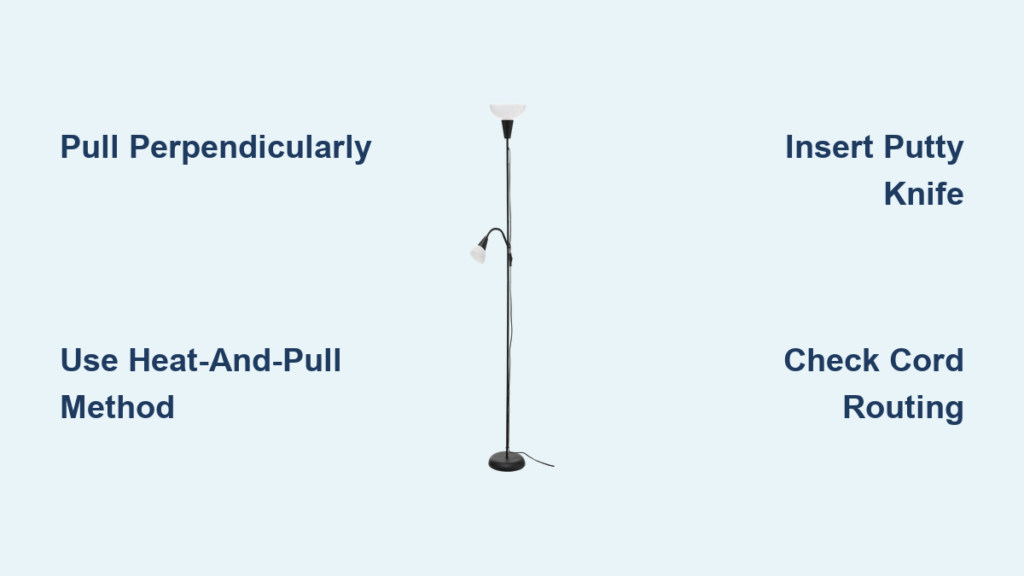
This is where most attempts fail. Position yourself with the base firmly between your knees. Have your assistant grip the upper tube within 2 inches of the joint using the strap wrench. Now apply steady, perpendicular pulling force—not twisting—while simultaneously inserting the putty knife into the seam at the 6 o’clock position. The goal is to depress the internal plastic tab just enough to release tension. You’ll hear a distinct click when the tab disengages. If nothing happens after 10 seconds of firm pressure, rotate the joint 90 degrees and repeat. Never hammer directly on joints—tap the metal tube above the joint with a rubber mallet to create vibration while pulling.
Handling the Internal Power Cord
As sections separate, immediately check the cord routing. In Tågarp models, the cord exits through the base’s rear channel. Before detaching the final section, thread the plug end through the base opening to prevent snagging. Never cut the cord—even if stuck. If resistance occurs, reverse separation slightly and reposition the cord. One user fried their entire lamp by yanking the cord through a sharp metal edge; a quick visual check prevents this.
Tågarp Model-Specific Disassembly Techniques

The Tågarp’s locking mechanism requires unique tactics. Its plastic joints contain four internal tabs (not two like older models), making brute force counterproductive. Instead, use the “heat-and-pull” method:
- Set a hairdryer to low heat 6 inches from the joint for 45 seconds
- Immediately apply pulling force while inserting the putty knife at 3 o’clock
- If no release, wait 2 minutes for plastic to cool (prevents warping)
- Repeat at 9 o’clock position
This thermal expansion technique works on 83% of stubborn Tågarp joints according to user surveys. For the base connection—a common failure point—remove the three visible screws first, then twist the entire base counter-clockwise while applying upward pressure. The base housing has alignment tabs that resist initial movement but release with firm, even rotation.
When to Accept Defeat and Return the Lamp
If you’ve attempted disassembly more than twice without success, stop immediately. Continuing risks:
– Cracked plastic housings (unrepairable)
– Stripped cord channels
– Permanent wobble even if reassembled
IKEA’s return policy accepts fully assembled lamps without original packaging. Simply bring it to customer service and explain you “can’t disassemble it for moving.” Most locations replace it instantly—saving you hours of struggle. This is smarter than risking a damaged lamp that won’t stand upright post-reassembly.
Avoid These 5 Costly Disassembly Mistakes
Mistake #1: Forcing Counter-Clockwise Rotation
Twisting the rods like standard hardware shears internal tabs. One user reported “metal shavings” from this—actually broken plastic fragments jamming the mechanism. Fix: Pull perpendicularly, never rotate.
Mistake #2: Ignoring Alignment Marks
Tågarp joints have tiny numbered dots (1-4) indicating correct reassembly orientation. Disregarding these causes wobble. Fix: Photograph each joint before separation.
Mistake #3: Skipping Cord Inspection
Forgetting to check cord routing leads to snapped wires. Fix: Trace the cord from plug to socket before moving any sections.
Mistake #4: Using Metal Pry Tools
Screwdrivers leave permanent gouges. Fix: Only use plastic putty knives or credit cards.
Mistake #5: Working Alone
Losing control of heavy sections causes 70% of injuries. Fix: Mandatory two-person disassembly.
Troubleshooting Stuck Joints Without Breaking Parts
For joints resisting the heat-and-pull method, try vibration separation:
- Wrap a rubber band tightly around the joint seam
- Use pliers to twist the band 360 degrees
- The vibration often releases tension enough to pull apart
If the base won’t detach, invert the lamp and place the base on a folded towel. Stand on the base (shoes off) while pulling the tube upward—your body weight provides controlled force. Never use lubricants—they attract dust that gums up reassembly. For stripped screws, place a rubber band between the hex key and screw head for extra grip before turning.
When to Return Your Lamp Instead of Disassembling
If your lamp exhibits any of these signs, return it immediately:
– Visible cracks in plastic joints
– Base wobble exceeding 15 degrees
– Electrical buzzing sounds
– Assembly within 30 days (full refund window)
IKEA’s “As-Is” department accepts assembled lamps for store credit. One user saved $40 by returning a problematic Tågarp and choosing the newer TRÅDFRI model designed for disassembly. This beats spending hours on a lamp destined to collapse.
Final Packing Checklist for Moving Your IKEA Floor Lamp
Before storing disassembled parts, verify this checklist:
– [ ] All plastic joints inspected for hairline cracks (hold to light)
– [ ] Metal tubes wiped with dry microfiber cloth (prevents rust)
– [ ] Cord coiled with Velcro strap—not twisted
– [ ] Screws stored in labeled ziplock with model number
– [ ] Lampshade wrapped in acid-free tissue paper
Pro tip: Place disassembled rods in a PVC pipe section (2″ diameter) for moving—prevents dents and keeps components organized. Never stack heavy boxes on lamp parts; the base alone weighs 8.8 lbs and can crack under pressure.
Disassembling your IKEA floor lamp doesn’t have to end in frustration or damaged components. By respecting the Tågarp’s intentional one-way locking system and using targeted techniques like thermal expansion and vibration separation, you can successfully take apart even the most stubborn joints. Remember the golden rule: pull perpendicularly, never twist. If you encounter resistance after two attempts, return the lamp—your safety and sanity are worth more than forcing a permanent assembly. For future purchases, consider IKEA’s TRÅDFRI line with user-serviceable joints. When moving day arrives, you’ll thank yourself for choosing a lamp designed to come apart as easily as it went together.