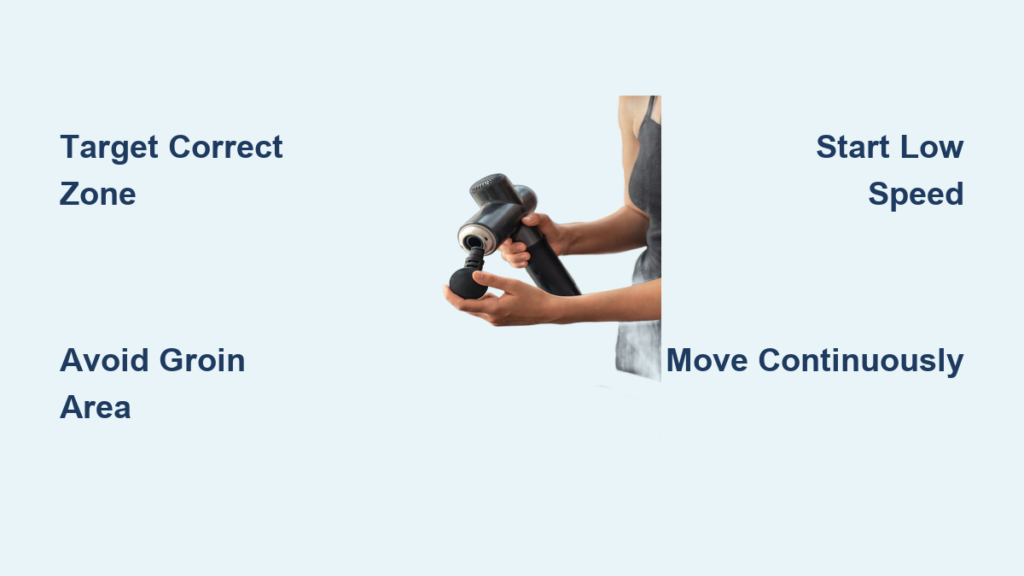
That persistent ache in your front hip that makes sitting uncomfortable, climbing stairs difficult, or even sleeping a challenge? You’re not alone. Millions suffer from tight hip flexors due to sedentary lifestyles, intense athletic training, or poor movement patterns. Learning how to massage gun hip flexor muscles properly can provide immediate relief from this common but often misunderstood pain. The hip flexors—particularly the iliacus and psoas—are deep muscles that become tight from prolonged sitting, inadequate stretching, or muscular imbalances. When these muscles shorten, they pull on your pelvis, causing lower back strain and limited mobility. A massage gun delivers targeted percussion therapy that breaks up adhesions, increases blood flow, and resets muscle tone. But improper use can cause more harm than good. This guide reveals exactly how to safely and effectively use a massage gun on your hip flexors for lasting relief.
Essential Safety Steps Before Hip Flexor Treatment
Stop immediately if you experience sharp, shooting pain, numbness, or tingling during treatment—these indicate potential nerve irritation or more serious issues. Using a massage gun on hip flexors requires special caution because of the femoral triangle, which contains major blood vessels and nerves. Never apply the massage gun to the soft, inner groin area where your leg meets your torso. If you have a history of blood clots, osteoporosis, hernias, or recent abdominal surgery, consult your doctor before attempting self-treatment.
For proper setup, choose a conical or bullet attachment that provides precise targeting of these deep muscles. Begin at the lowest speed setting (1,200-1,500 percussions per minute) and use only the weight of the device—never press down forcefully. Always work on clean, dry skin without lotions or oils that could cause slipping. Before starting, take 3-5 deep breaths to relax your nervous system, allowing your muscles to release tension more effectively. If you’re new to this technique, limit initial sessions to just 1-2 minutes per side to assess your body’s response.
Precisely Locate Your Hip Flexors and Safe Zones
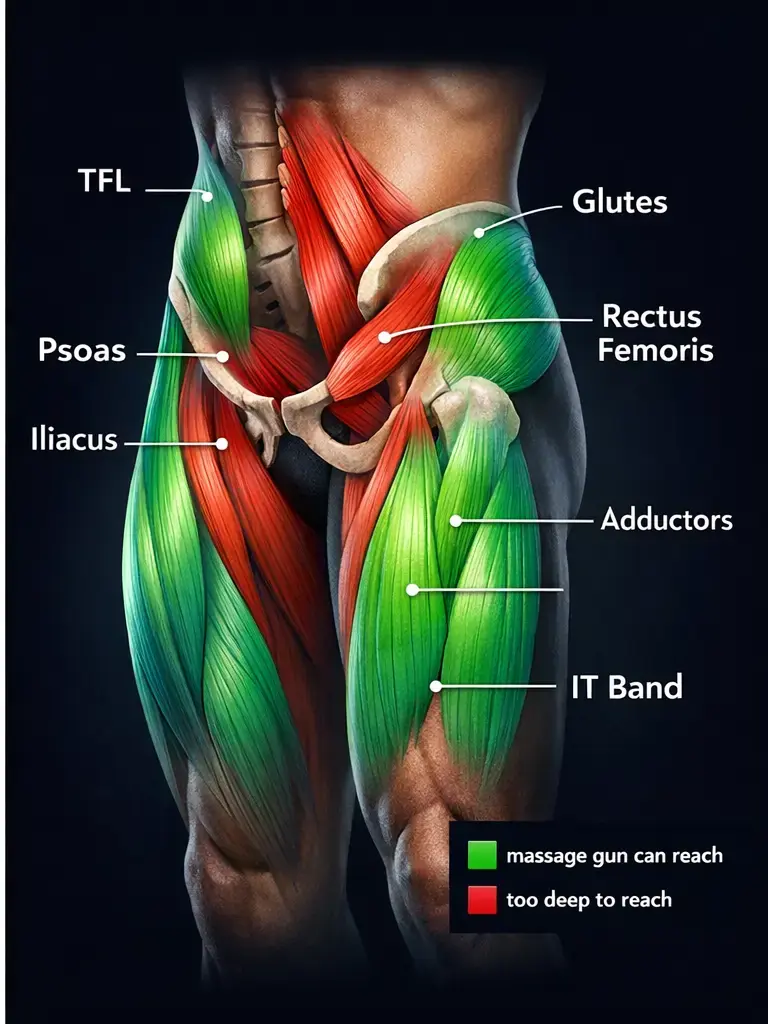
Your hip flexors aren’t where most people think—they’re deeper and more internal than the quadriceps. To find the safe treatment area, place your fingers on the front bony point of your hip (the ASIS). Move 1-2 inches inward and downward from this landmark toward your belly button. This is Zone A in the three-zone approach—your primary target area. The iliacus muscle lies here, originating from the inner surface of your pelvic bowl.
Crucially avoid these danger zones:
* The inguinal ligament (the diagonal crease between torso and thigh)
* The femoral triangle (soft inner groin area with major vessels/nerves)
* Direct pressure on bony prominences like the ASIS or pubic bone
When properly positioned, you should feel firm but yielding muscle tissue—not hard bone or soft, hollow areas. If you’re unsure, gently palpate the area first to identify tender spots before applying the massage gun. Remember: the safe zone is toward the front of your hip, not the inner thigh. Many users mistakenly target the groin area, which can cause nerve irritation or vascular issues.
Step-by-Step Hip Flexor Release Protocol
Positioning and Initial Assessment
Lie on your back with knees bent and feet flat on the floor. For deeper access, place a pillow or foam roller under your hips to gently tilt your pelvis backward. Locate the target area 1-2 inches medial to your ASIS and gently press with your fingers to identify tender spots. Begin with the massage gun on the lowest setting and place the conical attachment on the outer edge of your target zone, not directly on the most tender spot.
Proper Technique and Movement Patterns
Apply the massage gun with vertical strokes along the muscle fibers (3-5 passes), then transition to small circular motions (1-inch diameter) moving at 2-3 cm per second. Never hold the device in one spot for more than 20-30 seconds—continuous movement prevents tissue damage. Use the pain scale as your guide: 1-3/10 is ideal for treatment, 4-6/10 is your maximum therapeutic range, and anything above 7/10 requires immediate reduction in pressure. Spend just 1-2 minutes per side during your first session.
Progressive Treatment Parameters
For optimal results, gradually increase treatment time over 2-4 weeks:
* Week 1: 1-2 minutes per side, once daily
* Week 2: 2-3 minutes per side, once daily
* Week 3+: 3-5 minutes per side, 1-2 times daily
Always start at the lowest intensity and increase only as your tissues adapt. If you experience increased pain 24 hours after treatment, you’ve overdone it—reduce time and intensity during your next session. For stubborn tension, incorporate cross-fiber friction (horizontal strokes across muscle fibers) for 30-45 seconds on particularly tight areas.
Avoid These 3 Common Hip Flexor Massage Mistakes

Grinding on Bony Landmarks
Many users mistakenly press the massage gun directly against the ASIS (front hip bone), causing bruising and inflammation. Solution: Stay 2-3 finger widths away from all bony points. Focus on the soft tissue between the hip bone and belly button. If you feel hard bone beneath the attachment, reposition immediately.
Skipping the Warm-Up Phase
Applying intense percussion to cold, tight muscles triggers protective tension. Solution: Perform 5-10 minutes of light cardio (walking, marching in place) or dynamic stretches before treatment. This increases blood flow and prepares tissues to accept therapy. Your muscles should feel warm but not fatigued.
Over-Treating Sensitive Areas
More isn’t better with hip flexors. Excessive treatment causes inflammation and delayed onset muscle soreness. Solution: Strictly follow the 1-2 minute maximum for initial sessions. Remember that increased blood flow from proper technique creates a 20-30% circulation boost—this therapeutic effect continues after you turn off the device.
Post-Treatment Care for Maximum Results
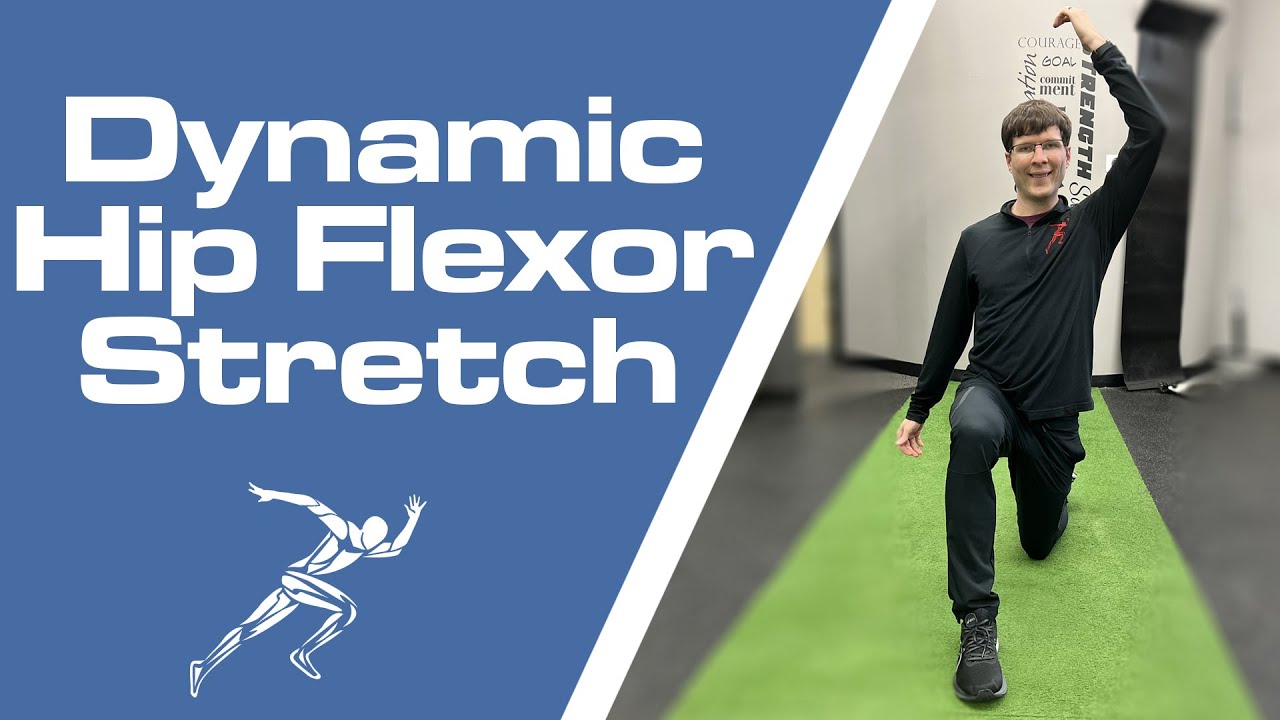
Your hip flexors need specific care immediately after massage gun therapy to lock in benefits. Drink 16-24 ounces of water within 30 minutes to help flush metabolic waste released during treatment. Follow with 5-10 minutes of gentle dynamic stretching—try standing hip circles (10 in each direction) or cat-cow stretches (10 reps). Avoid static stretching immediately after treatment, as your muscles are in a relaxed, elongated state and need time to reset.
For lasting relief, integrate these daily maintenance practices:
* Perform a kneeling hip flexor stretch (30 seconds per side)
* Do standing hip circles daily (10 in each direction)
* Incorporate cat-cow stretches into your morning routine (10 reps)
* Use your massage gun 2-3 times weekly for maintenance
If you experience mild soreness (1-2/10) for 12-48 hours, this is normal. Apply heat for 15-20 minutes followed by 15 minutes of cold if inflammation appears. Discontinue use and consult a healthcare professional if sharp pain persists more than 72 hours post-treatment.
Complementary Therapies That Enhance Results
A massage gun works best as part of a comprehensive approach. Try this effective sequence: 15 minutes of heat application → 5-7 minutes of targeted massage gun therapy → 5 minutes of dynamic stretching. For stubborn tightness, incorporate foam rolling on your quadriceps and glutes first—this reduces compensatory tension on your hip flexors.
When professional help is available, schedule physical therapy sessions (1-2x weekly) to address underlying movement patterns. A physical therapist can verify your technique and identify if your hip flexor pain stems from core weakness or spinal issues. For chronic cases, consider adding yoga or Pilates to build core stability—this prevents recurrence by addressing the root cause of your tight hip flexors.
Remember that proper technique yields results in 1-2 weeks (pain reduction), 2-4 weeks (improved flexibility), and 4-8 weeks (functional improvement during activities). If you see no improvement after 4 consistent weeks, experience worsening pain, or develop neurological symptoms, seek professional evaluation—these indicate you need more than self-treatment can provide.