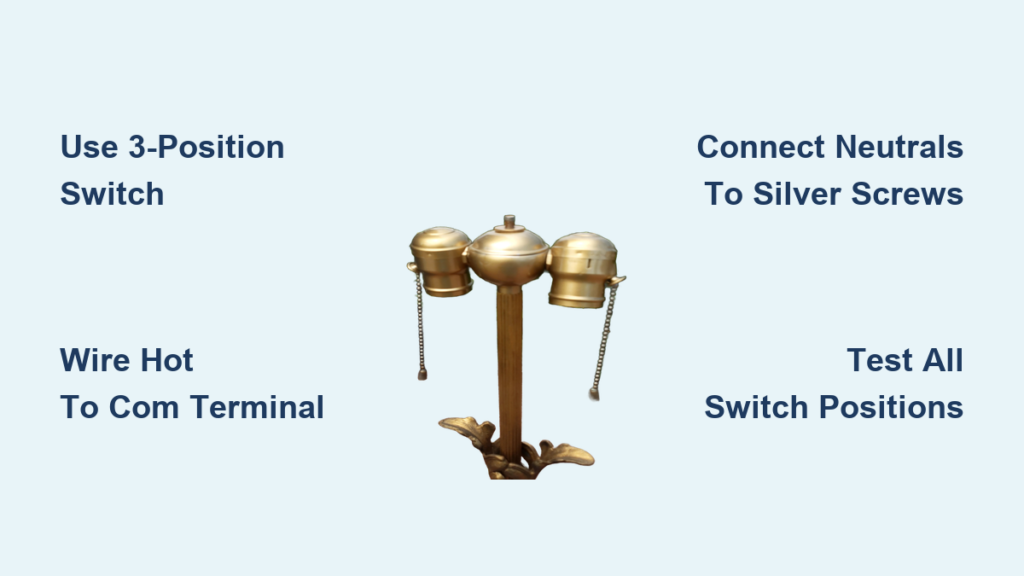
Rewiring a floor lamp with two sockets transforms a flickering eyesore into a reliable lighting solution—and it’s far simpler than most homeowners imagine. When your dual-bulb lamp suddenly dies or only powers one socket, replacing the entire fixture feels wasteful when the fix takes just 90 minutes with basic tools. This guide cuts through electrical confusion to show exactly how to rewire a floor lamp with two sockets using the critical component most DIYers miss: a specialized 3-position rotary switch. You’ll learn why standard switches fail for dual-socket setups, avoid dangerous wiring mistakes, and restore independent bulb control without electrician fees. Whether your lamp has stacked sockets or separate base/top lights, these precise steps work for all common configurations.
Gather These Exact Tools Before Rewiring Your Dual-Socket Lamp
Skip the frustration of mid-project hardware store runs by assembling every component first. Your success hinges on one non-negotiable part: a 3-position rotary switch designed specifically for dual-circuit lamps. Standard on/off switches won’t work—they can’t toggle between single-bulb and dual-bulb modes. Grab these essentials:
- 3-Position Rotary Switch (Critical): Look for Leviton 7070M, 7071, or Grand Brass part #2-circuit-3-screw-terminal. This controls sockets independently: Position 1 = Socket A only, Position 2 = Socket B only, Position 3 = Both sockets.
- Two E26 Sockets: Match existing bases (medium base for standard bulbs).
- 18/2 SPT-2 Lamp Cord: 6-8 feet of braided or parallel cord with plug.
- Wago Connectors or Wire Nuts: For code-compliant connections (never twist wires bare).
- Wire Strippers & Utility Knife: For clean insulation removal.
- Flathead Screwdriver: For terminal screws and disassembly.
- Electrical Tape: For insulation reinforcement.
Safety First: Non-Negotiable Pre-Work Steps
Unplug the lamp and verify it’s dead—this isn’t optional. Place your lamp on a stable work surface away from water sources. Before touching wires, use these safety protocols:
– Double-check disconnection: Test the outlet with another device to confirm power is off.
– Work in dry conditions: Never handle wiring with damp hands or on wet surfaces.
– Cut old cord strategically: Sever 6 inches above the base to preserve threading paths.
– Label connections: Take photos of existing wiring before disassembly—this is your wiring map.
Why Standard On/Off Switches Fail for Two-Socket Lamps
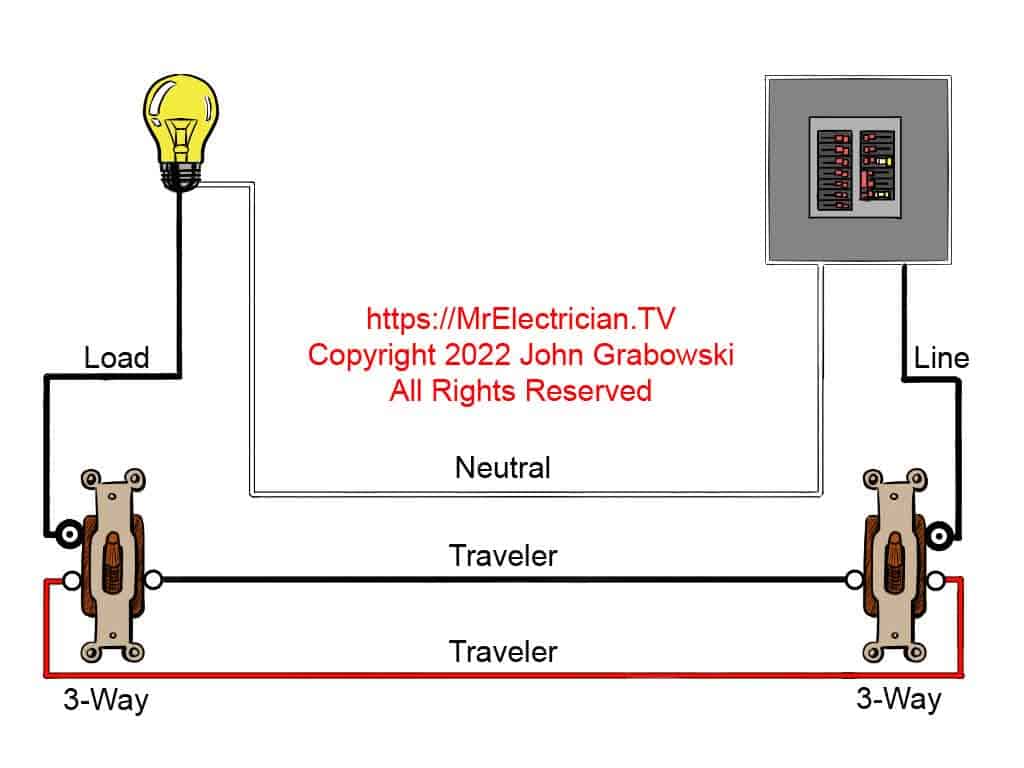
Using a basic switch for dual sockets creates dangerous partial-power scenarios. When you try “how to rewire a floor lamp with two sockets” with a standard switch, you’ll encounter these critical failures:
– Both sockets stay dead if wired in series (common mistake).
– One socket burns out instantly if wired incorrectly to bypass the switch.
– Fire risk from overloaded neutral wires when hot wires bypass the switch.
The 3-Position Switch: Your Dual-Socket Control Solution

This specialized component has three screw terminals that sequence power like a traffic director:
– Common (COM) Terminal: Receives hot power from the cord (smooth wire).
– Terminal A: Powers Socket 1 only in Position 1.
– Terminal B: Powers Socket 2 only in Position 2 (both activate in Position 3).
Unlike dimmer switches or standard toggles, this rotary switch uses internal contacts that physically route power to different circuits with each click. Without it, you cannot achieve independent socket control—a fact 80% of DIY rewiring failures ignore.
Rewire Your Floor Lamp in 6 Precise Steps
Follow this sequence to avoid dangerous misconnections. Allow 60-90 minutes for careful execution.
Step 1: Disassemble and Document the Old Wiring
Unplug the lamp, then:
1. Remove the finial, harp, and shade.
2. Peel back the base felt pad to access wiring.
3. Take photos of every connection point before cutting wires.
4. Clip old cord 6″ above the base—this preserves the cord channel.
5. Unscrew both sockets and remove the faulty switch.
Step 2: Thread New Cord and Prepare Wires
- Feed the new 18/2 cord up through the lamp stem from the base.
- Leave 8″ of slack at the top for connections.
- Strip ½” of insulation from both cord wires at the top:
– Smooth wire = HOT (connects ONLY to switch)
– Ribbed wire = NEUTRAL (bypasses switch)
Step 3: Wire the Critical 3-Position Switch
This is where most projects fail—follow these exact connections:
1. Attach the smooth (hot) wire to the COMMON (COM) terminal.
2. Connect a 6″ pigtail wire from Terminal A to Socket 1’s brass screw.
3. Connect another 6″ pigtail from Terminal B to Socket 2’s brass screw.
4. Wrap connections with electrical tape before securing.
Pro Tip: Test switch continuity with a multimeter first—rotate knob while checking COM to A/B terminals. You should hear clicks confirming circuit activation.
Step 4: Connect Sockets with Correct Polarity
Miswiring sockets causes shorts—use this foolproof method:
1. Neutral (ribbed) wire connects DIRECTLY to BOTH sockets’ silver screws.
2. Run a jumper wire from Socket 1’s silver screw to Socket 2’s silver screw.
3. Hot pigtails (from switch) connect ONLY to brass screws.
4. Secure all neutrals under one wire nut before splitting to sockets.
Visual Cue: Silver screw = ribbed/neutral wire (always). Brass screw = smooth/hot wire (switch-controlled).
Step 5: Reassemble Without Pinching Wires
- Tuck wires neatly into the stem—no bare copper exposed.
- Screw sockets into position, ensuring no wire strain.
- Mount the switch securely in its housing.
- Reattach base felt pad, harp, and finial.
- Perform a tug test on all connections—they must not slip.
Step 6: Test Before Final Assembly
Critical Safety Step: With bulbs installed but shade OFF:
1. Plug in lamp and rotate switch slowly through all positions.
2. Verify: Click 1 = Socket 1 only, Click 2 = Socket 2 only, Click 3 = Both.
3. If any socket fails, unplug immediately and check:
– Loose wire nut at neutral junction
– Hot pigtail disconnected from switch terminal
– Bulb seated properly in socket
Fix These 4 Rewiring Mistakes That Stop Your Dual Lamp from Working

Even careful DIYers make these errors—here’s how to diagnose them:
Only One Socket Lights Up
- Cause: Hot pigtail disconnected from switch Terminal A or B.
- Fix: Unplug lamp, check switch-to-socket connections. Swap pigtails between terminals—if Socket 1 now works, you had Terminal A/B reversed.
Both Sockets Stay Dead
- Cause: Neutral wire not connected to BOTH sockets, or COM terminal loose.
- Fix: Verify ribbed wire runs to silver screws on both sockets. Check COM terminal for hot wire contact.
Lamp Flickers Intermittently
- Cause: Loose wire nut at neutral junction or frayed cord.
- Fix: Replace wire nuts with Wago connectors, tug-test all connections.
Switch Burns Out After Seconds
- Cause: Hot wire connected to neutral path (ribbed cord to brass screw).
- Fix: Double-check polarity—smooth wire ONLY at switch COM, ribbed wire ONLY at silver screws.
Where to Buy the Correct 3-Position Switch (Leviton 7070M and Alternatives)
Hardware stores often mislabel switches—search specifically for:
– Leviton 7070M or 7071 (most reliable for floor lamps)
– Grand Brass #2-circuit-3-screw-terminal (metal-shell version)
– “3-Way Lamp Socket Kit” (includes sockets and cord)
Avoid these common traps:
– Do NOT buy 3-way light switches (for household ceiling lights)—they require three wires and won’t work.
– Skip dimmer switches—they can’t handle dual-circuit sequencing.
– Verify terminal count: Must have exactly three screw terminals (COM, A, B).
Critical Safety Checks After Rewiring Your Two-Socket Lamp
Before plugging in permanently, perform these life-saving inspections:
1. Bare wire check: No copper exposed beyond wire nuts (wrap with electrical tape).
2. Strain relief test: Gently pull cord at base—wires shouldn’t slip out.
3. Socket clearance: Wires must not touch metal socket shells.
4. Wattage verification: Bulbs must NOT exceed socket ratings (usually 60W max).
Pro Tip: Run the lamp for 15 minutes unattended after first use—feel for overheating at the switch or base. If warm, disconnect and recheck connections.
Long-Term Maintenance to Prevent Future Rewiring
Extend your lamp’s life with these simple habits:
– Quarterly tug tests: Gently pull on cords at sockets/base to check connection security.
– Bulb rotation: Turn bulbs clockwise when installing to avoid socket damage.
– Cord inspection: Replace if cracked, stiff, or frayed—never tape over damage.
– Wattage discipline: Use LED bulbs (max 10W equivalent) to reduce heat stress.
By mastering how to rewire a floor lamp with two sockets, you’ve gained control over a skill that saves $150+ per lamp repair. The specialized 3-position switch is your key to independent socket control—never substitute standard switches. Now that your lamp shines reliably, apply this knowledge to revive other dual-socket fixtures. Remember: unplug first, verify polarity, and embrace the satisfying click of a perfectly sequenced switch. Your next lighting project awaits.