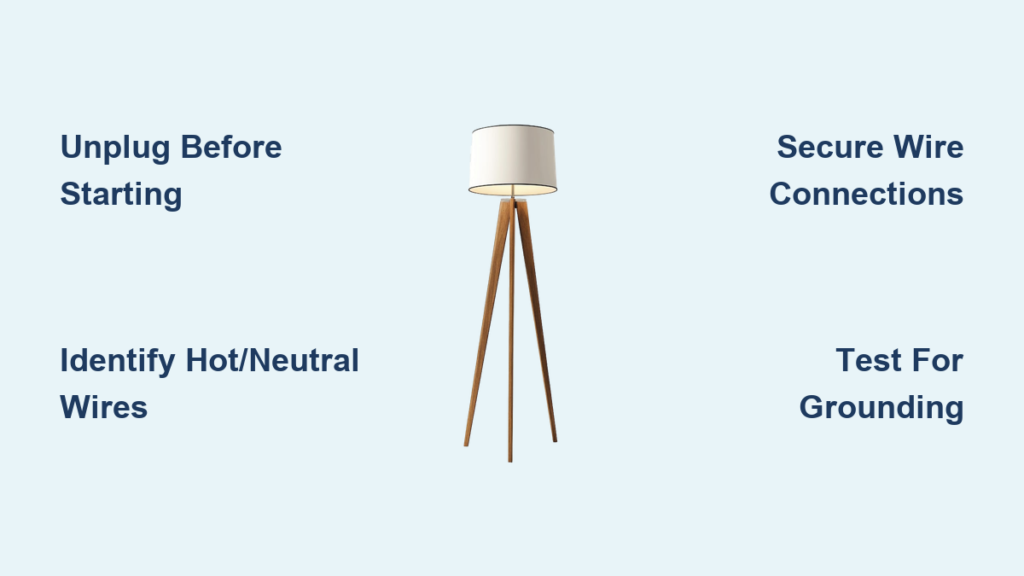
That beloved vintage floor lamp in your living room? The one with the elegant brass base and art deco shade? Its brittle, crumbling insulation could be hiding a serious shock hazard. Old lamp wiring becomes dangerously fragile over time, with exposed conductors risking fires or electrocution every time you flip the switch. Learning how to rewire an old floor lamp isn’t just about preserving an heirloom—it’s about making it safe for daily use. In this guide, you’ll discover exactly how to replace worn wiring in under two hours using basic tools. We’ll cover critical safety checks, precise wire connections, and professional-grade testing so you can restore your vintage treasure without risking your home’s safety. By the end, you’ll know precisely how to rewire an old floor lamp while avoiding dangerous mistakes that compromise functionality.
Why Rewiring Your Vintage Floor Lamp Is Non-Negotiable for Safety
Ignoring deteriorating lamp wiring risks far more than a burnt-out bulb. Brittle insulation from decades-old cords exposes live conductors, creating fire hazards when wires rub against metal lamp bodies. For metal-base lamps, absence of grounding turns the entire fixture into a shock hazard—a single frayed wire could electrify the base you touch daily. Vintage sockets with cardboard insulation also fail catastrophically when overheated, melting into flammable debris. Modern electrical standards require grounded connections for metal fixtures, making rewiring essential before plugging in any pre-1980s lamp. Skipping this step violates basic safety protocols and could void home insurance if a fire occurs.
Critical Danger Signs Requiring Immediate Rewiring
- Visible cracks or stiffness in the cord (test by gently bending—it should stay flexible)
- Discolored or warped sockets indicating past overheating
- Two-prong plugs on metal lamps (no grounding path)
- “Crackling” sounds when operating the lamp
Metal vs. Non-Metal Lamp Grounding Rules
For wooden or ceramic lamps, a standard two-wire cord suffices—hot to brass socket terminal, neutral to silver. But metal-base lamps demand a three-wire cord: the green ground wire must attach directly to the lamp’s metal frame using a grounding screw. Never omit this step—it’s not just best practice but electrical code compliance. Attempting to rewire without proper grounding transforms your vintage piece into a lethal trap.
Gather These 9 Essential Tools Before Touching Your Lamp
Using improper tools risks damaging delicate vintage components or creating unsafe connections. For rewiring an old floor lamp, you’ll need:
- SPT-2 lamp cord (18-gauge for floor lamps; 3-wire if metal base)
- Reproduction socket matching your lamp’s vintage style (e.g., B&P Lamp Supply)
- Voltage tester (non-contact type) to confirm zero power
- Wire strippers with 3/4″ depth gauge
- Phillips screwdriver (size #1 or #2)
- Needle-nose pliers for wire bending
- Safety glasses (mandatory for broken bulb removal)
- Multimeter for final continuity testing
- Replacement harp if original is bent
Pro Tip: For lamps with fabric-covered cords, buy “vintage-style” SPT-2 wire that mimics the original look while meeting modern safety standards. Never reuse old sockets—cardboard insulation degrades internally even if the exterior looks intact.
Step 1: Safely Disassemble Your Floor Lamp Without Breaking Components
Always start with the lamp unplugged for 24+ hours—residual charge can linger in capacitors. Confirm zero voltage using your non-contact tester at the plug and socket.
Remove Lamp Components in This Order
- Unscrew the finial holding the shade, then lift off the shade and harp
- Extract the bulb (if broken, use the potato method: press halved potato into base and twist counterclockwise)
- Loosen the socket set screw (usually on the collar) with a Phillips driver
- Slide off the socket shell to expose wiring terminals
- Cut the old cord 2 inches above the base to preserve threading access
Critical Mistake to Avoid: Never force corroded parts—apply penetrating oil and wait 10 minutes. Forcing vintage threads strips them permanently.
Step 2: Thread the New Cord Through Your Lamp’s Body Correctly
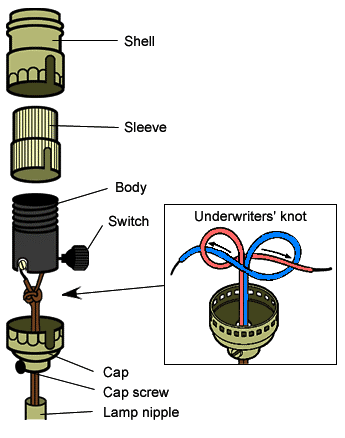
Feeding wire through twisted lamp stems requires finesse. Start from the base upward to prevent kinks.
Proper Cord-Feeding Technique
- Insert cord end into base hole, gripping with needle-nose pliers
- Gently snake upward while rotating the cord (don’t yank)
- Pull 8–10 inches extra through the top for wiring slack
- Visual cue: Stop when the cord’s ribbed/smooth markings become visible
Time-Saver: Tape a small weight (like a nut) to the cord end—it drops straight down through vertical tubes. For curved stems, use a fish tape or stiff wire guide.
Step 3: Identify Hot vs. Neutral Wires for Safe Socket Connection
:max_bytes(150000):strip_icc()/electrical-wire-color-coding-1152863-1885f3461ba9443f8bcf14a1f9236a2d.png)
Misidentifying wires causes reversed polarity—a major shock risk where the socket’s threaded shell becomes live. Correct identification prevents this:
- Ribbed or textured wire = Neutral (connects to silver socket screw)
- Smooth wire = Hot (connects to brass socket screw)
- Green wire = Ground (attaches to metal lamp frame)
Why This Matters
If hot/neutral are swapped, changing a bulb while the lamp is on could electrocute you—the metal socket shell should never carry current. Always verify with a multimeter: touch probes to bare wire ends while someone flips the switch; the hot wire shows voltage.
Step 4: Securely Attach Wires to the New Socket Terminals
This step demands precision—loose connections cause arcing and fires.
Foolproof Socket Wiring Method
- Strip 3/4″ insulation from each wire end
- Hot (smooth) wire: Loop clockwise around brass terminal screw, tighten firmly
- Neutral (ribbed) wire: Loop clockwise around silver terminal screw, tighten
- Tuck wires neatly into socket base—zero bare copper should protrude
- Reassemble socket housing without pinching wires
Warning: Never use wire nuts inside sockets—they’re prohibited by electrical code for lamp wiring. Direct terminal connections only.
Step 5: Install the Plug Without Common Wiring Mistakes
Plug errors cause 30% of DIY rewiring failures. For a standard two-prong plug:
- Hot (smooth) wire → Brass screw (often smaller)
- Neutral (ribbed) wire → Silver screw
- Secure the cord grip before attaching wires to prevent strain
For three-prong plugs on metal lamps:
– Green ground wire → Green screw (center terminal)
– Cord clamp must bite outer jacket—not inner wires
Pro Check: After assembly, tug the cord sharply—the plug shouldn’t detach.
Step 6: Reassemble Your Lamp for Flawless Functionality
Reverse your disassembly steps while checking alignment:
1. Slide socket down the stem until base contacts the harp saddle
2. Tighten set screw against the cord (not the wire insulation)
3. Reattach harp, then shade and finial
4. Critical visual cue: Cord should exit straight from the socket base—no twists
Step 7: Critical Safety Tests Before Plugging In

Never skip these checks—they prevent catastrophic failures:
1. Visual inspection: Scan for exposed copper, pinched wires, or loose screws
2. Multimeter test: Set to continuity; probe hot/neutral at plug and socket
3. Ground verification (metal lamps): Test between plug ground pin and lamp base—should show zero resistance
Plug in only after passing all tests. Operate lamp for 15 minutes away from flammable materials, checking for heat or smells.
Step 8: Troubleshoot 3 Common Post-Rewireing Issues
Lamp Won’t Turn On?
- Confirm bulb works in another lamp
- Unplug and check socket terminal tightness—loose hot wire is the #1 culprit
- Verify switch continuity with multimeter (replace socket if faulty)
Flickering or Intermittent Operation
- Socket contact tab is likely flattened: Unplug lamp, bend tab upward 1/8″ with needle-nose pliers
- Check cord strain at plug/socket—re-secure if wiggling causes flickering
Humming Noise
Indicates arcing from loose connections. Immediately unplug and recheck:
1. Socket terminal screws (most common)
2. Plug wire attachments
3. Ground connection on metal bases
When to Call a Professional Instead of DIY Rewiring
Stop immediately if:
– Your lamp has complex wiring (e.g., multiple switches or 3-way circuits)
– The metal base shows corrosion where ground wire attaches
– You’re unsure about polarity testing—electricians have specialized tools
For valuable antiques, consult a lamp restoration specialist—improper rewiring destroys collector value.
Extend Your Lamp’s Life: 4 Maintenance Habits After Rewiring
- Unplug when unused for >48 hours—prevents capacitor stress
- Inspect cord annually for kinks or abrasion near bases
- Use LED bulbs only—they produce 90% less heat than incandescents
- Tighten socket set screws every 6 months—vibration loosens connections
Rewiring an old floor lamp transforms a fire hazard into a safe, functional heirloom. By following these precise steps—especially correct hot/neutral identification and grounding for metal lamps—you’ve given your vintage treasure decades more life. Remember: if your lamp still won’t operate after troubleshooting, seek professional help immediately. Never compromise on electrical safety. For replacement parts that preserve authenticity, trusted suppliers like B&P Lamp Supply offer period-correct sockets and cords meeting modern safety standards. Your restored lamp isn’t just beautiful—it’s now built to last.