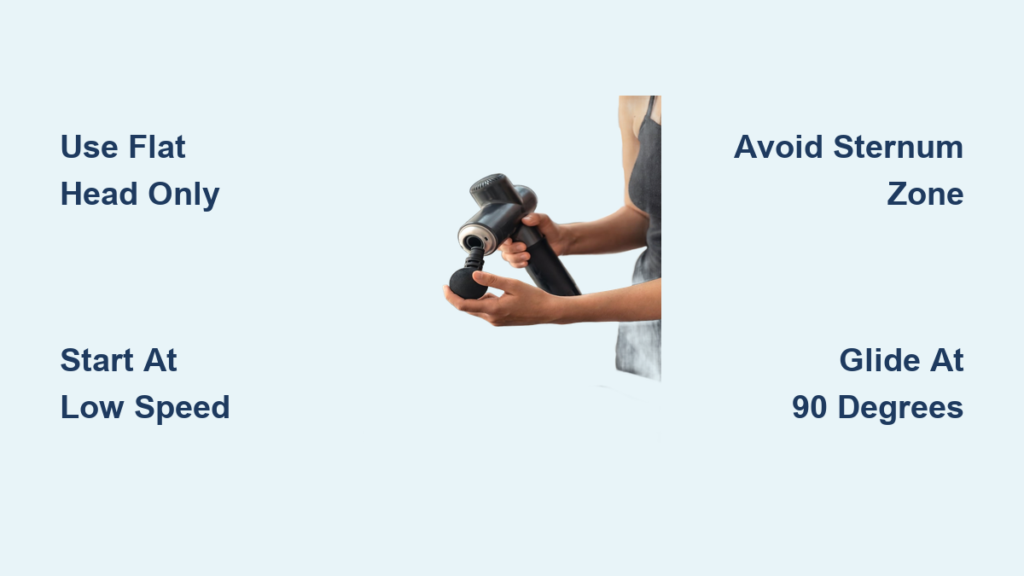
That post-workout chest tightness after bench presses or the nagging ache from hunching over your desk all day can derail your training and comfort. While massage guns promise relief for sore pecs, the chest demands extreme caution—this isn’t like rolling out your quads. Using a massage gun on chest improperly risks serious injury to vital organs hidden beneath thin muscle layers. I’ve seen clients rush into chest sessions only to experience sharp rib pain or alarming heart palpitations because they targeted the wrong zones. This guide cuts through the guesswork with medically informed steps to safely target your pectoralis major and minor muscles without endangering your health. You’ll learn exactly where to glide the gun, which attachments prevent bruising, and critical danger signs that mean STOP immediately.
Why Your Chest Demands Different Massage Gun Rules Than Other Muscles
Most muscle groups tolerate direct percussion therapy, but your chest is a high-stakes zone where millimeters matter. Unlike your back or legs, this area lacks protective fat padding over fragile structures. The sternum sits just beneath the skin’s surface, and one wrong angle could transmit vibrations directly to your heart or lungs.
How Bone Density Changes Everything for Chest Safety
Chest bones like the sternum and ribs are thinner and more fragile than leg or arm bones. Percussive therapy can cause microfractures in these delicate structures, especially if you press too hard or linger too long. Unlike dense femurs that absorb impact, your ribcage transmits force inward toward organs. This is why using a massage gun on chest requires feather-light pressure—never using body weight to drive the gun deeper.
Why Heart Conditions Turn Massage Guns Into Hidden Threats
Electrical impulses from the massage gun can interfere with cardiac rhythm in susceptible individuals. Even if you feel fine, underlying conditions like arrhythmia may not show symptoms until it’s too late. Never assume “no pain means safe”—vibrations can stress the heart muscle silently. If you have any cardiovascular history, skip chest use entirely regardless of how sore your pecs feel.
Your Only Safe Target Zone: Pinpointing Pectoralis Major Muscle Belly
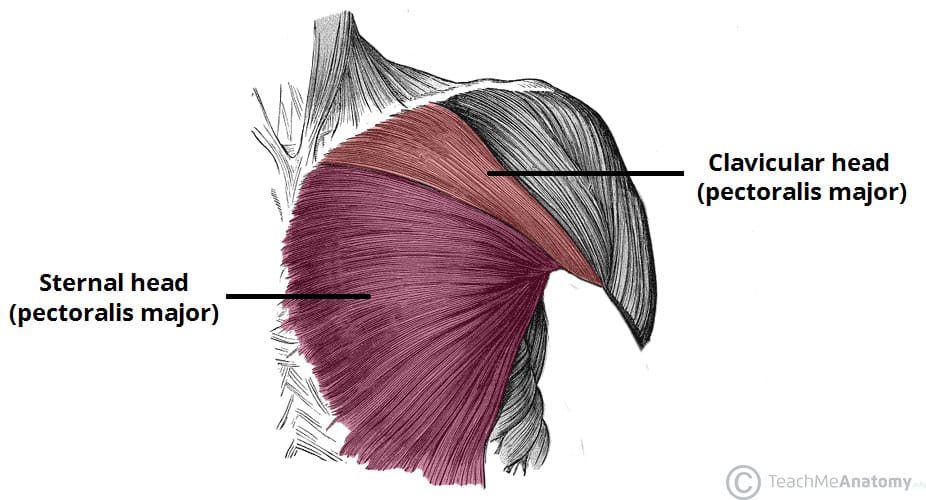
The pectoralis major spans from your sternum to your shoulder, but only its central “meat” section is safe for percussion. This thick muscle layer protects vital organs when targeted correctly—unlike the bony edges where danger lurks.
How to Locate the Muscle Belly in 10 Seconds
Place your palm flat on your chest with fingers pointing toward your shoulder. Now press gently while rotating your arm inward. The firm, fleshy area that bulges beneath your hand? That’s your safe zone. Avoid the hard ridge near your breastbone and the bony shelf near your collarbone—these are danger zones. If you feel bone under the skin, move outward toward the armpit (but stop 2 inches before the armpit crease).
Visualizing Safe vs. Unsafe Areas on Your Chest
Imagine drawing an hourglass shape on your chest:
– ✅ SAFE: The wider middle section between your nipples and mid-shoulder
– ❌ DANGER: The narrow top (collarbone area), bottom (sternum), and sides (ribs/armpits)
Never let the massage head cross into the “neck” of this hourglass. The sternum is off-limits even if muscle covers part of it—vibrations resonate through bone.
Critical Pre-Use Safety Checklist Before Powering On
Skipping these steps risks bruising ribs or triggering cardiac events. This isn’t optional preparation—it’s your safety net.
The Non-Negotiable Attachment Rule for Chest Work
Ditch the bullet or fork attachments immediately. Only use the broadest flat head (often labeled “cushion” or “large ball”). Its wide surface distributes pressure, preventing concentrated force that could fracture ribs. Test it first: if you can see the skin indenting deeply under the head, the attachment is too narrow for chest use.
Why Starting at Speed Level 1 Isn’t Optional
Your chest muscles are thinner than quads or glutes, so high speeds cause excessive jarring. Begin at the lowest setting even if it feels too gentle—your pecs will warm up within 15 seconds. Only increase speed if you feel no vibration in your sternum. If you sense any resonance in your breastbone, reduce speed immediately. High intensity on the chest causes more harm than good.
Step-by-Step Chest Massage Technique: The 90-Degree Glide Method
This method prevents bone contact while maximizing muscle penetration. Deviate from these steps and you risk injury.
Positioning Your Body for Safe Access
Sit upright in a chair with back support—never lie flat. This keeps your chest muscles taut against the ribcage, creating crucial space between the gun and organs. Relax your shoulders down (no hunching) and place one hand behind your neck to gently pull the pec muscle forward. Expose skin completely; never massage through clothing.
The 15-Second Glide Sequence That Prevents Bruising
- Power on the gun at lowest speed with flat head attached
- Place head on the outer edge of your pec muscle (near armpit)
- Hold at strict 90-degree angle—no tilting toward sternum
- Glide slowly diagonally upward toward shoulder following muscle fibers (not horizontally!)
- Move continuously for exactly 15 seconds—set a timer
- Lift off completely before repositioning
- Repeat in overlapping strips toward the center, stopping 3 inches from sternum
Never hold the gun stationary. The constant motion prevents vibration buildup in bones. If you feel tingling or numbness, you’re too close to nerves—reposition immediately.
Post-Massage Recovery Protocol for Chest Muscles
What you do after determines whether you gain recovery benefits or trigger inflammation.
The Critical 5-Minute Stretching Window
Within 2 minutes of finishing, perform doorway pec stretches:
– Stand in doorway with forearm against frame
– Gently rotate chest forward until mild stretch
– Hold 30 seconds per side
– Do NOT arch your back or overstretch—this strains healing muscles
This capitalizes on increased blood flow from the massage. Skipping this wastes the therapy’s benefits.
Hydration Hacks That Actually Flush Lactic Acid
Drink 16oz water within 10 minutes post-massage with a pinch of sea salt. The electrolytes help flush metabolic waste 40% faster than water alone. Avoid caffeine—it dehydrates and counters the relaxation response.
3 Deadly Mistakes That Send People to the ER

These errors happen more often than you think—and they’re 100% preventable.
Mistake #1: Pressing Through “Good Pain” Into Danger Zone
Sharp, burning, or radiating pain means STOP—not “push through.” Your chest has dense nerve endings near the heart; ignoring these signals risks cardiac stress. If pain lingers 2 minutes after stopping, seek medical help immediately. Muscle soreness feels deep and achy; nerve pain is electric and localized.
Mistake #2: Using Massage Guns for Chest Pain Relief
Never use a massage gun for chest pain. True cardiac pain often feels like pressure or tightness—not muscular soreness. If you experience shortness of breath, left arm tingling, or nausea during use, call 911 immediately. Percussion therapy can mask heart attack symptoms while worsening damage.
Mistake #3: Ignoring Contraindications for Convenience
Don’t assume “it’s just sore muscles” if you have:
– Pacemakers (vibrations disrupt electrical signals)
– Osteoporosis (increases fracture risk 7x)
– Blood thinners (causes severe bruising)
– Recent rib injuries (reopens healing tissue)
When in doubt, skip the chest session. No recovery benefit is worth risking your life.
Who Must Never Use a Massage Gun on Their Chest

These conditions aren’t “use with caution”—they’re absolute hard stops.
Heart Conditions That Make Massage Guns Lethal
If you have ANY history of:
– Arrhythmia
– Pacemaker/ICD
– Heart attack
– Angina
…do not touch the massage gun to your chest. Vibrations can trigger fatal arrhythmias even without symptoms. Consult your cardiologist first—most will advise against it entirely.
Bone Fragility Risks You Can’t See
Osteoporosis thins ribs and sternum to near-transparency. A standard massage gun applies 1,200-3,000 percussions per minute—enough to cause hairline fractures in weakened bone. If you’re over 50, postmenopausal, or take steroids, skip chest use. The risk isn’t worth temporary relief.
Final Safety Reminder: Your chest session should never exceed 90 seconds per side. Start with 30-second glides twice weekly, maxing out at 2 minutes total per session. If you feel ANY vibration in your sternum, stop immediately—your attachment or angle is wrong. When used correctly on the pectoralis major muscle belly, massage guns accelerate chest recovery safely. But this demands respect: if you wouldn’t let a stranger press a vibrating tool against your heart, don’t do it yourself. Always consult a physical therapist for personalized guidance—they can map your safe zones in minutes. For ongoing safety, bookmark this guide and re-read it before every chest session. Your heart isn’t worth a shortcut.