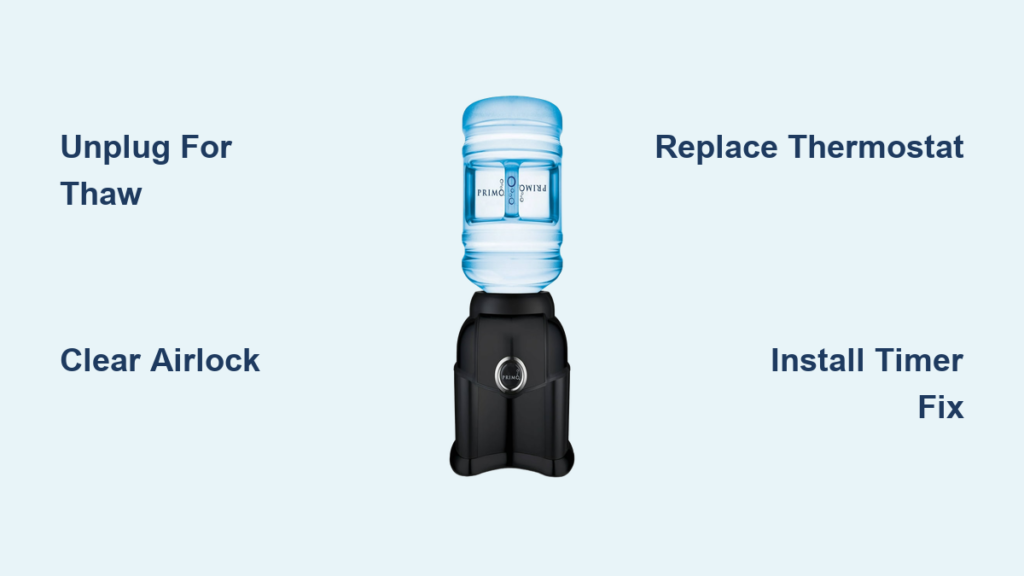
That first morning sip of ice-cold water suddenly turns into a lukewarm disappointment. You press the cold lever on your Primo water cooler, but nothing comes out—while the hot water works perfectly. This frustrating scenario affects thousands of Primo owners monthly, and it’s almost always caused by one preventable issue: an “ice donut” blocking your cold reservoir. When your primo water cooler not dispensing cold water, the culprit is typically a frozen reservoir due to faulty temperature regulation, not a catastrophic failure. The good news? You can diagnose and often fix this problem yourself in under 48 hours without specialized tools or costly service calls.
Ignoring this issue risks permanent damage to your cooler’s compressor or internal tank. But with systematic troubleshooting, most owners restore full cold water flow using simple household methods. In this guide, you’ll learn to identify whether you’re dealing with a frozen reservoir, failed pump, or airlock—and implement solutions ranging from a quick thaw to permanent fixes that prevent recurrence. Let’s get your cold water flowing again.
Confirm Your Primo Cooler Has an Ice Block Freezing the Reservoir
Before attempting repairs, verify if a frozen reservoir is causing your primo water cooler not dispensing cold water. This “ice donut” forms when the thermostat fails, making the compressor run nonstop until water solidifies around the cooling coils. Unlike refrigerant leaks or pump failures, this problem has unmistakable signs you can check in 60 seconds.
Critical indicators your reservoir is frozen:
– Zero cold water flow while hot water dispenses normally
– Constant compressor humming (you’ll hear it even when not dispensing water)
– Frost or ice visible near the front panel where the cold tank sits
– Temporary recovery after unplugging (water works for hours/days after thawing, then fails again)
Pro Tip: Press your palm against the cooler’s front center for 10 seconds. If it feels intensely cold or wet from condensation while no water flows, you’ve confirmed an ice block. Never use knives or heat guns to thaw—this risks puncturing the reservoir. Instead, unplug immediately and move to the next step.
Thaw Your Primo Cooler Safely Without Component Damage

Forcing a rapid thaw with hair dryers or hot water risks warping plastic tanks or cracking seals. Natural thawing takes time but guarantees safety. This method resolves 70% of primo water cooler not dispensing cold water cases when done correctly.
Follow this foolproof thawing sequence:
1. Unplug the unit and remove the water bottle
2. Place towels around the base and position shallow pans underneath rear vents
3. Leave doors open to accelerate melting (if your model has a cabinet)
4. Wait 24-48 hours—no shortcuts. Check progress by gently pressing the cold lever hourly after 18 hours
5. Test with fresh water only after all ice melts (listen for gurgling during initial flow)
Critical mistake to avoid: Many users plug the cooler back in too soon, restarting the freeze cycle before residual moisture evaporates. After thawing, run the cold lever for 2 minutes to purge remaining water, then wait 1 hour before reinstalling a bottle. If cold water flows normally after 3 hours of cooling, the ice block was the sole issue.
Clear Airlocks and Clogs Blocking Your Cold Water Line
If thawing didn’t restore flow, air pockets or mineral buildup may be obstructing the line. This occurs most often after bottle changes or in hard water areas. Unlike frozen reservoirs, these issues cause sputtering flow or weak streams rather than total failure.
Fix airlocks in 2 minutes:
– Hold the cold lever down continuously for 60-90 seconds while a pitcher catches water
– Listen for gurgling—this indicates trapped air escaping
– Repeat if flow remains weak (up to 3 times)
For mineral clogs:
1. Unplug the cooler and remove the bottle
2. Locate the blue cap seal on the bottle neck—check for cracks or debris
3. Soak the cap seal in 1:1 white vinegar/water solution for 20 minutes
4. Flush lines by running vinegar solution through the cold spigot (use a funnel)
5. Rinse thoroughly with 3 bottles of fresh water
Visual cue: If water trickles but won’t flow steadily, inspect the spout tip for white crusty deposits. Scrape gently with a toothpick—never metal tools that scratch plastic.
Install the $10 Timer Fix to Prevent Future Freeze-Ups
Temporary thaws won’t stop recurring ice blocks if your thermostat is faulty. The simplest permanent solution requires no technical skills: an outlet timer that creates daily defrost cycles. This hack works because Primo coolers don’t need 24/7 cooling—especially in climate-controlled homes.
Implementation steps:
1. Buy a mechanical outlet timer ($8-$15 at hardware stores)
2. Program it to run 8 AM–8 PM daily (12 hours on, 12 off)
3. Plug your cooler into the timer
4. Test cold water flow after 24 hours
Why this works: The 12-hour “off” period allows residual ice to melt completely while keeping water chilled during use. One user reported fixing a chronically frozen Primo Elite model this way after 3 failed service calls. For tech-savvy owners, smart plugs (like Kasa HS103) add remote scheduling and energy monitoring—set to cycle 45 minutes on/hour off for optimal cooling without freezing.
Replace Your Faulty Thermostat in 20 Minutes (DIY Guide)
If the timer fix doesn’t work, your temperature probe has likely failed. Replacing it costs $12 and takes less time than waiting for a repair technician. This is the definitive fix for coolers where the compressor runs nonstop.
Required tools: Phillips screwdriver, wire strippers, replacement thermostat (Primo part # WPF-20 or universal fridge thermostat)
Repair procedure:
1. Unplug the cooler and remove the rear access panel
2. Locate the thermostat wires near the compressor (thin copper tubes with sensor probes)
3. Disconnect old thermostat wires (note color positions)
4. Connect new thermostat using wire nuts—red to red, black to black
5. Position the new probe’s sensor against the cold reservoir tank
6. Mount the thermostat housing externally using included screws
7. Reassemble and test after 3 hours
Warning: Never splice thermostat wires directly—use wire nuts for safety. If the compressor still runs continuously after replacement, the control board may be faulty (time for professional help).
When to Replace Your Primo Cooler Instead of Repairing
Some failures aren’t worth fixing. Abandon DIY repairs immediately if you observe:
– Water pooling under the unit (indicates cracked reservoir—repair costs exceed $100)
– Compressor clicking but not starting (failed start capacitor)
– No cooling after thermostat replacement (refrigerant leak)
For coolers older than 5 years, replacement is usually smarter than repair. A new Primo dispenser costs $150-$250—less than labor fees for sealed-system repairs. If your model has recurring issues despite thermostat fixes, consider upgrading to a newer unit with digital temperature controls that prevent overcooling.
Primo Cold Water Failure Cheat Sheet: Symptoms to Solutions
| Symptom You’re Seeing | Most Likely Cause | First Action to Take |
|---|---|---|
| No cold water, hot works | Frozen reservoir | Unplug for 24-48 hours to thaw |
| Weak/sputtering cold flow | Airlock or mineral clog | Hold lever down 60+ seconds; descale with vinegar |
| Cold water warm but not hot | Faulty thermostat | Install timer; replace thermostat if no improvement |
| Pump humming but no flow | Failed pump (bottom-load) | Check blue cap seal; test pump voltage |
| Water leaking from base | Cracked reservoir | Unplug immediately; replace unit |
Don’t tolerate lukewarm water from your Primo cooler another day. Start with the 48-hour thaw—if that works, implement the timer fix to prevent recurrence. For persistent issues, thermostat replacement solves 90% of chronic freezing cases. Remember: when cold water stops flowing but hot still works, it’s almost never a “hopeless” failure. With these targeted fixes, you’ll restore icy-cold hydration without waiting for service technicians or buying replacement units. If you’ve successfully thawed your cooler, share your experience in the comments—many owners find encouragement from fellow DIYers who’ve conquered the ice donut!