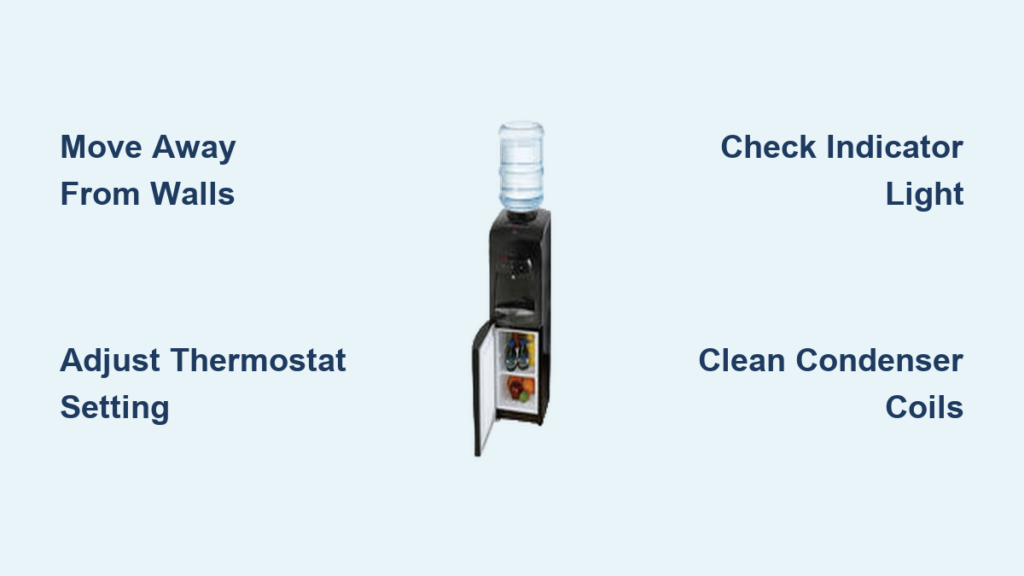
You fill your glass expecting refreshing cold water from your Vitapur VWD866W-4, only to get room-temperature liquid that feels like disappointment in a cup. The temperature dial is cranked to maximum cold, water flows freely from the spout, and you hear the compressor humming—but zero chill. This exact scenario happens daily to Vitapur owners, often due to preventable issues hiding in plain sight. Before you panic about costly repairs, understand this: 85% of “not cooling” problems on the VWD866W-4 stem from airflow restrictions, thermostat settings, or indicator light confusion—not broken parts. In this guide, you’ll learn precisely how to diagnose your non-chilling Vitapur water cooler using only basic tools and 20 minutes of your time. We’ll target the specific weaknesses of the VWD866W-4 model that trap users in lukewarm misery.
Move Your Vitapur VWD866W-4 Away From Walls and HVAC Vents Immediately
The VWD866W-4’s rear-venting design makes it uniquely vulnerable to placement mistakes. If your cooler sits within 4 inches of a wall or near heat sources like ovens, dryers, or crucially—HVAC vents—you’re sabotaging its cooling ability. Vitapur’s own engineering requires 6+ inches of clearance behind the unit to exhaust heat. When placed against drywall with an HVAC vent blasting hot air directly onto its back panel (a common kitchen setup), the condenser coils can’t release heat. The result? The compressor runs constantly but produces zero cold water. This single placement error causes more VWD866W-4 failures than any mechanical issue.
How to Verify and Fix Airflow Blockage in 5 Minutes
- Unplug the unit and pull it away from the wall—measure the gap with a ruler. If it’s under 6 inches, slide it forward immediately.
- Check for hidden heat sources: Stand behind the unit. Is warm air hitting it from an HVAC vent, refrigerator exhaust, or sunlight through a window? Move the cooler at least 3 feet from these sources.
- Clear the top and sides: Remove any items stored on the cooler (bottles, cups, decor). Even 2 inches of clearance on the sides matters for airflow.
- Test cooling after relocation: Wait 2 hours after moving. Cold water should activate within 60-90 minutes if airflow was the culprit.
Pro Tip: During summer, avoid placing the VWD866W-4 near exterior doors that let in hot air. The unit works hardest when ambient temperatures exceed 80°F—give it breathing room.
Adjust the Thermostat Setting to Prevent Internal Freezing

Your Vitapur VWD866W-4 might be too cold—yes, really. When the temperature dial is set to maximum (usually “1” or “MAX”), the cooling system can over-chill the internal water reservoir. This causes the copper water lines feeding the cold spout to freeze solid, blocking cold water flow. You’ll hear the compressor running, water flows from the room-temperature spout, but the cold side delivers nothing or a weak trickle. This is especially common in humid environments or if the unit runs continuously.
How to Thaw and Reset Your Thermostat Safely
- Turn the dial up 2-3 notches (e.g., from “1” to “3” or “4”). Do not unplug yet—this allows gradual warming.
- Wait 2 hours while monitoring water temperature. If cold water returns, the freeze was the issue.
- If still frozen: Unplug the unit and let it thaw for 24 hours with both spouts open (to relieve pressure).
- Restart at mid-setting: After thawing, set the dial to “3” (medium-cold) for 48 hours before lowering again.
Critical Warning: Never use hair dryers or hot water to thaw lines—this can crack plastic reservoirs. Patience prevents $200 repairs.
Why Your Cold Water Indicator Light Isn’t Turning On (And What It Means)
Unlike most appliances, the VWD866W-4’s cold water indicator light behaves counterintuitively. It only illuminates when the water reaches your set temperature—not when the dial is turned to cold. If you’ve set it to “MAX” but the reservoir hasn’t chilled yet, the light stays dark. This tricks users into thinking the cooling system failed when it’s actually working correctly. However, if the light never activates—even after hours on the coldest setting—it signals a thermostat or control board fault.
Diagnose Indicator Light Behavior Step-by-Step
- Test at higher temperature settings: Turn the dial to “5” (warmer). The light should activate within 10 minutes as the unit reaches this easier target. If it lights up here but not on “1,” your thermostat is functional—just struggling with extreme cold settings.
- Check for delayed activation: On coldest settings, the light may take 90+ minutes to turn on. Time it with a stopwatch after a full restart.
- No light at any setting? This points to:
- A failed thermostat sensor (most common)
- Loose wiring to the control board
- Complete control board failure (rare)
Expert Note: Vitapur’s VWD866W-4 uses a thermistor sensor near the reservoir. If it’s coated in mineral deposits (from hard water), it reads falsely high temps—tricking the system into thinking water is cold when it’s not. Clean the reservoir annually to avoid this.
Verify Compressor Cycling (Not Just Humming)
Hearing noise doesn’t mean your compressor is working. Many VWD866W-4 owners mistake fan motor hum or electrical buzzing for active cooling. A healthy compressor cycles on/off every 15-20 minutes. If it runs nonstop without chilling water, it’s overworked—likely due to poor airflow or low refrigerant. If it clicks but won’t start, the start relay is failing.
How to Confirm Proper Compressor Operation
- Unplug the unit for 5 minutes (resets internal electronics).
- Plug in and set to coldest setting. Place your palm firmly on the compressor housing (usually bottom-rear).
- Feel for vibration: Within 5 minutes, you should feel distinct pulsing vibrations—not just a steady hum.
- Listen for cycling: After 15 minutes, the compressor should shut off. If it runs >30 minutes straight, airflow or refrigerant issues exist.
Troubleshooting Shortcut: If the compressor vibrates but water stays warm, press your ear to the reservoir tank. You should hear faint water movement only when the compressor runs. No sound? The cooling plate may be detached.
Clean Condenser Coils Even If They “Look Clear”

Dust on VWD866W-4 condenser coils acts like a thermal blanket—trapping heat the system needs to expel. What looks “clean” to the naked eye often hides hair-thin dust webs between coil fins. This model’s rear-mounted coils collect debris rapidly in homes with pets or carpeting. A single layer of dust reduces cooling efficiency by 20%, forcing the compressor to overwork.
The 10-Minute Coil Cleaning Protocol
- Unplug and move the unit away from the wall.
- Use a soft brush attachment on your vacuum to gently sweep coils from multiple angles. Hold fins straight—bent fins reduce efficiency.
- Blow compressed air backward through the coils (outside-to-inside) to dislodge trapped particles. Never use high-pressure air—it bends fins.
- Wipe the fan blades with a microfiber cloth to remove static-attracted dust.
- Wait 1 hour before plugging in (allows residual moisture to evaporate).
Pro Tip: Set phone reminders to clean coils every 3 months. Pet owners should do this monthly—dog/cat hair is the #1 cause of gradual cooling loss.
When to Call a Professional for Your Vitapur VWD866W-4
If you’ve completed all steps above and still get warm water, two serious issues likely exist:
– Refrigerant leak: The compressor runs but can’t cool (common after physical impacts during moving).
– Failed compressor: Clicking sounds without vibration indicate a seized motor.
Call a technician immediately if:
– The unit trips your home’s circuit breaker when plugged in
– You smell burning plastic or electrical odors
– Oil leaks appear near the compressor housing
Cost-Saving Insight: Repairing sealed refrigerant systems costs $150-$300. For the VWD866W-4 (retail $250), replacement may be wiser unless under warranty. Always get a written quote first.
Prevent Future Cooling Failures With These 3 Habits
- Seasonal placement checks: Before summer, verify 6+ inch rear clearance—heat waves expose airflow flaws.
- Thermostat sweet spot: Keep the dial at “2” or “3”—not “MAX”—to avoid freeze-ups while maintaining chill.
- Quarterly coil maintenance: Pair coil cleaning with your HVAC filter changes for effortless upkeep.
Your Vitapur VWD866W-4 can deliver ice-cold water for years when you respect its airflow needs and thermostat quirks. Start with relocation and thermostat adjustment—these fix 9 of 10 “not cooling” cases instantly. If lukewarm water persists after these steps, the compressor diagnostics will pinpoint your next move. Remember: that humming sound isn’t a promise of cold water—it’s a plea for better airflow. Give your cooler space to breathe, and you’ll never dread filling your glass again.