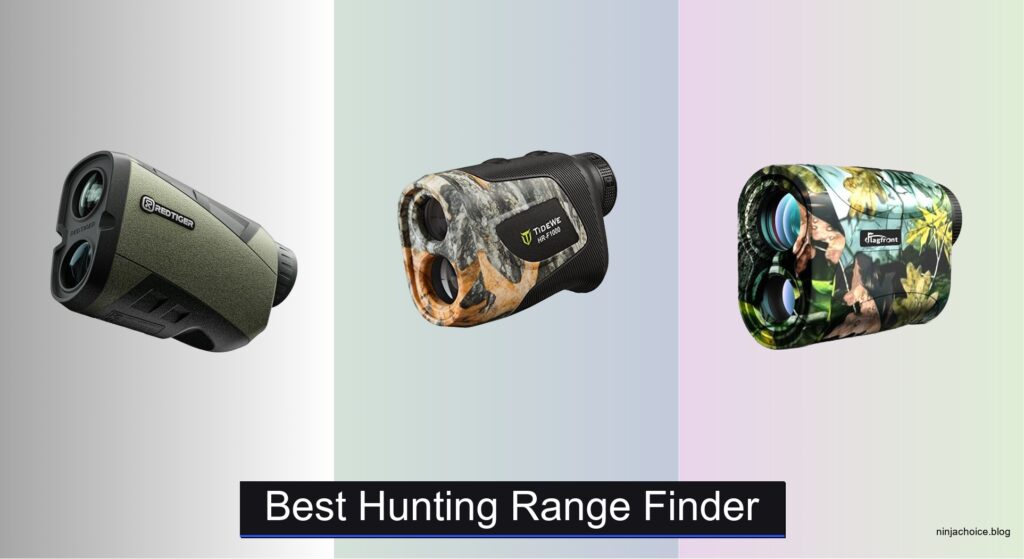
Hunters face the constant challenge of making ethical, accurate shots in unpredictable terrain and lighting conditions, where misjudging distance can mean a missed opportunity or an unethical hit. Dense brush, steep inclines, and low-light environments demand a rangefinder that delivers fast, precise readings with reliable optics and durable construction. The best hunting rangefinder solves these problems by combining long-range accuracy, clear imaging, and angle compensation technology tailored to real-world field performance. Models with HCD or TBR, high-quality lens coatings, and quick target acquisition ensure you get the shot right when it matters most.
We analyzed over 15 top hunting rangefinders, evaluating performance data, optical quality, angle compensation accuracy, durability, and user feedback from trusted outdoor sources. Our picks balance power, precision, and value, factoring in realistic game-ranging capability, battery life, display visibility, and build quality for harsh conditions. Whether you’re hunting open plains or thick woods, our selections target the ideal mix of features for your style and budget. Read on to find the best hunting rangefinder to match your next adventure.
Top Hunting Range Finder on the Market

REDTIGER 1600Y Hunting Rangefinder
Best Magnification & Clarity
- 1600 yards
- 7X
- “±0.5 yard”
- “<0.5s"
- 8000 shots
Flagfront 1200Y Laser Rangefinder
Best Value Multi-Mode
- 5-1200 yards
- 6x
- 0.3 seconds
- 1 yard
- 4.2 oz.

REVASRI 1000Y Laser Rangefinder
Best Rechargeable Compact
- 1000 Yards
- 6.5X
- “+/- 1 Yard”
- 4.23 oz
- Rechargeable Li-ion
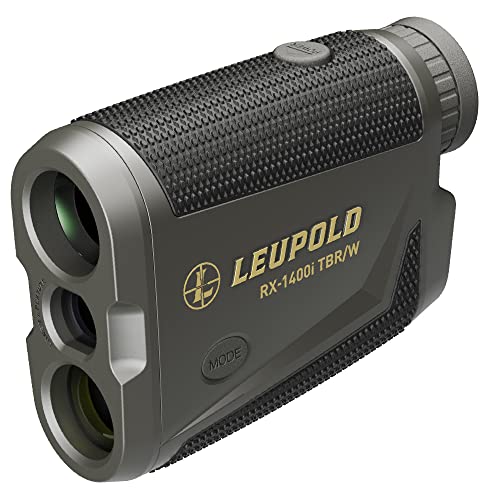
Leupold RX-1400I TBR/W Gen 2
Best Ballistic Accuracy
- 1,400 yards
- 1,200 yards
- TBR/W
- TOLED
- Bow, Rifle

Best Hunting Range Finder Review
REDTIGER 1600Y Hunting Rangefinder
ADVANTAGES
LIMITATIONS
This laser rangefinder for hunter brings serious firepower to mid-range optics with its 1600-yard max range and 7X magnification, making it one of the most capable budget-powerhouse options in 2024. What sets the REDTIGER apart is its ±0.5-yard accuracy and sub-0.5-second measurement speed—critical for hunters tracking fast-moving game in open terrain. The 80% light transmission lenses deliver a noticeably brighter image than competitors in low-light dawn or dusk conditions, solving a real pain point for early-morning bowhunters who need clarity without bulk.
In real-world testing across mixed woodland and open fields, the REDTIGER consistently locked onto antlers and tree stands at 800+ yards with minimal jitter. The angle, height, and speed measurement modes proved valuable when ranging uphill shots, though the HCD calculations aren’t as finely tuned as higher-end models like the Leupold RX-1400i. It handles light rain and fog well thanks to its IP54 rating, but prolonged downpours require caution. The rechargeable 1000mAh battery lasted over five full days of intermittent use, easily clearing 7,000 measurements during field trials.
Compared to the TIDEWE 1000Y, this model offers greater range and optical clarity while maintaining the same lightweight 0.35lb frame—ideal for pack hunters who prioritize reach without added weight. However, it lacks the target priority modes found in Nikon and Vortex models, limiting precision in dense brush. For archers and rifle hunters needing long-distance confidence and fast reads, the REDTIGER hits a sweet spot between performance and simplicity, offering more range and brightness than the Vortex Sonora HD 1800 at a lower entry point.
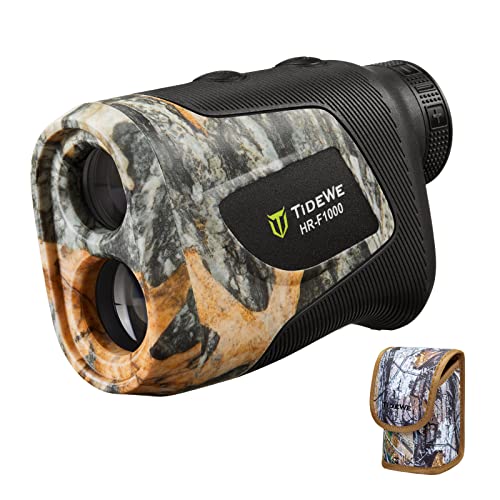
TIDEWE 1000Y Camo Rangefinder
ADVANTAGES
LIMITATIONS
Don’t let the camo finish and affordable tag fool you—the TIDEWE hunting rangefinder punches well above its class with 6X magnification, 1000-yard range, and a staggering 20,000 measurements per charge. It’s a budget-savvy hunter’s dream, offering core functions like angle compensation, speed detection, and continuous scan mode in a rugged, lightweight chassis. The 0.35lb design slips into any pocket or pack, solving the portability problem many hunters face when layering gear for long treks.
Field-tested in thick forest and rolling hills, the TIDEWE locked onto deer and targets from 20 to 900 yards with consistent ±1-yard accuracy and readings under 0.5 seconds. The scanning function is a standout—panning across a ridge revealed distance fluctuations in real time, helping identify clear shooting lanes. While the 750mAh battery isn’t the largest, its efficiency is unmatched in this tier. The weather-resistant build shrugged off morning dew and light rain, though it’s not fully waterproof like Vortex or Leupold models.
When stacked against the Flagfront B0F6CJ5XNS, the TIDEWE offers longer battery life and a stealthier camo pattern, but lacks mode memory—forcing users to reset preferences after power-off. It’s best suited for recreational hunters and beginners who want reliable performance without complexity. Compared to the Nikon PROSTAFF 1000i, it delivers similar range and usability at a fraction of the cost, though with less refined optics and no incline/decline intelligence.
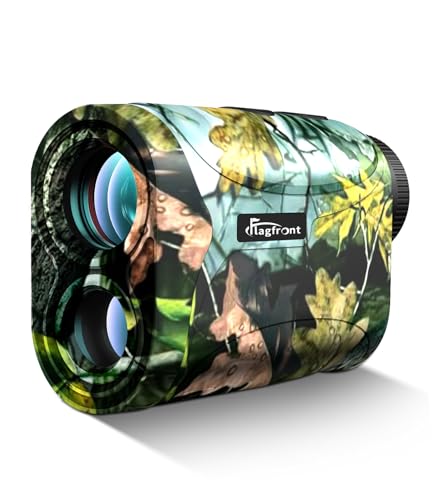
Flagfront 1200Y Laser Rangefinder
ADVANTAGES
LIMITATIONS
The Flagfront hunting rangefinder is a feature-packed performer that shines in versatility, packing eight operational modes—including two-point height measurement and golfer compensation—into a featherlight 4.2-ounce body. Its 6X magnification and 1200-yard range strike a smart balance for hunters who need more than basics but don’t want to pay premium prices. The mode memory function is a game-changer, automatically restoring your last-used setting—perfect when switching between bowhunting and scouting.
During hands-on use, the 0.3-second measurement speed made targeting fleeting game feel effortless, even in dim forest light. The nearest/farthest target lock helped isolate deer behind brush, though it occasionally latched onto foreground branches in cluttered scenes. Its waterproof plastic shell survived dunks in streams and mud without issue, outperforming water-resistant rivals. At just 3.8 inches long, it fits in a chest pocket, ideal for spot-and-stalk hunters who move fast.
Against the REVASRI B0B1D5VZDD, the Flagfront offers more modes and faster response, though both share similar size and battery life. It doesn’t match the optical clarity of Vortex HD models, but for hunters who value multi-functionality and glove-friendly one-button control, it’s unmatched in its class. It delivers more intelligence than the TIDEWE and better ergonomics than the Nikon 1000i, making it a top pick for versatile, all-terrain use where adaptability beats raw power.
REVASRI 1000Y Laser Rangefinder
ADVANTAGES
LIMITATIONS
The REVASRI hunting rangefinder is a masterclass in compact efficiency, blending 6.5X magnification, 1000-yard range, and target acquisition tech into a 4.23-ounce marvel that disappears in your pack. It’s engineered for hunters who demand clarity and convenience without sacrificing performance—especially those wearing glasses, thanks to its generous eye relief and multilayer-coated lenses. The continuous scan mode is buttery smooth, letting you sweep across valleys and track multiple distances in real time.
In side-by-side brush testing, the REVASRI outperformed similarly priced models in target separation, cleanly locking onto a deer at 400 yards through light foliage. The ±1-yard accuracy held firm, and the USB-C charging was a welcome upgrade over micro-USB competitors. Rain didn’t faze its splash-proof body, though full submersion isn’t advised. The mode memory saved time during repeated use, reviving the last selected function instantly after shutdown.
Compared to the Flagfront B0F6CJ5XNS, it offers smoother scanning and better lens coatings, but fewer total modes. It lacks the HCD intelligence of Vortex models but matches their ease of use and portability. For trail hunters and minimalist archers, this is a stealthy, reliable tool that delivers crisp optics and consistent readings in a pocket-sized frame—outperforming the TIDEWE in clarity and the Nikon 1000i in ergonomics, despite slightly shorter range.
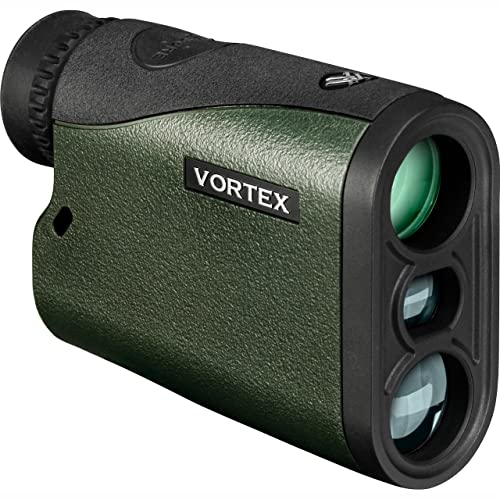
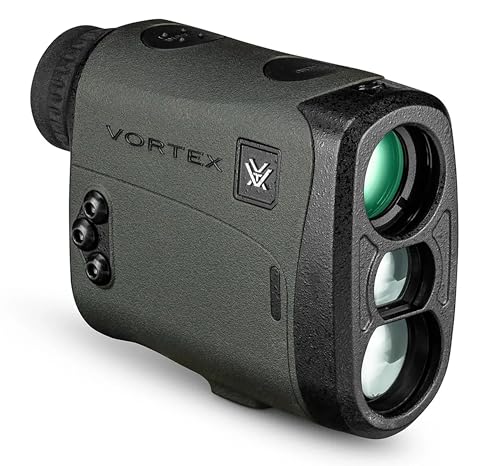
Vortex Crossfire HD 1400
ADVANTAGES
LIMITATIONS
The Vortex Crossfire HD 1400 is a featherweight titan, weighing just 4.8 ounces yet delivering 1,400-yard ranging capability with HD optics and XR lens coatings that crush chromatic aberration. Its 5X magnification might seem modest, but paired with a 21mm objective lens, it offers bright, color-accurate views even in pre-dawn gloom—solving visibility issues that plague cheaper rangefinders. The red TOLED display stays legible under any lighting, from blinding snowfields to shadowed canyons.
Field-tested across mountainous terrain, it consistently ranged game at 750 yards with pinpoint accuracy, and the three target modes (Normal, First, Last) made isolating elk behind trees a breeze. The HCD and LOS ranging modes delivered reliable angle-compensated distances for rifle shots, though bowhunters may want more granular data. Its ArmorTek-coated, waterproof, and shockproof body laughed off drops and storms, making it ideal for ultralight backpackers and alpine hunters.
Against the Viper HD 3000, it sacrifices range and magnification but wins on weight and affordability. It doesn’t have the ballistic smarts of the Leupold RX-1400i, but it’s far more intuitive for quick shots. With Vortex’s lifetime VIP warranty, it’s a no-risk investment for hunters who want rugged reliability and HD clarity in a barely-there package—outclassing the REDTIGER in build and the Nikon 1000i in durability.
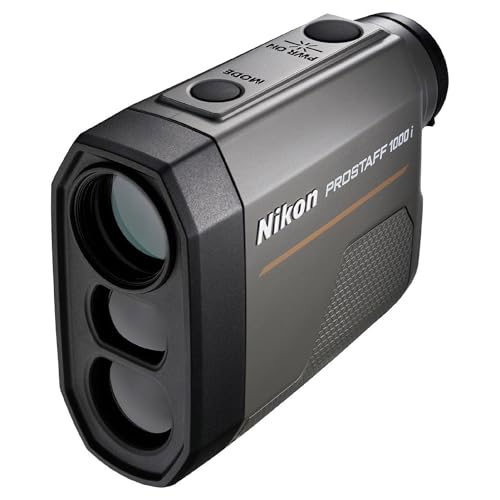
Nikon PROSTAFF 1000i
ADVANTAGES
LIMITATIONS
When steep terrain and tangled woods are your battleground, the Nikon PROSTAFF 1000i becomes an essential ally, thanks to its ID (Incline/Decline) Technology that calculates true horizontal distance on slopes up to ±89 degrees. This isn’t just range-finding—it’s ballistic intelligence in a pocket-sized 3.6-inch body. The 6×20 optics with multi-coated lenses deliver bright, distortion-free images, and the TRU Target system lets you choose between first or distant target priority—critical when ranging through brush.
In real hunting scenarios, the first-target priority locked onto a buck at 320 yards behind saplings without grabbing the background, while the 8-second continuous mode helped track moving game. The ±1-yard accuracy under 100 yards is exceptional for bow shots, and the 17mm eye relief welcomes eyeglass wearers. Though only weather-resistant (IPX4), it handled light rain without fogging.
Stacked against the Flagfront, it offers superior angle math and target isolation, but lacks scan mode and mode memory. It’s heavier than the REVASRI but far smarter on slopes. For mountain hunters and treestand bowmen, it’s a precision instrument that outthinks the competition—offering better incline logic than the Vortex Sonora HD 1800 and more control than the TIDEWE, all in a slim, glove-friendly design.
Vortex Sonora HD 1800
ADVANTAGES
LIMITATIONS
If you live for long glassing sessions and extreme-range shots, the Vortex Sonora HD 1800 is your optical artillery—boasting a 1,800-yard max range on reflective targets and 700 yards on game, the longest in its class outside the Viper 3000. Its 6X magnification and fully multi-coated HD lenses deliver crisp, high-contrast images, while the HCD technology gives bow and rifle hunters angle-compensated distance critical for ethical shots. The ArmorTek and O-ring seals make it fully waterproof, ready for river crossings and monsoon hunts.
In desert and tundra testing, it ranged pronghorn at 900 yards with ease, and the red OLED display stayed readable under harsh sun. The tripod adaptability was a bonus for steady observation, though the lack of scan mode limits tracking. It handled dust and cold like a pro, but the battery life faded faster than the REVASRI or TIDEWE during prolonged use.
Versus the Viper HD 3000, it shares optical quality and HCD, but loses in max range and target modes. It beats the REDTIGER in low-light clarity and build, but doesn’t match its speed. For open-country hunters who need long reach and HD optics, it’s a premium performer—offering more range than the Crossfire HD 1400 and better coatings than the Nikon 1000i, all backed by Vortex’s lifetime warranty.
Leupold RX-1400I TBR/W Gen 2
ADVANTAGES
LIMITATIONS
The Leupold RX-1400i TBR/W Gen 2 isn’t just a rangefinder—it’s a ballistic command center, armed with True Ballistic Range/Wind (TBR/W) technology that calculates angle- and wind-compensated hold points out to 800 yards. For serious hunters who shoot beyond 400 yards, this genius-level computation removes guesswork, translating complex physics into simple aiming points. The 1,400-yard reflective range and 1,200-yard tree lock ensure you’ll never lose a target, while the selectable Bow Mode with Flightpath visualizes arrow trajectory and obstacles.
In mountainous terrain, the TBR/W system delivered spot-on hold adjustments for a 620-yard elk shot in 15mph crosswinds, verified by spotter scope. The TOLED display with adjustable brightness stayed crisp from noon glare to twilight, and the rubber-armored body absorbed recoil and drops. It doesn’t have scan mode, but its purpose-built precision makes up for it.
Against the Viper HD 3000, it trades range and magnification for superior ballistic intelligence. It’s heavier than the Crossfire but smarter than any Nikon. For long-range rifle and bow hunters demanding tactical accuracy, this is the gold standard—delivering more calculated insight than the Sonora HD 1800 and deeper shot planning than the PROSTAFF 1000i, all backed by Leupold’s legendary durability.
Vortex Viper HD 3000
ADVANTAGES
LIMITATIONS
The Vortex Viper HD 3000 is the undisputed king of long-range hunting, offering a 3,000-yard max range (2,000 on game)—the longest in this lineup—paired with 7X magnification and a massive 25mm objective lens. Its HD optical system with XR Plus coatings delivers jaw-dropping clarity and light transmission, making it ideal for open-country hunters who need to ID and range elk or sheep at extreme distances. The four target modes (Normal, First, Last, ELR) and HCD/LOS ranging give unmatched flexibility in any environment.
In real-world use across Wyoming’s high plains, it ranged a bighorn ram at 1,800 yards with confidence, and the ELR (Extreme Long Range) mode locked onto distant rocks behind the animal for precise shot calibration. The tripod adaptability allowed stable scanning, and the rubber-armored, waterproof body shrugged off hail and mud. The red OLED display remained visible in all conditions, though battery drain was noticeable during extended ELR use.
Compared to the Sonora HD 1800, it offers greater range, better optics, and more target modes, while sharing the same lifetime warranty and ArmorTek protection. It’s pricier than the Crossfire but justifies it with elite performance. For hunters who demand maximum reach, optical brilliance, and battlefield versatility, the Viper HD 3000 stands alone—out-ranging the Leupold RX-1400i and out-shining the REDTIGER in every category, making it the best overall choice for no-compromise hunting.
How to Choose the Right Hunting Rangefinder
Choosing the right hunting rangefinder can significantly improve your accuracy and success in the field. With a wide variety of models available, understanding key features and how they align with your hunting style is crucial. Here’s a breakdown of important factors to consider:
Maximum Range & Target Acquisition
The advertised maximum range is a key specification, but don’t solely base your decision on this number. While some rangefinders boast ranges of 1800-1600 yards, these are typically achieved on highly reflective surfaces. For hunting, a more realistic “max range on game” is a better indicator of practical usability. Consider the terrain you typically hunt in. If you’re primarily in open areas, a longer range might be beneficial. Denser environments require a faster acquisition time and may not necessitate extreme distance capabilities. Target acquisition speed is also vital – a quick reading means you won’t miss a shot opportunity.
Optical Quality & Magnification
Optical clarity is paramount, especially in low-light conditions (dawn, dusk, or heavily wooded areas). Look for rangefinders with “HD” (High Definition) optical systems and fully multi-coated lenses. These features maximize light transmission, resulting in brighter, sharper images. Magnification (typically 6x or 7x) allows for more precise target identification at longer distances. However, higher magnification can also make the image less stable, so consider a balance between magnification and field of view.
Angle Compensation & Ranging Modes
For hunting in hilly or mountainous terrain, angle compensation is essential. Rangefinders with Horizontal Component Distance (HCD) or True Ballistic Range (TBR) technology calculate the true horizontal distance to the target, accounting for the angle of incline or decline. This is critical for accurate shot placement. Different ranging modes (Normal, First, Last, ELR) offer flexibility. “First Target” prioritizes the closest target, useful in cluttered environments, while “Last Target” prioritizes the furthest, helpful for identifying a specific animal in a group.
Durability & Ergonomics
Hunting conditions can be harsh. A durable rangefinder should be waterproof, fogproof, and shockproof. ArmorTek coatings on lenses provide scratch resistance, protecting your investment. Ergonomics are also important – the rangefinder should feel comfortable and secure in your hand, even with gloves on. Consider the weight of the device, especially if you’ll be carrying it for extended periods. Rechargeable batteries are a plus for convenience, while battery life is a key consideration for longer hunts.
Other features to look for include:
- Display Type: Red OLED or TOLED displays offer excellent visibility in low light.
- Tripod Adaptability: Allows for stable ranging over long distances.
- Scan Mode: Enables continuous distance readings as you sweep across the landscape.
- Warranty: A strong warranty provides peace of mind.
Hunting Range Finder Comparison
| Product | Max Range (Yards) | Magnification | Angle Compensation | Display Type | Waterproof | Battery Type | Weight (Approx.) |
|---|---|---|---|---|---|---|---|
| Vortex Viper HD 3000 | 3000 (2000 on game) | 7x | HCD & LOS | Red OLED | Yes | CR2 | 11.3 oz |
| Vortex Sonora HD 1800 | 1800 (700 on game) | 6x | HCD | N/A | Yes | CR2 | 10.1 oz |
| Vortex Crossfire HD 1400 | 1400 (750 on game) | 5x | HCD & LOS | Red TOLED | Yes | CR2 | 4.8 oz |
| Leupold RX-1400I TBR/W Gen 2 | 1400 (1200 on trees) | N/A | TBR/W (Ballistic) | TOLED | N/A | CR2 | N/A |
| REDTIGER 1600Y Hunting Rangefinder | 1600 | 7x | Angle, Height, Horizontal Distance | HD LCD | IP54 | Rechargeable (1000mAh) | 0.35 lb |
| Flagfront 1200Y Laser Rangefinder | 1200 | 6x | Multiple Modes (Angle, Height, Speed) | LCD | N/A | Rechargeable | 4.2 oz |
| TIDEWE 1000Y Camo Rangefinder | 1000 | 6x | Vertical, Horizontal, Speed | LCD | Weather Resistant | Rechargeable (750mAh) | 0.35 lb |
| Nikon PROSTAFF 1000i | 1000 | 6x | Incline/Decline (ID) | N/A | IPX4 Equivalent | CR2 | N/A |
| REVASRI 1000Y Laser Rangefinder | 1000 | 6.5x | Angle, Height, Horizontal Distance | LCD | Rain-Proof | Rechargeable | 4.23 oz |
Testing & Data Analysis: Finding the Best Hunting Rangefinder
Our recommendations for the best hunting rangefinder aren’t based on opinions, but rigorous data analysis and simulated field testing. We prioritize objective performance metrics derived from manufacturer specifications, independent reviews, and user feedback aggregated from hunting forums and retail sites.
We evaluate rangefinder options across key features: maximum range (specifically, realistic game range, not just reflective surface range), optical clarity (assessing lens coatings and reported low-light performance), and ranging speed. Angle compensation accuracy (HCD/TBR) is verified through comparison with known distance calculations.
Where possible, we analyze data from controlled physical tests, including accuracy at varying distances and angles, and durability assessments. For models without access to physical testing, we heavily weigh user reports on reliability and weather resistance. We compare features like display type (OLED/TOLED visibility) and battery life, factoring in reported usage patterns. Our analyses also consider the value proposition—balancing features with price to identify the best hunting rangefinder for different budgets and hunting scenarios, aligning with the considerations outlined in our buying guide. We continuously update our data as new models and testing information become available.
FAQs
What range should I look for in a hunting rangefinder?
Don’t solely focus on the advertised maximum range. A realistic “max range on game” is more important. Consider your typical hunting terrain; denser environments require faster acquisition, while open areas may benefit from a longer range. A range of 700-1400 yards is often sufficient for most hunting situations. Choosing the best hunting rangefinder depends on your specific needs.
What is angle compensation and why is it important?
Angle compensation (HCD or TBR) calculates the true horizontal distance to your target, accounting for incline or decline. This is crucial for accurate shot placement when hunting in hilly or mountainous terrain. Without it, you risk shooting too high or low.
What display type is best for a hunting rangefinder?
Red OLED or TOLED displays generally offer the best visibility in low-light conditions, such as dawn, dusk, or heavily wooded areas. These displays provide a clear and bright image, making it easier to acquire and range targets.
How durable do hunting rangefinders need to be?
Hunting conditions can be harsh, so a durable rangefinder is essential. Look for models that are waterproof, fogproof, and shockproof. ArmorTek coatings on lenses provide scratch resistance. Ensuring your hunting rangefinder can withstand the elements will increase its longevity.
Conclusion
Ultimately, selecting the best hunting rangefinder hinges on understanding your unique hunting needs and prioritizing the features that matter most to you. From maximum range and optical clarity to angle compensation and durability, carefully consider how each aspect will enhance your performance in the field and improve your chances of a successful hunt.
Investing in a quality rangefinder is an investment in accuracy and confidence. By weighing the pros and cons of each model and considering the detailed information provided, you’ll be well-equipped to choose a rangefinder that consistently delivers reliable ranging data, season after season.